World's Largest Computer Society's Top Operating Systems Conference Awards Asia's First Two Best Paper Awards
Bug Detection Possible Without Semiconductors
Applicable to Android and Windows Operating Systems
A technology that can preemptively identify critical issues that may occur in the operating system while using Apple’s latest computers and tablet PCs equipped with the 'M3' chip has been developed domestically. This technology is expected to be applicable not only to Apple but also to chips produced by most semiconductor companies worldwide, including Qualcomm and Samsung Electronics.
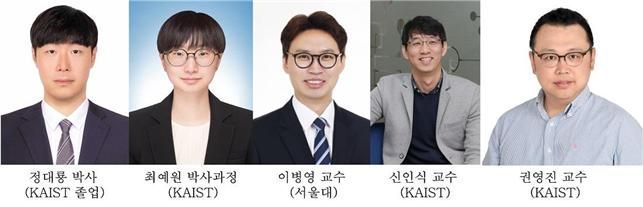
A technology that can preemptively identify critical issues that may occur in the operating system while using Apple’s latest computers and tablet PCs equipped with the ‘M3’ chip has been developed domestically. This technology is expected to be applicable not only to Apple but also to chips produced by most semiconductor companies worldwide, including Qualcomm and Samsung Electronics.
According to KAIST (Korea Advanced Institute of Science and Technology, President Lee Kwang-hyung) on the 2nd, a research team led by Professors Kwon Young-jin and Shin In-sik from the School of Computing, in collaboration with Professor Lee Byung-young from Seoul National University, received the Best Paper Award twice for the first time in Asia at the SOSP Symposium on Operating Systems Principles, the top conference in the field of operating systems organized by the world’s largest computer society, ACM (Association for Computing Machinery).
The research is about a technology that detects concurrency bugs caused by out-of-order execution that can hack or halt operating system systems without the physical semiconductor of RISC-based ARM cores used by Apple’s system-on-chip (SoC), Qualcomm, Samsung Electronics, and others. Recently, Apple’s M series and Qualcomm’s Snapdragon X Elite chips have been increasingly used in the AI laptop market. This research means that software issues that may arise when using these chips can be identified. The research team explained that it is the world’s first technology to detect concurrency bugs that can occur in out-of-order execution-based semiconductors like those in MacBooks.
Concurrency bugs caused by out-of-order execution are extremely difficult bugs to find, so much so that even professional developers may not detect them for years. If exploited by hackers, these bugs can lead to system hacking or operational shutdown.

ACM SOSP is the world’s most prestigious academic conference in the field of computer systems, requiring such high standards that only four papers have been published from Korea in the past 30 years.
Professor Kwon Young-jin received the Best Paper Award at ACM SOSP in 2021, the first from an Asian institution. Including this recent award, he has won the Best Paper Award twice at ACM SOSP.
Professors Kwon Young-jin and Shin In-sik’s team devised a method to accurately and quickly implement software-only emulation without the need for physical semiconductors, enabling the Linux kernel operating system to run in an emulation environment.
Additionally, the team utilized fuzzing, a technique that randomly inputs values to discover bugs or errors during the process, and reported 11 new bugs in the general-purpose Linux kernel, providing security patches to Linux kernel developers. The discovered bugs were found in critical kernel components that pose security threats, including TLS code used in encrypted networks.
The research team explained that the developed technology can be applied not only to Linux but also to Android operating systems used in mobile phones and Windows. It is applicable to devices using ARM-based chips such as servers, PCs, and smartphones. The team expects the range of applications to continue expanding. The research results have been released as open source on the developer community platform GitHub.
Professor Kwon Young-jin expressed his gratitude in his award acceptance speech, saying, "I thank the student researchers who persevered through trial and error and the fellow professors who generously offered excellent advice." The research team plans to discuss technology transfer with major domestic and international companies.
This research was conducted with support from the National Research Foundation of Korea, Institute for Information & Communications Technology Planning & Evaluation (IITP), Korea Institute of Science and Technology Information, K-Startup, and Samsung Electronics.
© The Asia Business Daily(www.asiae.co.kr). All rights reserved.
![Clutching a Stolen Dior Bag, Saying "I Hate Being Poor but Real"... The Grotesque Con of a "Human Knockoff" [Slate]](https://cwcontent.asiae.co.kr/asiaresize/183/2026021902243444107_1771435474.jpg)
















