Japan's 'Minpei Law' Punishes Acts Causing Discomfort
Considered Sexual Harassment Even Without Physical Contact
"Malicious Behavior" vs "Too Stigmatizing"

A man who blatantly smelled women’s hair on a subway in Japan was charged with sexual harassment and fined.
On the 27th, Hong Kong’s South China Morning Post (SCMP) reported that a 48-year-old man identified as Mr. A was caught by police for closely sticking to a high school girl on a subway in Kyoto, Japan, and repeatedly smelling her hair. Police confirmed through closed-circuit television (CCTV) installed in the subway that Mr. A had committed this type of sexual harassment multiple times over a long period against female students and young women. Accordingly, he was prosecuted under the so-called “Minpae Law,” and the court sentenced Mr. A to a fine of 400,000 yen (approximately 3.96 million KRW) last month.
Japan’s “Minpae Law” refers to the Minor Offenses Act, which serves as a legal basis to punish acts that cause discomfort to others. Therefore, even without physical contact, such behavior can be considered sexual harassment, and any act causing mental harm to others can be subject to legal action. Mr. A expressed regret to the police but reportedly stated during the investigation, “I don’t think my actions were criminal,” and “I never thought I would be arrested.”
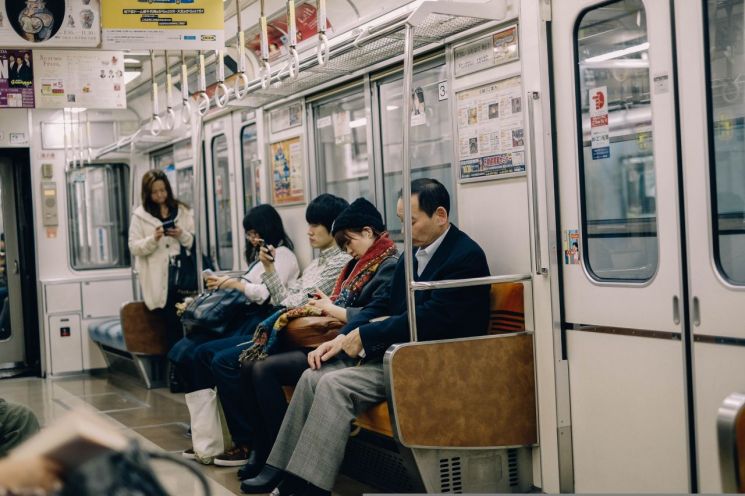
Regarding the incident, Kansai TV cited the results of a recent survey conducted among female university students. The Japanese research firm “Circle Up” conducted a survey in February targeting about 200 female university students. The results showed that 35% of respondents said they had experienced “non-contact sexual harassment.”
Examples of victimization included getting uncomfortably close to smell hair or perfume, staring continuously, blowing on the victim, deliberately sitting excessively close, whispering so only the victim could hear, and sending inappropriate images or messages via mobile phone data sharing functions (AirDrop). However, many women let these incidents pass due to difficulties in proving the harassment or not knowing how to report it. A significant number of victims did not receive help despite experiencing harassment.
Following Kansai TV’s report, local netizens expressed outrage toward the perpetrators with comments such as, “They seem to exploit the fact that it’s hard to prove if the victim denies it,” “It’s really a cunning and malicious act,” “I’m more tense on domestic public transportation than when I was in Europe or the U.S.,” and “More people need to respond strongly.” On the other hand, some expressed disagreement, saying, “It’s too much to label someone as a sexual harasser just for staring,” and “I’m afraid that soon people will be considered criminals just for breathing next to someone.”
© The Asia Business Daily(www.asiae.co.kr). All rights reserved.
![Clutching a Stolen Dior Bag, Saying "I Hate Being Poor but Real"... The Grotesque Con of a "Human Knockoff" [Slate]](https://cwcontent.asiae.co.kr/asiaresize/183/2026021902243444107_1771435474.jpg)
















