DeepL CEO Visits Korea Four Times... Adds Korean to LLM
OpenAI Also Joins Efforts to Foster Domestic AI Ecosystem
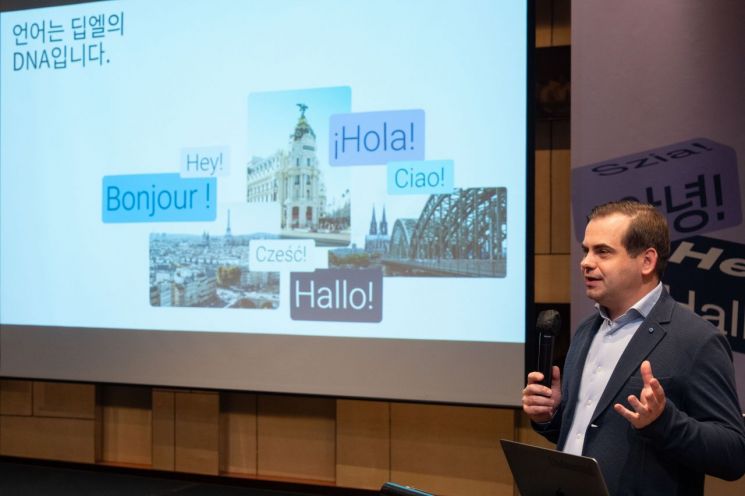 Jarek Kutylowski, CEO and founder of DeepL, is explaining the voice translation solution 'DeepL Voice' at a press conference held on the 28th at the Grand Hyatt Seoul in Yongsan-gu, Seoul. Provided by DeepL
With the emergence of artificial intelligence (AI) capable of understanding the context of multiple languages, language barriers are breaking down. Interest, which was previously concentrated on widely spoken languages such as English and Chinese, has gradually shifted toward Korean. As demand for Hangul continues to grow, global companies are also putting great effort into supporting the Korean language.
According to industry sources on the 30th, global language AI company DeepL has launched its first voice translation solution, 'DeepL Voice,' in South Korea, including support for Korean. The voice translation service covers languages such as English, Spanish, German, French, Russian, and Korean. Additionally, DeepL’s next-generation large language model (LLM), designed for translation, now includes Korean language support.
Jarek Kutylowski, CEO and founder of DeepL, personally visited South Korea and held a press briefing to introduce DeepL Voice, demonstrating the company’s commitment to entering the Korean market. Since launching Korean language services in January last year, he has visited Korea once last year and three times this year. Regarding the inclusion of Korean in DeepL Voice, he emphasized, "We included Korean at launch because Korean users and customers continuously expressed the need for it." Currently, DeepL shows strength in the domestic B2B (business-to-business) translation market.
Besides DeepL, global big tech companies are also showing strong interest in supporting Korean. Google Cloud recently added seven languages, including Korean, to its AI model Gemini embedded in the 'Workspace' product suite. Google Translate is considered the second most used translation application among general mobile users in South Korea, following Naver’s Papago. Previously, Google expressed its intention to enter the market by adding Korean and Japanese as supported languages for its conversational AI, following English.
OpenAI is also accelerating its entry into the Korean market by recently signing a memorandum of understanding (MOU) with the Korea Development Bank to foster the AI ecosystem. This is the first time OpenAI has signed an MOU in Korea to discuss business plans. The agreement reportedly includes comprehensive plans to nurture the AI ecosystem, such as supporting domestic AI startups, developing AI models tailored to the Korean context, and exploring the possibility of establishing domestic data centers. ChatGPT has been criticized for the low quality of responses to Korean language queries, raising expectations that OpenAI may release AI models better suited to the Korean context.
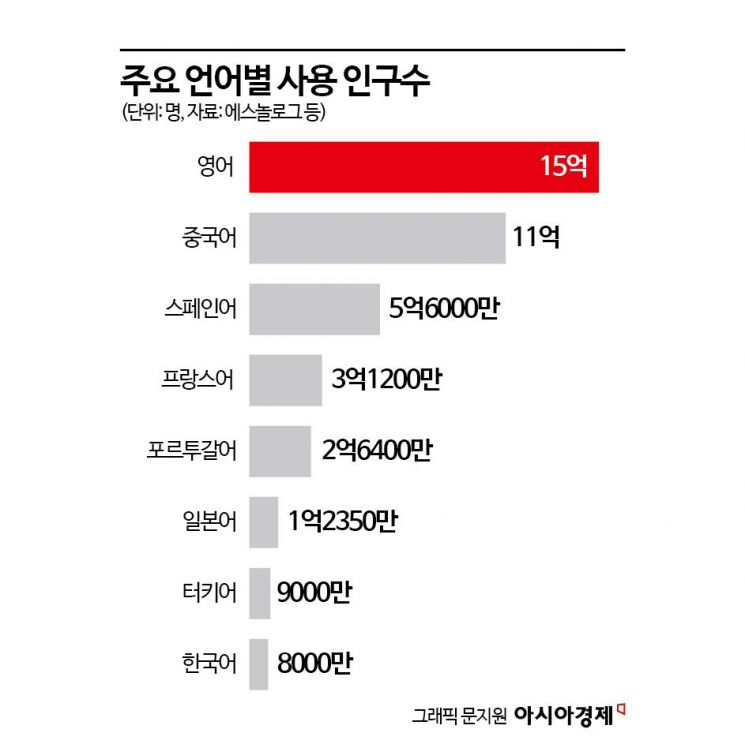
Korean does not have a very large number of speakers compared to major languages. According to Ethnologue, a language information site, Korean ranks 23rd in terms of number of speakers, with approximately 80 million speakers. This is relatively small compared to English with 1.5 billion speakers, Chinese with 1.1 billion, Spanish with 560 million, French with 312 million, Portuguese with 264 million, Japanese with 123.5 million, and Turkish with 90 million.
The reason global companies are interested in Korean is its high scalability. Thanks to the popularity of Hallyu (the Korean Wave) and other factors, demand for Korea is increasing. Additionally, due to the domestic industrial structure’s reliance on exports, meetings and business conversations with overseas companies are frequent. Therefore, domestic companies inevitably have high demand for AI services supporting Korean, especially in translation and interpretation.
Sanghoon Kim, senior researcher at the Electronics and Telecommunications Research Institute (ETRI), stated in his report on "The Current Status and Key Technology Trends of Multilingual Automatic Interpretation Services Based on Conversational AI," that "With the recent dramatic advancement in AI learning capabilities, the usability of automatic interpretation, which had stagnated for over 20 years, has greatly improved," and added, "Its application is gradually expanding from breaking down language barriers in daily life to areas with significant ripple effects such as business simultaneous interpretation."
Problems that needed to be solved to support Korean, such as grammar, context understanding, and inference, also seem to be gradually resolving. CEO Kutylowski explained, "Important information in sentences tends to appear at the end, so (the AI) approaches translation step-by-step," adding, "It makes predictions, and if it goes in a different direction, it re-translates to provide alternatives." OpenAI’s latest model, ChatGPT o1 Preview, reportedly scored 97 points on the Korean language section of the 2025 College Scholastic Ability Test (CSAT), answering all but one question correctly.
© The Asia Business Daily(www.asiae.co.kr). All rights reserved.


















