<양곡관리법, Passed in the Plenary Session with 173 Votes in Favor
President Yoon Seok-yeol Expected to Exercise Veto Power on the Four Agricultural Laws>
The 'Agriculture 4 Acts,' including the partial amendment bill to the Grain Management Act (Grain Management Act), which requires the government to compulsorily purchase rice when rice prices plummet, passed the National Assembly plenary session led by the opposition party. The ruling party opposed it, citing the enormous budget required.
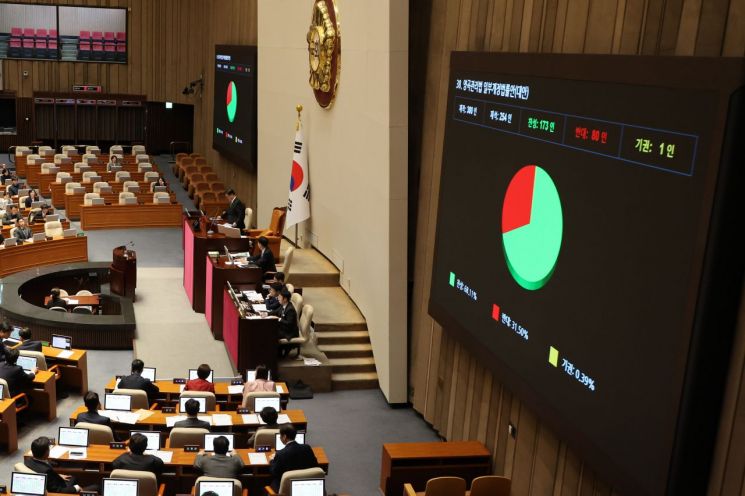 On the afternoon of the 28th, the partial amendment bill of the Grain Management Act was passed at the National Assembly plenary session. Photo by Yonhap News
On the 28th, the National Assembly held a plenary session and voted on the Grain Management Act, passing it with 254 members present: 173 in favor, 80 against, and 1 abstention. Although the ruling party cast opposing votes, the bills passed under the leadership of the opposition party. The partial amendment bill to the Act on Distribution and Price Stabilization of Agricultural and Fishery Products (Agricultural and Fishery Products Price Stabilization Act) was passed with 253 members present: 166 in favor, 85 against, and 2 abstentions; the partial amendment bill to the Agricultural and Fishery Disaster Insurance Act (Agricultural and Fishery Disaster Protection Act) passed with 239 members present: 175 in favor, 84 against; and the partial amendment bill to the Agricultural and Fishery Disaster Countermeasures Act (Agricultural and Fishery Disaster Countermeasures Act) passed with 262 members present: 175 in favor, 87 against.
The amendment to the Grain Management Act includes provisions requiring the government to compulsorily purchase rice when rice prices sharply fall or when rice is overproduced. The Agricultural and Fishery Products Price Stabilization Act introduces a minimum price guarantee system for agricultural products. The Agricultural and Fishery Disaster Insurance Act excludes the application of surcharge for natural disaster damage when calculating insurance premiums, and the Agricultural and Fishery Disaster Countermeasures Act guarantees production costs incurred before disasters.
The Democratic Party of Korea holds the position that these bills are necessary to save farming households. Jin Seong-jun, the Democratic Party policy chief, said at a press briefing at the National Assembly the day before, "The four livelihood laws to save agriculture are a natural consequence and alternative to the Yoon administration's broken promises and agricultural policy failures," adding, "We will definitely establish fundamental measures so that farmers can farm without worrying about prices and disasters."
The government and ruling party oppose the Grain Management Act and others, citing the heavy burden on the national budget. Kim Seon-gyo, a member of the People Power Party, said ahead of the vote, "Rice consumption is decreasing, and rice is being overproduced. How long must we pour trillions of won annually to support rice prices?" He added, "The bigger problem is that even if astronomical budgets are invested, the actual benefits do not return to the farmers themselves."
President Yoon Seok-yeol is expected to exercise his veto power on the Grain Management Act and others again, as he did in March last year. Song Mi-ryeong, Minister of Agriculture, Food and Rural Affairs, stated at an emergency press briefing on the 25th that she would recommend President Yoon exercise his veto power on the Agriculture 4 Acts. The People Power Party set its opposition to the Grain Management Act and others as its party stance and proceeded to vote. Choo Kyung-ho, floor leader of the People Power Party, told reporters after a closed-door party meeting that day, "This is a bill brought to the plenary session by the opposition party's unilateral forced passage."
© The Asia Business Daily(www.asiae.co.kr). All rights reserved.

















