Seminar Hosted by the Korea Semiconductor Industry Association
Kim Moon-soo, Minister of Employment and Labor, met with semiconductor industry officials from Samsung Electronics, SK Hynix, and others to emphasize the need to introduce a flexible working hours system for semiconductor research and development (R&D) personnel.
On the 28th, at Samsung Electronics' Pyeongtaek plant in Pyeongtaek, Gyeonggi Province, during the first seminar on improving the semiconductor work environment hosted by the Korea Semiconductor Industry Association, Minister Kim stated, “The original bill should be passed to grant the semiconductor industry considerable discretion through the Semiconductor Special Act, and the Ministry of Labor will actively support this.” He added, “For urgent fields like semiconductor R&D, the system should be improved with pinpoint precision like an awl.”
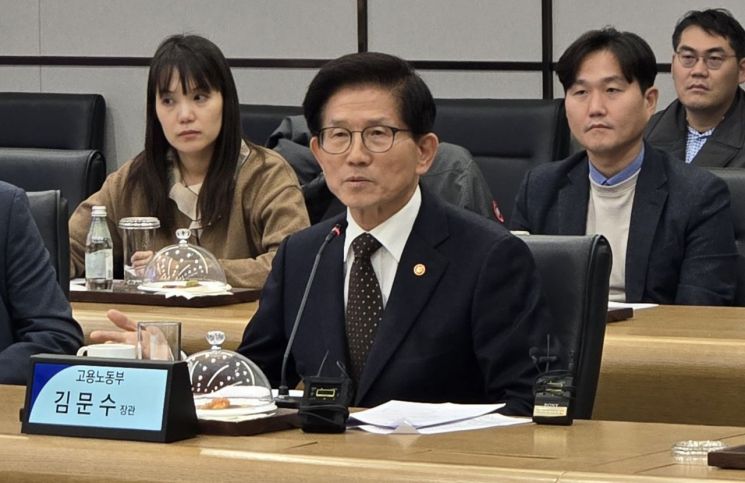 Kim Moon-soo, Minister of Employment and Labor, is speaking at the Ministry of Employment and Labor meeting invited by the Semiconductor Association held on the 28th at Samsung Electronics Pyeongtaek Campus in Pyeongtaek, Gyeonggi Province. Photo by Choi Seo-yoon
Targeting the exemption clause for the 52-hour workweek, Minister Kim said, “The current Semiconductor Special Act is an appropriate form,” and “If labor and management agree on expanding working hour options for semiconductor R&D workers, protecting their health, and providing sufficient compensation, we can find a way forward for Korea’s semiconductor industry.” He also noted, “Currently, special extended work hours are supported for semiconductors and advanced industries, but it is complicated and difficult because labor and management must agree and government approval is required.” He emphasized, “The voices from the field are important,” and urged, “Please actively share your opinions on what is inconvenient and what the government should do after hearing from the field and the industry.”
The seminar, held under the theme “Let Korea’s Semiconductor Industry Soar Again,” was attended by 17 people including Kim Jung-hoe, Vice Chairman of the Korea Semiconductor Industry Association; James Kim, Chairman of the American Chamber of Commerce in Korea (AMCHAM); Nam Seok-woo, President and CTO of Samsung Electronics DS Division Foundry Business; and Cha Seon-yong, Head of SK Hynix Future Technology Research Institute. The industry conveyed to the government the need to improve the current working hours system, and the government agreed to listen to the difficulties faced by companies on-site and seek win-win solutions between labor and management.
Participants expressed numerous opinions such as, “The current working hours system should reflect the diverse working environment characteristics of the semiconductor industry and changes in the global competitive environment,” and “Within the semiconductor industry, there are differences in work characteristics among design companies, manufacturing companies, and materials and parts companies, so expanded flexibility in working hours is urgently needed.” They also noted, “High-level expertise and concentration are required for the challenging semiconductor R&D,” and “From a production perspective, workload fluctuations are frequent due to changes in customer orders or quality issues.” A field example was mentioned where research was delayed because equipment power was turned off, requiring two hours the next day to reset the equipment, even though only 30 more minutes of research was needed.
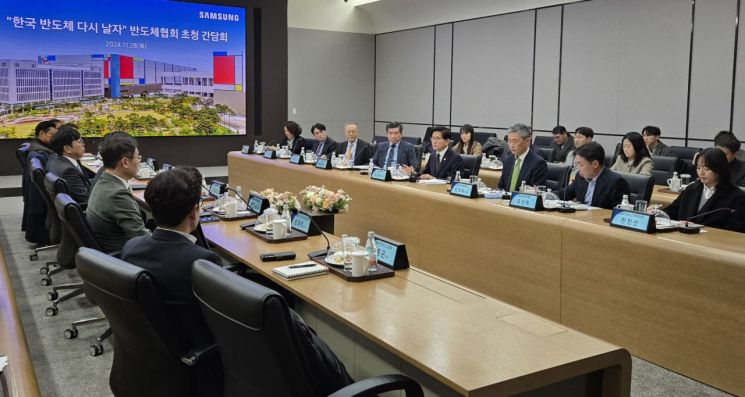 On the 28th, the Korea Semiconductor Industry Association held a meeting with the Minister of Employment and Labor at Samsung Electronics' Pyeongtaek plant in Pyeongtaek, Gyeonggi Province. Photo by Choi Seoyoon
The National Assembly’s Industry, Trade, Energy, Small and Medium Enterprises Committee is reviewing the Semiconductor Special Act bills proposed separately by the ruling and opposition parties. The ruling and opposition parties attempted to pass the Semiconductor Special Act at the plenary session of the National Assembly on the same day, but it failed as the Democratic Party of Korea proposed deleting the key exemption clause for the 52-hour workweek in the People Power Party’s Semiconductor Special Act. The 52-hour exemption clause is also called the Korean version of the “white-collar exemption,” which exempts high-income professionals in the U.S. from working hour regulations. The core is to exclude semiconductor R&D personnel from the 52-hour workweek limit based on labor-management agreement.
Minister Kim also stated at the National Assembly Budget and Accounts Special Committee plenary session on the 12th, “Allowing flexibility limited to research fields is a cautious and correct direction.” On the other hand, the Democratic Party opposes the 52-hour exemption, arguing that it could signal unnecessary expansion of working hour flexibility in the labor market and raise health issues caused by long working hours.
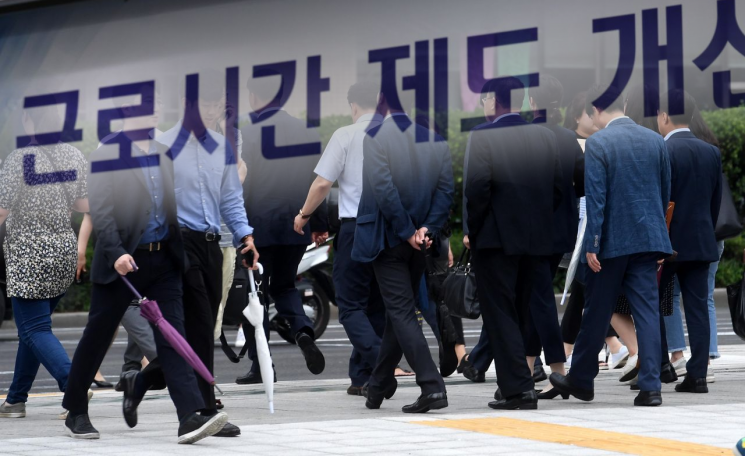
Labor opposition could also be a variable. Labor groups such as the two major trade unions have argued that “allowing exceptions to working hours for workers in specific industries and occupations effectively nullifies the Labor Standards Act, which legally sets minimum standards for working conditions.” The Federation of Korean Trade Unions submitted a statement to the government and the National Assembly the day before, stating, “The Semiconductor Special Act includes provisions that exclude important labor conditions such as working hours, breaks, and holidays under the Labor Standards Act, raising serious concerns about setbacks in workers’ life, safety, and health rights.”
The Korean Confederation of Trade Unions pointed out, “The special extended work permit system for the semiconductor industry is being expanded indefinitely,” and “For flexible working hours exceeding three months, 64 hours per week for six consecutive months, 80 hours per week for 16 consecutive weeks under the selective working hours system, and practically unlimited working hours per day and week under the discretionary working hours system are allowed.” Earlier, the National Samsung Electronics Labor Union (Jeonsamno) issued a statement on the 5th, saying, “Samsung Electronics employees are already being forced to work weekend overtime and extended hours,” and “The 52-hour workweek is an essential legal standard to protect workers’ health and safety.”
© The Asia Business Daily(www.asiae.co.kr). All rights reserved.
![Clutching a Stolen Dior Bag, Saying "I Hate Being Poor but Real"... The Grotesque Con of a "Human Knockoff" [Slate]](https://cwcontent.asiae.co.kr/asiaresize/183/2026021902243444107_1771435474.jpg)

















