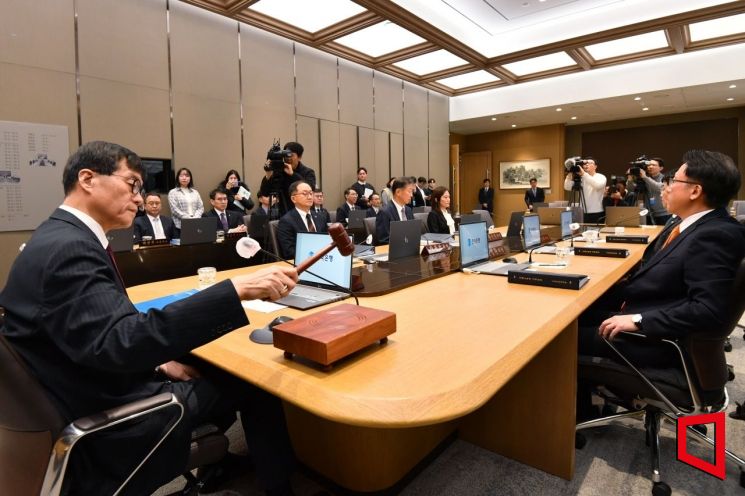
 Lee Chang-yong, Governor of the Bank of Korea, is striking the gavel at the Monetary Policy Committee meeting held at the Bank of Korea in Jung-gu, Seoul on the 28th. Photo by Joint Press Corps
Despite the Bank of Korea's surprise interest rate cut, the won-dollar exchange rate closed slightly lower. It is interpreted that the recent weakness of the US dollar offset the impact of the rate cut. However, as the Bank of Korea has signaled additional rate cuts, exchange rate volatility is expected to increase further.
On the 28th, in the Seoul foreign exchange market, the won-dollar exchange rate closed at 1,395.6 won, down 1.4 won from the previous trading day as of 3:30 p.m.
The won-dollar exchange rate opened at 1,391.0 won, down 6.0 won from the previous trading day, in the morning. Afterward, around 9:50 a.m., following the Bank of Korea's interest rate cut announcement, the rate rose to the 1,396 won level, but further increases were limited.
That morning, the Bank of Korea's Monetary Policy Board held a meeting to decide the direction of monetary policy and decided to cut the base interest rate by 0.25 percentage points to an annual rate of 3.00%. The market had expected the Bank of Korea to keep rates steady this month and observe the effects of last month's rate cut, but due to concerns over economic sluggishness, the Bank of Korea chose to implement a second consecutive rate cut.
There were expectations that the exchange rate would surge if the Bank of Korea cut the base rate, but the domestic foreign exchange market was influenced by the perception that the recent dollar strength was excessive, leading to a weaker dollar.
Park Sang-hyun, a specialist at iM Securities, said, "The recent weakness of the US dollar seems to have offset the impact of the Bank of Korea's rate cut today," adding, "However, it is clear that the downward pressure on the exchange rate has increased due to the rate cut, and volatility is likely to increase in the future."
The Bank of Korea emphasized that the domestic foreign exchange authorities have sufficient capacity to manage exchange rate volatility. Lee Chang-yong, Governor of the Bank of Korea, stated at a press briefing that morning, "We have sufficient foreign exchange reserves to manage exchange rate volatility," and added, "We are also discussing expanding the amount and extending the duration of the foreign exchange swap with the National Pension Service, which will help manage exchange rate volatility."
© The Asia Business Daily(www.asiae.co.kr). All rights reserved.

















