KCCI Hosts Seminar on 'Value-Up and Governance Regulation Discussions'
Academia: "Only Increasing Confusion... Utilize Alternatives Like Strengthening Disclosure Rules"
As the National Assembly discusses amendments to the Commercial Act that expand directors' fiduciary duties, claims have emerged that regulations related to corporate governance are not a panacea for value-up (enhancement of corporate value). It is pointed out that instead of merely strengthening regulations, comprehensive reviews of related legal systems, including policies for defending management rights and easing inheritance tax systems, are necessary. Since there are plenty of alternatives such as strengthening Korea Exchange disclosure regulations, and amending the law as the opposition party suggests could increase legal confusion, there are growing calls for caution in legislative discussions.
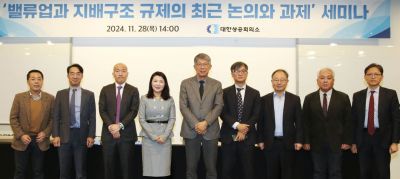 Kang Seok-gu, Head of the Research Department at the Korea Chamber of Commerce and Industry (first from the right), and others who attended the seminar "Recent Discussions and Challenges of Value-Up and Corporate Governance Regulations" held by the Korea Chamber of Commerce and Industry on the 28th at the Korea Chamber of Commerce and Industry Hall in Jung-gu, Seoul, are taking a commemorative photo. Photo by Korea Chamber of Commerce and Industry
On the 28th, academic experts attending the seminar titled "Recent Discussions and Challenges of Value-Up and Governance Regulation," held at the Korea Chamber of Commerce and Industry building in Jung-gu, Seoul, unanimously agreed that merely strengthening regulation-centered amendments to the Commercial Act is not the solution.
The seminar featured lectures and discussions on the current amendment to the Commercial Act being discussed in the National Assembly, led by the Democratic Party of Korea. The amendment includes provisions expanding the scope of directors' fiduciary duties from the existing 'company' to 'company and shareholders.' The Democratic Party plans to pass the amendment within the regular session of the National Assembly.
Professor Kwak Gwan-hoon of Sunmoon University said in his lecture, "In civil law countries like Korea and Japan, as well as in common law jurisdictions, directors are principally expected to protect the company's interests," adding, "While there are cases where courts have recognized directors' duties to shareholders, these are not explicitly stated in law."
He pointed out that concepts in the amendment such as 'overall shareholder interests,' 'proportional interests of shareholders,' and 'duty to treat shareholders fairly (equally)' are vague and fail to provide specific responsibility scopes or behavioral guidelines for directors. He warned that such unclear legal changes could inhibit directors' business judgment, leading to a decline in corporate competitiveness.
Professor Kwak added, "Japan considered introducing 'corporate social responsibility' into its Commercial Act in 1981 and codifying parent company directors' supervisory duties over subsidiaries in 2014, but these amendments were postponed due to ambiguous concepts and responsibility scopes," expressing concern that "until concrete standards are established through precedents, expanding directors' fiduciary duties will inevitably increase uncertainty in corporate management."
Professor Choi Seung-jae of Sejong University said, "The current conflict of interest cases involve 'controlling shareholders versus minority shareholders,' not 'directors versus shareholders,'" and noted, "Even if directors' fiduciary duties to shareholders are recognized, the amendment offers no solution when short-term shareholder interests like dividends conflict with long-term interests such as new business development."
Regarding other governance regulation proposals like mandatory cumulative voting or expanded separate election of audit committee members, Professor Choi argued, "It is more reasonable to allow companies the freedom to choose whether to adopt such measures rather than imposing uniform and rigid regulations."
He emphasized the need for a comprehensive review of related areas, including inheritance tax improvements related to governance issues, supplementation of management rights defense measures, and enhancing the efficiency of regulations against private benefit appropriation in internal transactions among affiliates under the Fair Trade Act. He stressed the importance of organically reviewing related laws such as the Commercial Act, tax law, and the Fair Trade Act in this process.
During the subsequent discussion, opinions emerged that targeted 'pinpoint corrections' for specific problematic cases are preferable to a full-scale revision of the Commercial Act.
Han Seok-hoon, chairman of the National Pension Fund Stewardship Responsibility Committee, said, "The company's interests and the overall shareholders' interests are not different," criticizing the amendment to add shareholder protection duties to directors as unnecessary and warning that "legal disputes will only increase due to shareholders misinterpreting 'shareholders' interests' subjectively." He added, "Pinpoint corrections for specific issues are needed rather than a comprehensive amendment to the Commercial Act, which has wide-ranging effects on the legal system."
There were also calls for alternatives such as strengthening Korea Exchange disclosure regulations. Kang Young-gi, a research professor at Korea University, advised, "It is hard to imagine a situation where directors owe duties to shareholders with whom they have no direct contractual relationship, except in cases where shareholders suffer direct damages due to directors' violations of laws recognized as tort liability under civil law," and suggested, "It is preferable to resolve conflicts of interest among shareholders through soft norms (amendments) like strengthening exchange disclosure regulations, as Japan has done, rather than through legal amendments."
Concerns were raised that including only shareholders in the scope of directors' fiduciary duties while excluding other stakeholders such as creditors could increase legal confusion. Lawyer Kim Ji-pyeong of Kim & Chang Law Firm said, "If only shareholders are added as fiduciary duty subjects, directors might be interpreted as having to prioritize shareholders' interests over those of other stakeholders like creditors," and warned, "Especially in Korea, unlike major countries, violations of directors' duties can be punished as breach of trust, so ambiguous regulations could infringe on the principle of legality (nullum crimen sine lege)."
Kang Seok-gu, head of the Korea Chamber of Commerce and Industry's Research Headquarters, expressed concerns in his opening remarks, saying, "There is worry that the amendment to the Commercial Act might act as a 'law encouraging overseas speculative funds to make short-term profits and then exit by selling shares.'" He added, "For small and medium-sized enterprises, where management rights attacks are possible with relatively small capital and response capacity is limited, it is necessary to carefully examine whether expanding fiduciary duties is indeed a necessary measure."
© The Asia Business Daily(www.asiae.co.kr). All rights reserved.
![Clutching a Stolen Dior Bag, Saying "I Hate Being Poor but Real"... The Grotesque Con of a "Human Knockoff" [Slate]](https://cwcontent.asiae.co.kr/asiaresize/183/2026021902243444107_1771435474.jpg)
















