Yangju City, Gyeonggi Province (Mayor Kang Su-hyun), announced on the 28th that during the 14th excavation of Yangju Daemosanseong, conducted with budget support from the National Heritage Administration in collaboration with the Giho Cultural Heritage Research Foundation (Director Ko Jae-yong), four wooden tablets were unearthed from the upper collection facility inside the fortress, following last year’s discovery.
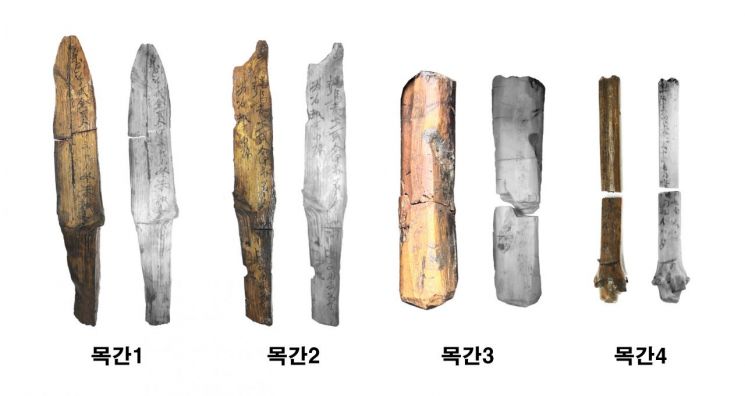 Four wooden tablets excavated from the upper water collection facility inside the fortress during the 14th excavation of Daemosanseong Fortress in Yangju, following last year. Provided by Yangju City.
A total of four wooden tablets were excavated this time, all found in the same upper collection facility inside the fortress where the ‘Taebong Kingdom wooden tablets’ had previously been discovered.
The ‘Taebong Kingdom wooden tablets’ represent the first-ever unearthed artifacts from Taebong (Later Goguryeo), a state established by Gung Ye (?~918), marking the earliest discovery of such wooden tablets in Korea. Among the wooden tablets excavated domestically, they contain the greatest number of surfaces, the greatest number of lines, and a total of 123 characters, bringing new insights to the study of ancient Korean history.
Among the four newly excavated wooden tablets, two form a pair (hereafter referred to as wooden tablets 1 and 2), which are believed to have been made by splitting a single piece of wood in half.
This appears to have been intentionally designed both in form and content to complement each other, with the handle portion shaped to be held in hand and trimmed into a knife shape, with ink inscriptions on the blade part.
Each of these two wooden tablets bears inscriptions reading ‘Geumwa-in (金瓦人)’ and ‘Towa-in (土瓦人),’ respectively, suggesting that they are ritual wooden tablets with contrasting content. The third wooden tablet (hereafter wooden tablet 3) contains the phrase ‘Chaiin (此二人 = these two people),’ which seems to refer to Geumwa-in and Towa-in.
Furthermore, these tablets align with the ritualistic nature of the ‘Taebong Kingdom wooden tablets’ unearthed last year at Yangju Daemosanseong and are considered valuable physical evidence shedding light on the social conditions during the Taebong period.
However, some scholars speculate that the two paired wooden tablets mentioning Geumwa-in and Towa-in may refer to the kiln workers and tile makers (since gilt-bronze eaves tiles (金銅付椽) were excavated at Anapji, it is presumed that Geumwa-in made these), suggesting that they came from Jong-eup (宗邑, presumed to be present-day Gyeongju) and held the Silla external official rank of Ilbeol (一伐). This implies that these administrative documents were created before the abolition of external official ranks in 674, indicating that they might be Silla wooden tablets of administrative nature. Further academic research is anticipated.
Another wooden tablet (hereafter wooden tablet 4) contains specific examples of land area and grain quantity notations such as ‘Gyeolbu (結負),’ ‘Du (斗),’ ‘Dwe (刀),’ ‘Hop (合),’ and ‘Pun (分),’ which is the first case among currently excavated wooden tablets and is expected to be an important reference for future studies on measurement units during the Three Kingdoms period.
Additionally, the four wooden tablets excavated this time are composed of a large amount of Idu-style expressions, attracting scholarly attention as new Idu materials. Further examination will be conducted regarding the nature and composition of these wooden tablets and their relationship with the ‘Taebong Kingdom wooden tablets’ excavated last year.
Meanwhile, since 2018, the city has been conducting annual excavations of Yangju Daemosanseong to clarify its historical significance and plans to continue research to unravel the secrets of five wooden tablets, including those unearthed last year.
Moreover, Yangju City plans to present the major achievements of the 14th excavation of Yangju Daemosanseong, including the discovery process of the four wooden tablets, at the ‘Yangju Daemosanseong Academic Seminar’ to be held at the Yangju Hoeamsaji Museum on the 29th. Subsequently, on December 4th, the city will publicly exhibit the four excavated wooden tablets at the ‘Yangju Daemosanseong 14th Excavation Site Open House.’ Yangju City will continue its efforts to establish its status as the ‘Main Home of Northern Gyeonggi’ and the ‘Historical and Cultural Center of Northern Gyeonggi.’
© The Asia Business Daily(www.asiae.co.kr). All rights reserved.
![Clutching a Stolen Dior Bag, Saying "I Hate Being Poor but Real"... The Grotesque Con of a "Human Knockoff" [Slate]](https://cwcontent.asiae.co.kr/asiaresize/183/2026021902243444107_1771435474.jpg)















