All Ruling Party Members Exit: "Cannot Accept"
Chairman Kim Young-ho: "Must Stabilize the Scene"
Lee Joo-ho: "Concerned About Student Burden"
A bill defining AI (artificial intelligence) digital textbooks as educational materials rather than textbooks for curriculum use has passed the full meeting of the National Assembly's Education Committee, led by the opposition party. If the bill passes the plenary session of the National Assembly, the government will no longer be able to mandate digital textbooks for all schools nationwide as planned.
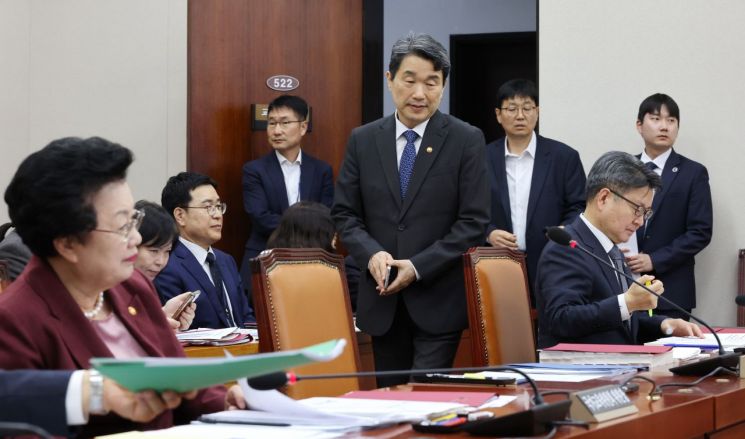
On the morning of the 28th, the Education Committee held a full meeting and approved the partial amendment to the Elementary and Secondary Education Act containing this provision, with ruling party members having left the session. Jo Jeong-hoon, the ruling party's secretary attending the meeting, stated, "The People Power Party cannot accept today's meeting nor the agenda adjustment committee decision made solely by the Democratic Party yesterday," adding, "We will take legal action later," before leaving.
Earlier, on the 26th, ruling party members protested and left the meeting room when the Democratic Party tried to pass the amendment bill unilaterally at the Education Committee's bill review subcommittee. The Democratic Party planned to pass the bill at the full Education Committee meeting that day as well, but the People Power Party requested the formation of an agenda adjustment committee, delaying the passage. The agenda adjustment committee is a body for discussing items requiring consensus. Later that night, members of the Democratic Party and the Justice Innovation Party in the agenda adjustment committee passed the amendment bill while People Power Party members had left.
'Opposition Blocks Full Introduction of AI Textbooks... Ruling Party Defends'
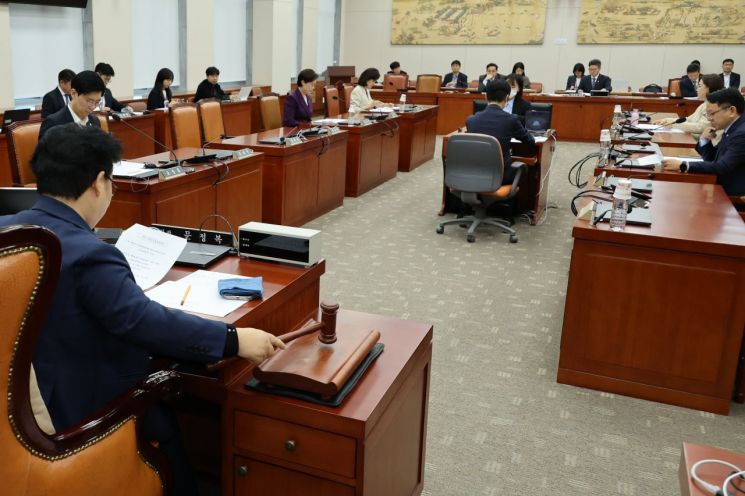
The ruling party emphasized the government's AI digital textbook policy aimed for introduction next year, while the opposition party submitted a bill opposing it. The amendment bills, respectively introduced by Democratic Party members Go Min-jeong and Moon Jeong-bok, seek to define AI digital textbooks as ‘educational materials’ rather than ‘textbooks for curriculum use’ so that they can be introduced to schools after social discussion. Previously, the opposition party expressed the need for cautious introduction of AI digital textbooks.
Therefore, if the amendment passes through the Education Committee, the Legislation and Judiciary Committee, and the plenary session, it is expected to hinder the government's AI digital textbook policy. Since educational materials are not mandatory textbooks that must be selected by each school, school principals will have autonomy in choosing whether to use them.
In response, companies involved in the review of AI digital textbook publishers and the Korea Textbook Association opposed the opposition party's bill ahead of the bill subcommittee. If AI digital textbooks are not recognized as textbooks for curriculum use, publishers may suffer losses in textbook production and management. They argued, "AI digital textbooks should maintain the status of textbooks for curriculum use."
Before the vote, Education Committee Chair Kim Young-ho said, "Representative Jo was worried that the opposition party's opposing bill would cause confusion among textbook companies," adding, "However, rather than worrying about companies' confusion, it is a bigger issue to check the reactions of teachers, parents, and students and to manage and stabilize their confusion."
In response, Deputy Prime Minister and Minister of Education Lee Ju-ho said, "We understand concerns about AI digital textbooks, but these can be addressed through policy measures without legal amendments," adding, "Despite conveying the government's position amid ongoing development, evaluation, training, and digital infrastructure construction according to the scheduled timeline, we regret the passage of the amendment." He further noted, "Educational materials are not subject to free compulsory education under the Elementary and Secondary Education Act, so costs may be passed on to students, and differences in usage depending on regional and school educational conditions may cause educational and learning gaps."
Going forward, the opposition party, which holds the majority, is expected to push for passage through the National Assembly's Legislation and Judiciary Committee and the plenary session. However, whether the president will exercise the veto power remains uncertain. When Chair Kim asked Minister Lee, "If the bill passes the plenary session, do you plan to recommend the president exercise the veto?" Lee replied, "We will continue efforts to persuade during the National Assembly and plenary session process."
Meanwhile, the Ministry of Education will announce the results of the AI digital textbook evaluation on the 29th. Afterwards, sample copies will be distributed to schools next month, followed by the textbook adoption process.
© The Asia Business Daily(www.asiae.co.kr). All rights reserved.
![Clutching a Stolen Dior Bag, Saying "I Hate Being Poor but Real"... The Grotesque Con of a "Human Knockoff" [Slate]](https://cwcontent.asiae.co.kr/asiaresize/183/2026021902243444107_1771435474.jpg)
















