Ministry of Science and ICT - Korea Communications Commission, Comprehensive Measures Established
Plan to Amend Telecommunications Network Act in First Half of Next Year
Prevention and Response Measures from Spam Sending to Receiving
The government has decided to confiscate criminal proceeds from malicious illegal spammers and impose fines on mobile carriers and others who fail to fulfill their obligations to prevent spam.
The Ministry of Science and ICT and the Korea Communications Commission announced the "Comprehensive Measures to Prevent Illegal Spam" with these details on the 28th at the Government Seoul Office.
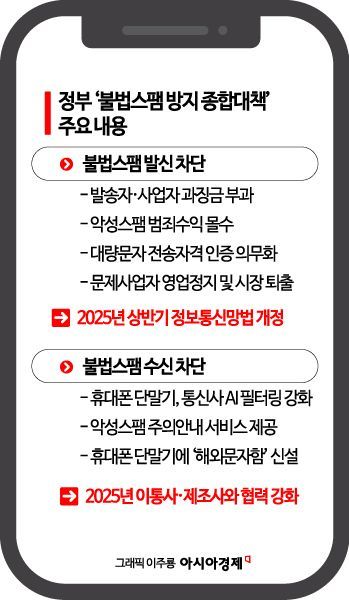
Illegal spam is being exploited as a means for various financial crimes such as voice phishing and smishing, causing serious damage to the property of the public. About 210 million spam reports were received in the first half of this year, and in June alone, a record high of 47 million reports was filed.
In response, the Ministry of Science and ICT and the Korea Communications Commission decided to strengthen countermeasures at every stage from sending to receiving illegal spam. First, they will prepare an amendment to the Network Act by the first half of next year to confiscate criminal proceeds from illegal spam senders. Malicious spam transmission acts will be defined as subject to confiscation and recovery to seize unfair profits. A new legal provision will be established to impose fines on mobile carriers, message relay companies, and resellers who violate their obligations by tolerating or neglecting illegal spam sending activities.
So far, message relay companies (a total of 10 companies) have been criticized for neglecting preventive measures, such as not sanctioning resellers with a high volume of spam reports or not checking spam report details. Among the 1,168 message resellers currently operating, problems such as failure to suspend accounts of spam senders have also been identified.
Additionally, the government plans to strengthen registration requirements for message resellers operating in a "fly-by-night" manner. They will raise capital requirements, add technical and managerial measures to business registration requirements, and mandate qualification certification for mass text message transmission. Problematic businesses will be subject to suspension or cancellation of registration to be removed from the market.

Institutional and technical systems to block illegal spam sending, such as preventing spoofing of message sender numbers, will also be strengthened. A "Spam Message Number and Account Management System" will be established to verify the validity of sender numbers and message service accounts by message operators, and mobile carriers will implement a dual blocking system to preemptively block reception of spoofed sender numbers. Furthermore, users of mass messaging services will be required to authenticate themselves each time they send a message.
Mobile carriers will enable users to check filtered illegal spam messages on their devices and build a dual spam filtering system through on-device artificial intelligence (AI). As spam sent from overseas has recently increased, the government plans to collaborate with phone manufacturers to create an "Overseas Message Inbox" on devices. They will also jointly respond with mobile carriers to detect phishing URLs in malicious messages and preemptively block international mass messages from unverified senders.
The public and private sectors will form a permanent consultative body on illegal spam next month to discuss voluntary regulation measures. They will also prepare measures to prevent an increase in illegal spam on other messaging platforms such as KakaoTalk and Telegram, which may arise as a balloon effect from mass messaging service regulations. Yoo Sang-im, Minister of Science and ICT, stated, "We hope to fundamentally block illegal spam so that the public no longer suffers and can enjoy a safe digital life."
© The Asia Business Daily(www.asiae.co.kr). All rights reserved.
![Clutching a Stolen Dior Bag, Saying "I Hate Being Poor but Real"... The Grotesque Con of a "Human Knockoff" [Slate]](https://cwcontent.asiae.co.kr/asiaresize/183/2026021902243444107_1771435474.jpg)

















