No Sign of Resolution for 'Medical School Expansion'
Second Measures Being Prepared to Strengthen Essential Medical Services
Central Disaster and Safety Countermeasures Headquarters: "Content Requested by the Medical Community"
As the medical community's strike opposing the increase in medical school admissions continues into its tenth month, the government stated that it will "make every effort to prepare feasible alternatives that meet the public's expectations." The government plans to prepare the '2nd Medical Reform Implementation Plan' by next month to persuade the medical community.
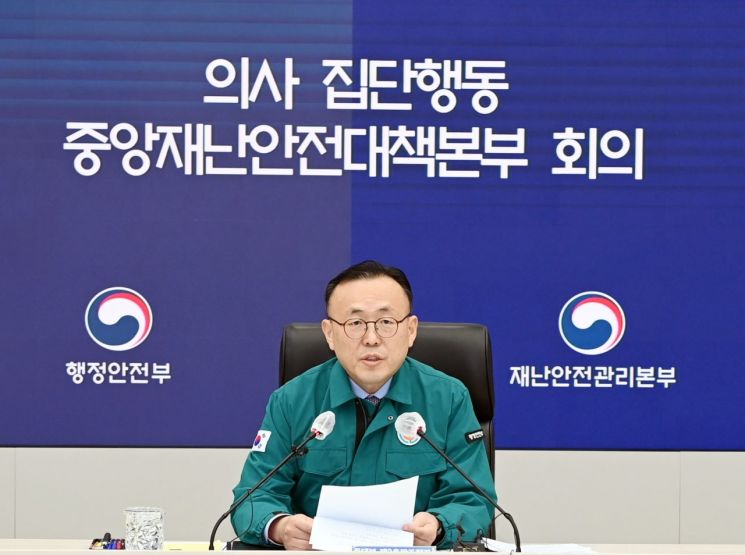
On the 28th, Lee Han-kyung, the 2nd Chief Coordinator of the Central Disaster and Safety Countermeasures Headquarters (Head of the Disaster and Safety Management Headquarters, Ministry of the Interior and Safety), held a Central Disaster and Safety Countermeasures Headquarters meeting during the doctors' collective action and said, "We are continuing dialogue with the medical community for medical normalization through the ruling and opposition parties and government consultation body."
The consultation body between the ruling and opposition parties and government, launched to resolve the medical-government conflict, has held three meetings recently but has yet to reach an agreement on the issue of increasing medical school admissions. The medical community remains firm, proposing measures such as adjusting the medical school quota for the 2025 academic year.
In response, the government continues to present measures to persuade the medical community. Earlier this year, it announced four major tasks for medical reform to strengthen essential and regional healthcare and is currently implementing key initiatives. Following the announcement of the '1st Medical Reform Implementation Plan' in August, which included restructuring of tertiary hospitals and innovation of resident training systems, the government plans to prepare the '2nd Implementation Plan' by next month.
Lee explained, "The Medical Reform Special Committee is rapidly discussing concrete implementation plans for the second phase of medical development to strengthen regional and essential healthcare, primary care enhancement, establishment of a medical accident safety net, and reform of non-reimbursable services and indemnity insurance." He added, "A pilot project for restructuring tertiary hospitals is also underway, focusing on concentrating on high-difficulty treatments such as severe and rare diseases and reorganizing around skilled personnel."
He emphasized, "The medical reform tasks the government is pursuing have long been demanded by the medical community and aim to correct the distorted medical system to revive essential and regional healthcare."
Lee expressed deep gratitude, saying, "I sincerely thank the public cooperating with the emergency medical system that has been ongoing for ten months and the medical staff protecting precious lives beside patients." He added, "The government will unite all government capabilities to ensure that the emergency medical system, centered on severe and emergency patients, operates smoothly even during the winter season when respiratory and cardiovascular diseases may increase, and will make every effort to this end."
© The Asia Business Daily(www.asiae.co.kr). All rights reserved.
![Clutching a Stolen Dior Bag, Saying "I Hate Being Poor but Real"... The Grotesque Con of a "Human Knockoff" [Slate]](https://cwcontent.asiae.co.kr/asiaresize/183/2026021902243444107_1771435474.jpg)
















