Announcement of 'Survey on Business Succession in Mid-sized Companies' Results on the 28th
72.9% of Mid-sized Companies Support Lowering the Maximum Inheritance and Gift Tax Rate Below 30%
Opinions from the mid-sized business sector have been presented, calling for a progressive reform of the current inheritance and gift tax system, which features the highest tax rates in the world and is excessively burdensome.
According to the results of the "Mid-sized Business Succession Survey" released by the Korea Federation of Mid-sized Enterprises on the 28th, 89.4% of mid-sized companies evaluated the current top inheritance and gift tax rate of 50% as "high," making up the majority. While 10.6% of mid-sized companies responded that the rate was "appropriate," there was no perception that it was "low."
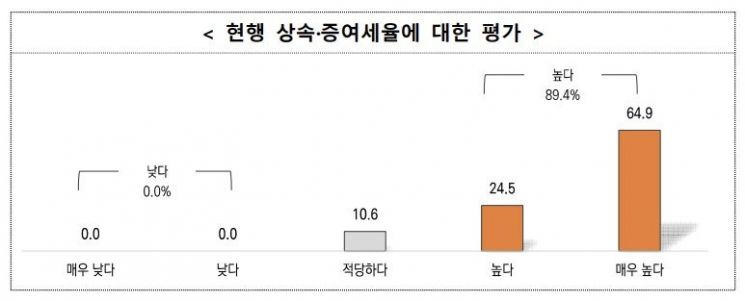
A representative from the Federation stated, "72.9% of respondents expressed the opinion that the top inheritance and gift tax rate should be lowered to at least the OECD average level of 30%." They added, "In particular, 43.1% of mid-sized companies suggested a rate below 20%, confirming that the corporate burden from inheritance and gift taxes is significant."
The survey was conducted from October 14 to November 5, targeting 151 mid-sized companies. 60.9% of these companies responded that the current inheritance and gift tax system hinders corporate value-up and causes a Korea discount.
The mid-sized business sector holds the view that due to excessively high inheritance and gift taxes, negative effects such as "threats to management rights due to share reduction after succession (37.7%)," "business deterioration (33.1%)," and "business downsizing (13.2%)" are inevitable even after succession.
The top priority for improving the current inheritance and gift tax system was identified as "lowering the inheritance tax rate (74.8%)." Other issues pointed out included raising the inheritance tax base (12.6%), abolishing the controlling shareholder premium valuation (5.3%), converting to capital gains tax (5.3%), and converting to estate acquisition tax (2.0%). However, the Federation explained that the excessive inheritance tax rate itself is confirmed as the urgent prerequisite task.
74.4% of mid-sized companies responded that the business succession deduction system should be improved, with 52.5% calling for an expansion of the deduction limit, 21.3% for expanding the deduction targets, and 21.3% for relaxing pre- and post-conditions. Regarding pre- and post-conditions, the most common opinions were to relax the pre-condition of the decedent’s controlling shareholder shareholding ratio (39.3%) and the post-condition of employment maintenance requirements (54.1%).
Regarding the 2024 tax law amendment, the most frequent opinion was to expand support for business succession deductions for excellent companies, doubling the deduction limit up to 120 billion KRW for value-up and scale-up excellent companies, and expanding the deduction targets to all mid-sized companies.
Lee Ho-jun, Executive Vice Chairman of the Federation, emphasized, "With the aging of founders, many mid-sized companies are approaching succession, and the excessive burden of inheritance and gift taxes could threaten the survival of excellent mid-sized companies, which are sources of national wealth creation." He added, "Under the constructive recognition that business succession is the foundation for quality jobs and sustainable growth for future generations, we will actively communicate with the government and the National Assembly to ensure that the inheritance and gift tax system is progressively improved."
© The Asia Business Daily(www.asiae.co.kr). All rights reserved.
![Clutching a Stolen Dior Bag, Saying "I Hate Being Poor but Real"... The Grotesque Con of a "Human Knockoff" [Slate]](https://cwcontent.asiae.co.kr/asiaresize/183/2026021902243444107_1771435474.jpg)
















