The value of the Russian ruble plummeted to its lowest level in 32 months on the 27th (local time), surpassing 120 rubles per US dollar. This is the level seen at the early stages of Russia's invasion of Ukraine. The decline is analyzed as a consequence of increased pressure on Russia by the Biden administration and major Western countries ahead of the inauguration of US President-elect Donald Trump, who has pledged an early end to the war.
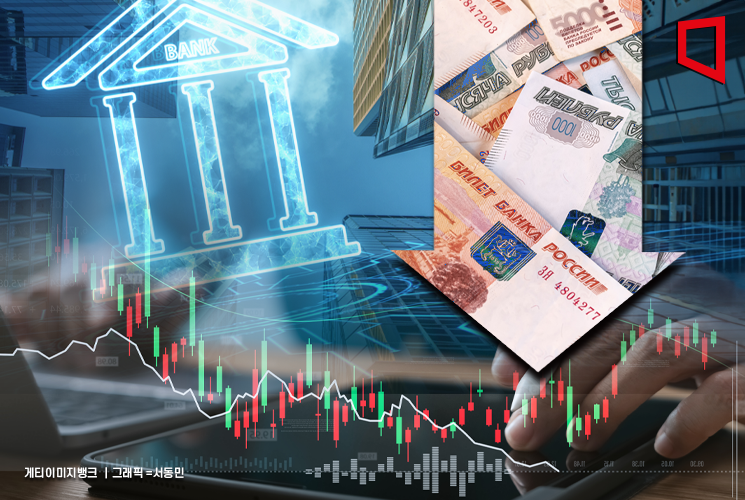
According to major foreign media, the ruble-dollar exchange rate briefly hit 120 rubles per dollar during the foreign exchange market on that day. This is the first time the rate has exceeded 120 rubles since March 22, 2022, right after Russia invaded Ukraine. This indicates a significant drop in the ruble's value against the dollar. Before the invasion, the exchange rate was around 75 to 80 rubles per dollar, but it surged to 150 rubles immediately after the invasion in February 2022, before stabilizing due to intervention by the central bank.
In particular, the recent weakness of the ruble has become more pronounced since the United States included Gazprombank, Russia's third-largest bank, on its sanctions list on the 21st. Gazprombank has played a key role in the settlement process of natural gas transactions between Russia and European countries. Additionally, the conflict has intensified as Ukraine has struck Russian mainland targets with long-range missiles supplied by the US and the UK, and Russia has responded with new medium-range missiles. With the US administration set to change to President-elect Trump in January next year, it is expected that the Biden administration and major Western countries will further tighten sanctions, which has also impacted the ruble.
Alongside this, Politico pointed out that the decline in crude oil prices and the sharp increase in Russian spending on the war effort have also burdened the Russian economy, contributing to the ruble's weakness. The benchmark Brent crude price fell about 4% this week following a ceasefire agreement between Israel and the Lebanese militant group Hezbollah.
While the weak ruble is positive for Russian exports, there are concerns it will further fuel already high inflation. Officially, Russia's inflation rate stands at 8.5%, but actual inflation is estimated to be higher. In response, the Russian Central Bank (CBR) has already raised its benchmark interest rate to 21%, the highest level in 20 years. Further hikes are expected in December. Typically, central bank rate increases are seen as factors that strengthen currency value, but their effect is limited during times of recession fears or lack of confidence in the foreign exchange market. Economic experts diagnose that Russia is showing signs of a recession characterized by low growth and high inflation. Politico reported, "Despite the Russian Central Bank sharply raising interest rates this year, it has failed to prevent the ruble's value from falling by about a quarter against the dollar."
However, Anton Siluanov, Russia's Minister of Finance, stated that the ruble's weakness is positive for Russian exports. Speaking at a financial conference held in Moscow the previous day, he said, "Today's exchange rate is very, very favorable for exporters." The Guardian noted that it is rare for the finance minister to comment on exchange rates in official settings, suggesting that Russia is satisfied with the ruble's depreciation. He also added that it helps cover the costs of the war in Ukraine. About one-third of Russia's budget this year has been allocated to military spending.
© The Asia Business Daily(www.asiae.co.kr). All rights reserved.
![Clutching a Stolen Dior Bag, Saying "I Hate Being Poor but Real"... The Grotesque Con of a "Human Knockoff" [Slate]](https://cwcontent.asiae.co.kr/asiaresize/183/2026021902243444107_1771435474.jpg)
















