On the 27th (local time), the French government claimed that Israeli Prime Minister Benjamin Netanyahu has 'immunity' in relation to the International Criminal Court (ICC) arrest warrant issued against him. This sudden change in stance came immediately after Netanyahu's cabinet accepted the Lebanon ceasefire plan proposed by France and the United States.
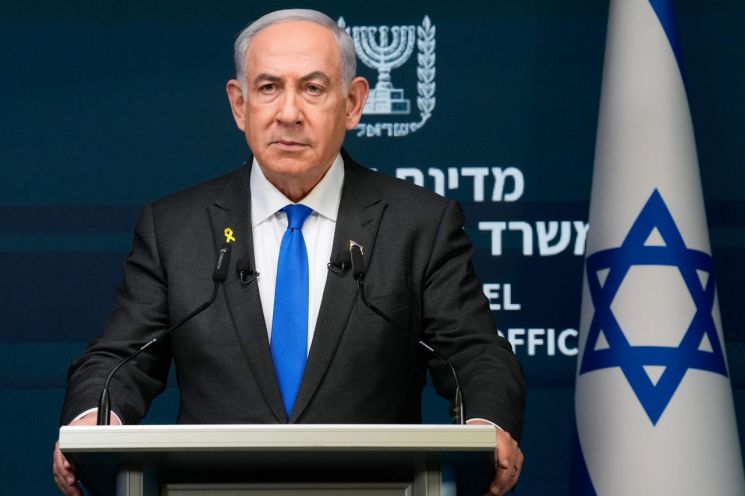
According to The Guardian and others, the French Ministry of Foreign Affairs stated on the same day that Israel is not a member of the ICC and expressed this position. In a statement, the French Foreign Ministry argued, "We cannot act in a manner that conflicts with international legal obligations concerning immunity granted to states not party to the ICC." It also emphasized, "Such immunity should apply to Prime Minister Netanyahu and the relevant ministers," adding, "If the ICC instructs us to arrest and hand them over, we must consider (the immunity)."
The ICC issued arrest warrants last month against Prime Minister Netanyahu and former Israeli Defense Minister Yoav Gallant on charges of war crimes. In response, the French government had previously stated a principled position that it would act in accordance with ICC regulations.
Notably, France's claim is striking because it conflicts with its previous stance on Russian President Vladimir Putin, who is also not an ICC member but against whom an arrest warrant was issued. Earlier, the ICC ruled that Mongolia violated its obligations as an ICC member by not arresting Putin during his visit, and at that time, the French Foreign Ministry expressed full support for the ICC, stating it was part of France's long-standing commitment to eliminate immunity.
The Guardian pointed out that France's sudden change in position appears to be based on Article 98 of the Rome Statute, which states that "a State Party shall not be compelled to surrender a person to the Court" in a manner that conflicts with its international obligations. It further noted that Article 27 specifies that immunity for high-ranking officials "shall not bar the Court from exercising its jurisdiction over such a person." The ICC had also concluded in 2019 that Article 98 is not a basis for immunity but rather a "procedural rule" guiding the execution of arrest warrants.

Criticism is pouring in from both inside and outside the international community. Amnesty International France criticized France's position on Netanyahu, saying it "contradicts France's obligations as an ICC member" and pointed out that "the principle of the ICC regulations is that no one, including Putin or Netanyahu, is above the law." UK Foreign Secretary David Lammy emphasized this as a "duty," stating, "If the named individuals try to enter our country, I will refer them to the courts."
Marine Tondelier, leader of the French Green Party, posted on X (formerly Twitter) on the same day, calling the decision "shameful" and "a splendid backtrack," suggesting that it might be the result of an agreement between French and Israeli leaders. He wrote, "France has once again succumbed to Netanyahu's demands, choosing him over international justice," and added, "It was likely a 'deal' for France to be mentioned in the official Lebanon ceasefire announcement released yesterday by France and the United States." He also questioned, "Does this mean Putin will not be arrested even if he visits UNESCO?" and called it "a historically very serious mistake."
France24, citing unconfirmed media reports, conveyed that Netanyahu, enraged by the ICC's issuance of the arrest warrant, called French President Emmanuel Macron to express his anger and urged him not to carry out the warrant.
© The Asia Business Daily(www.asiae.co.kr). All rights reserved.
![Clutching a Stolen Dior Bag, Saying "I Hate Being Poor but Real"... The Grotesque Con of a "Human Knockoff" [Slate]](https://cwcontent.asiae.co.kr/asiaresize/183/2026021902243444107_1771435474.jpg)

















