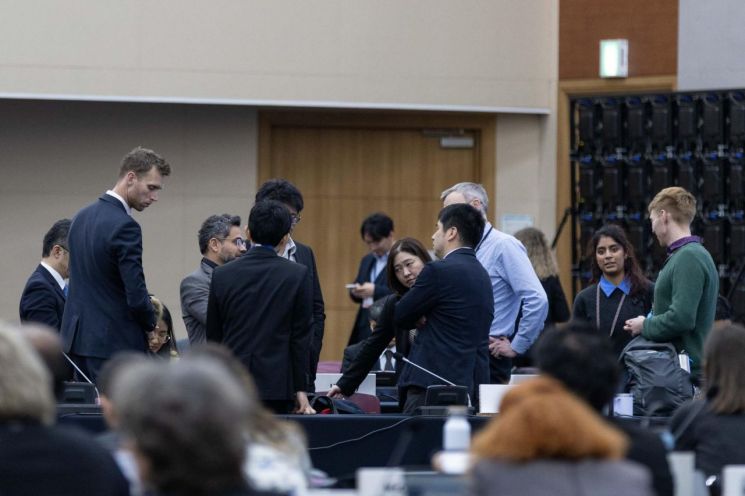
 At BEXCO in Suyeong-gu, Busan, on the 27th, officials from the United Nations Plastic Treaty Intergovernmental Negotiating Committee (INC-5) are seen discussing privately. Photo by the International Institute for Sustainable Development
As negotiations to reduce plastic waste fail to gain momentum, the South Korean government has officially proposed a compromise plan. The core idea is to establish general standards and guidelines, while allowing individual countries to autonomously implement specific policies and actions.
According to the government on the 27th, Environment Minister Kim Wan-seop held a dinner the previous day in Busan with the chief representatives of the "Host Country Alliance" and proposed this compromise plan. The Host Country Alliance is a group consisting of Uruguay, France, Kenya, Canada, South Korea, and others that hosted the United Nations Intergovernmental Negotiating Committee (INC) on the plastic treaty.
The compromise plan centers on recognizing each country's "voluntary measures." The plastic reduction treaty would maintain legal binding force by setting general standards and guidelines for major regulations such as production reduction and product design. However, it grants autonomy to member states to implement policies voluntarily through national implementation plans and other methods.
The compromise plan is interpreted as a measure to break the deadlock in the stalled negotiations. Since the 25th, the international community has been conducting final negotiations in Busan to reduce plastic production and consumption, but the talks remain at the draft treaty stage without concrete wording agreements. Countries are sharply divided over whether to directly regulate production substances.
The government evaluated the compromise plan as one that sufficiently contributes to reducing plastic pollution while considering the circumstances of each country. Minister Kim said, "For progress in the plastic negotiations, it must be a developing negotiation rather than a perfect one," adding, "We will contribute to drafting the treaty based on an appropriate balance of obligations and autonomy, understanding that each country's situation is different."
The government stated it will focus negotiations on essential elements that must be included in the treaty to successfully draft it. Afterwards, to further develop the treaty, it plans to urge countries to support follow-up work such as operating a science and technology panel and intergovernmental information exchange.
Meanwhile, at the dinner the previous day, chief representatives from each country took turns speaking on key issues and shared their positions. They discussed plastic product design, hazardous chemicals, national plans and reporting, financial and implementation measures, among other topics. The Host Country Alliance plans to summarize these discussions and deliver them to Chair Luis Bayas Valdivieso.
© The Asia Business Daily(www.asiae.co.kr). All rights reserved.
![Clutching a Stolen Dior Bag, Saying "I Hate Being Poor but Real"... The Grotesque Con of a "Human Knockoff" [Slate]](https://cwcontent.asiae.co.kr/asiaresize/183/2026021902243444107_1771435474.jpg)
















