Goldman and Others Flood Analysis Triggering Inflation
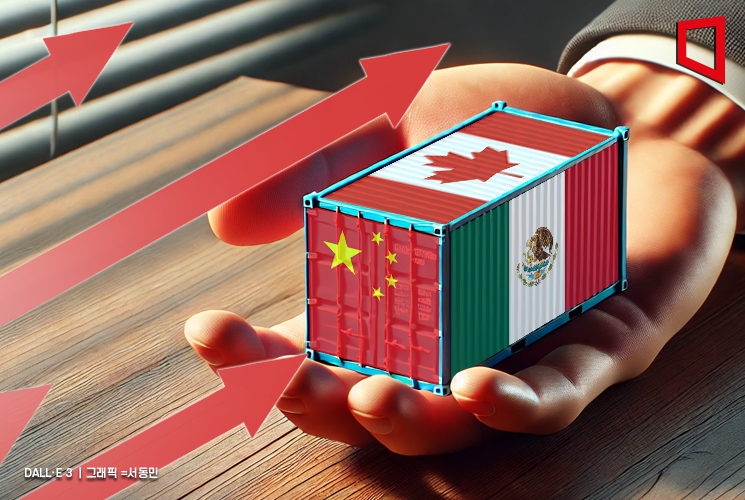
There is a flood of analysis suggesting that President-elect Donald Trump's plan to impose tariffs on Mexico, Canada, and China could exacerbate inflation in the United States.
According to foreign media on the 26th (local time), Trump announced the day before that he intends to impose a 25% tariff on Mexico and Canada and a 10% tariff on China. Investment bank (IB) Goldman Sachs analyzed that if such measures are implemented, they could trigger inflation in the U.S. Goldman Sachs' Chief Economist Jan Hatzius stated, "Based on experience, every 1 percentage point increase in the effective tariff rate raises core Personal Consumption Expenditures (PCE), excluding volatile energy and food prices, by 0.1%," and added, "If the tariff pledges are realized, core PCE could rise by 0.9%."
Trump is also reportedly planning to impose tariffs on crude oil without exception. About 40% of U.S. crude oil is imported, of which 60% comes from Canada. Goldman Sachs' Head of Commodity Research Daan Struyven predicted, "Especially tariffs on Canada will raise U.S. fuel prices, increasing the burden on American consumers."
There are also forecasts that prices of groceries and alcoholic beverages could rise. Mexico and Canada are key suppliers of agricultural products to the U.S. Last year, the scale of agricultural exports from the two countries to the U.S. reached $86 billion (approximately 120 trillion KRW). In Mexico's case, it accounts for two-thirds of U.S. vegetable imports and about half of fruit and nut imports. Exports of Mexican alcoholic beverages such as tequila and mezcal to the U.S. amounted to $4.66 billion (about 6.5 trillion KRW) last year, an increase of about 160% compared to 2019.
Prices of imported automobiles could also rise significantly. Wolfe Research stated that about 4 million cars enter the U.S. annually from Mexico and Canada, and if the U.S. imposes a 25% tariff on the two countries, the average price of imported vehicles could increase by about $3,000 (approximately 4.2 million KRW). As a result, it is analyzed that demand for about 1 million vehicles, roughly 6% of this year's U.S. light vehicle sales forecast, could disappear.
The Wall Street Journal (WSJ) reported concerns about price increases across all sectors. Yale University's Budget Research Institute estimated that considering Trump's tariff policy on the three countries and the possibility of retaliatory tariffs, U.S. consumer prices could rise by 0.75% next year. WSJ stated, "If retaliatory tariffs of up to 60% on Chinese goods are added, inflation will worsen further," and "this will be a factor causing the Federal Reserve (Fed) to maintain interest rates higher than expected next year."
Bloomberg News forecasted that Trump's tariff policy could be used as a bargaining chip because the drawbacks may outweigh the benefits.
© The Asia Business Daily(www.asiae.co.kr). All rights reserved.
![Clutching a Stolen Dior Bag, Saying "I Hate Being Poor but Real"... The Grotesque Con of a "Human Knockoff" [Slate]](https://cwcontent.asiae.co.kr/asiaresize/183/2026021902243444107_1771435474.jpg)















