Comprehensive Plan for Secondary Fine Dust Management Confirmed
Annual Average Concentration of PM2.5 to Reach 13㎍/㎥ by 2029
Early Vehicle Retirement Grades Reduced from 5 to 4, Brake Dust Also Managed
Prime Minister Han Deok-su: "Clean Air is National Competitiveness"
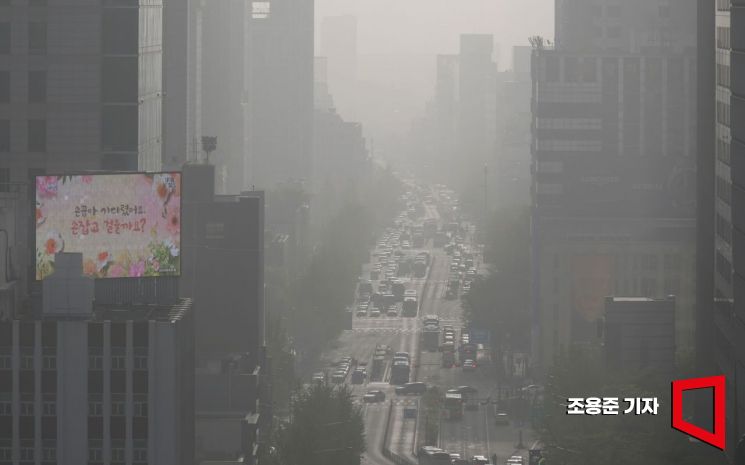
The government plans to reduce fine dust (PM2.5) concentrations by more than 27% within five years compared to 2021 levels. To achieve this, it will reduce the total allowable emissions from workplaces and additionally shut down aging coal-fired power plants.
On the 27th, Prime Minister Han Duck-soo chaired the 14th Special Committee on Fine Dust at the Government Seoul Office and reviewed and finalized the "2nd Comprehensive Fine Dust Management Plan." This plan will be implemented over five years starting next year. The goal is to lower the national annual average concentration of fine dust to below 13㎍/㎥ by 2029. This corresponds to a mid-level among OECD countries and requires a reduction of more than 27% compared to 2021 (18㎍/㎥).
The measures consist of 83 detailed tasks across five key areas: reduction of major emission sources, management of pollution sources around daily life, health protection, scientific policy foundation, and international cooperation. First, regulations on the total allowable emissions from workplaces within air management zones will be strengthened. During the 1st plan (2020?2024), the government expanded the total allowable emissions system, which was only applied in the metropolitan area, to all air management zones. In the 2nd plan, the total emissions from workplaces will be gradually restricted to the point where emissions are not allowed at all. Specific total limits will be presented later in the "Basic Plan for Air Environment Management by Zone."
Additionally, 18 aging coal-fired power plants that have been in operation for over 30 years will be shut down, which is three times more than the plan announced in the 1st comprehensive plan. The shutdown of coal power plants will be finalized according to the 11th Basic Plan for Electricity Supply and Demand. To minimize air impact during fuel and raw material transitions, technology development such as mixed combustion power generation using carbon-free fuels will also be promoted.
Early Vehicle Retirement Expanded from Grade 5 to 4, Management of Tire and Brake Wear Dust
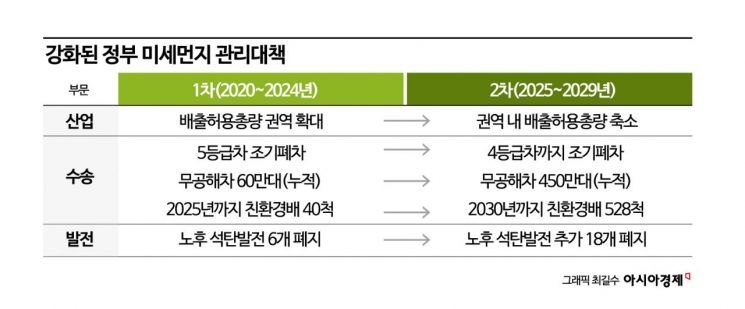
Strengthened dust reduction targets will also apply to the transportation sector. The supply of zero-emission vehicles will expand from 600,000 cumulative units last year to 4.5 million units by 2030. Especially considering research that heavier electric vehicles generate more dust from tire and brake wear, a management framework for "non-exhaust pollutants" will be established. The early vehicle retirement policy, which previously applied only to grade 5 vehicles, has been expanded to include grade 4 vehicles starting this year. For eco-friendly ships, the supply plan will increase from 40 vessels next year to 528 vessels by 2030.
To enhance the public’s perception of improved air quality, technical inspections, facility improvements, and follow-up management of dust prevention facilities will be conducted for workplaces located in residential areas. The government plans to support a total of 12 industrial complex areas and 1,200 workplaces by 2029. Air purification equipment installation will be supported in underground stations with high passenger traffic, and reduction equipment will be provided in places with heavy cooking fumes such as school cafeterias and direct-fire barbecue restaurants. A joint public-private intensive management system will be established in areas with high emissions of volatile organic compounds, known as major contributors to fine dust formation.
On the same day, the government also reviewed the "6th Seasonal Fine Dust Management Implementation Plan." This plan involves further reducing and managing air pollutant emissions during the high fine dust season from December to March, aiming to reduce fine dust and its precursors by 112,000 tons. Starting next month, fine dust reduction measures will be implemented at 407 large workplaces nationwide. Up to 15 coal-fired power plants will be shut down, and the output of up to 46 plants will be limited to 80%. Grade 5 emission vehicles will be restricted from operating in the metropolitan area and six major special/metropolitan cities. The high-concentration fine dust forecast period will be extended from 12 hours to 36 hours in advance.
Prime Minister Han said, "Clean air quality is not only essential for public health and improving quality of life but also a key source of national competitiveness in tourism and industrial production," adding, "Let us create blue skies free from fine dust worries."
© The Asia Business Daily(www.asiae.co.kr). All rights reserved.
![Clutching a Stolen Dior Bag, Saying "I Hate Being Poor but Real"... The Grotesque Con of a "Human Knockoff" [Slate]](https://cwcontent.asiae.co.kr/asiaresize/183/2026021902243444107_1771435474.jpg)
















