Possibility of USMCA Renegotiation Observed During First Term in Power
President-elect of the United States Donald Trump has called for overturning the trade agreement made with Mexico and Canada and imposing a 25% tariff on products from these countries.
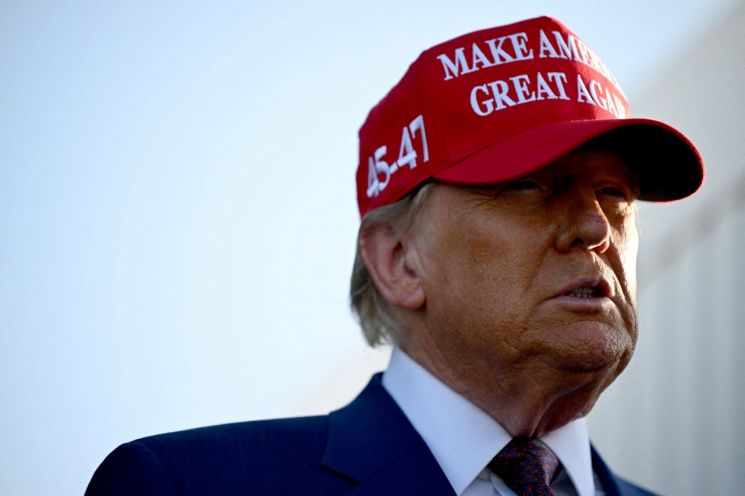
According to major foreign media, on the 25th (local time), President-elect Trump's call for tariffs was reported to violate the United States-Mexico-Canada Agreement (USMCA). President-elect Trump intends to scrap the agreement during his first term and alter the newly established agreement.
The USMCA was signed at the end of November 2018 during the first term of the Trump administration and came into effect in January 2020. At that time, it replaced the North American Free Trade Agreement (NAFTA), which was considered unfavorable to the United States. The USMCA, a successor to NAFTA signed in 1994, includes stronger regulations and provisions but ensures that goods traded among the three North American countries?the United States, Mexico, and Canada?are not subject to tariffs.
According to The Washington Post (WP), John Veroneau, who participated in trade negotiations during the George W. Bush administration, pointed out that this tariff policy could violate the USMCA. Veroneau stated, "Unilaterally imposing a 25% tariff on all trade would ruin the USMCA."
Veroneau explained, "All countries affected by President-elect Trump's plan could retaliate by imposing tariffs on American goods, which would harm U.S. exporters."
The Wall Street Journal (WSJ) also evaluated this by saying, "It will overturn the USMCA negotiated during President-elect Trump's first term."
During his first presidential campaign, President-elect Trump criticized NAFTA for increasing the U.S. trade deficit. Consequently, during his first term, he replaced it with the USMCA.
When the USMCA came into effect in January 2020, President-elect Trump said, "The USMCA is the fairest, most balanced, and most beneficial trade agreement."
The USMCA requires a review of the agreement's implementation every six years, with the first review scheduled for 2026.
Before the election, in October, President-elect Trump also stated in Detroit, Michigan, "Upon taking office, I will invoke the six-year renegotiation clause of the USMCA."
The British Guardian described President-elect Trump's remarks as a "trailer for future trade wars."
Alex Lu of Canadian investment bank TD Securities predicted, "Although the USMCA agreement can only enter renegotiation in 2026, President-elect Trump's announcement greatly increases the likelihood of initiating the agreement renewal process with Canada and Mexico."
Wendy Cutler, former Deputy U.S. Trade Representative and Vice President of the Asia Society Policy Institute (ASPI), assessed, "Since Mexico and Canada still heavily depend on the U.S. market, their ability to escape President-elect Trump's threats is limited."
© The Asia Business Daily(www.asiae.co.kr). All rights reserved.
![Clutching a Stolen Dior Bag, Saying "I Hate Being Poor but Real"... The Grotesque Con of a "Human Knockoff" [Slate]](https://cwcontent.asiae.co.kr/asiaresize/183/2026021902243444107_1771435474.jpg)















