"Not only the exterior walls but also the interior have lacquer graffiti"
Repeated work expected to consume significant time and cost
Recently, as some female university students staged sit-ins against their schools using lacquer spray and other means during protests, an online post detailing a cleaning company's visit to estimate the cost of removing lacquer spray painted inside and outside the campus has attracted attention.
On the 25th, a blog on a major domestic portal site featured a post by Mr. A, who runs a special cleaning and high-pressure washing company in Incheon, titled "Visited to Estimate Lacquer Removal at a Women's University." In the post, he shared his experience visiting a women's university. Mr. A said, "I traveled over three hours round trip to visit the university covered in lacquer graffiti," adding, "As soon as I arrived, I saw graffiti on the outer wall of the main gate."
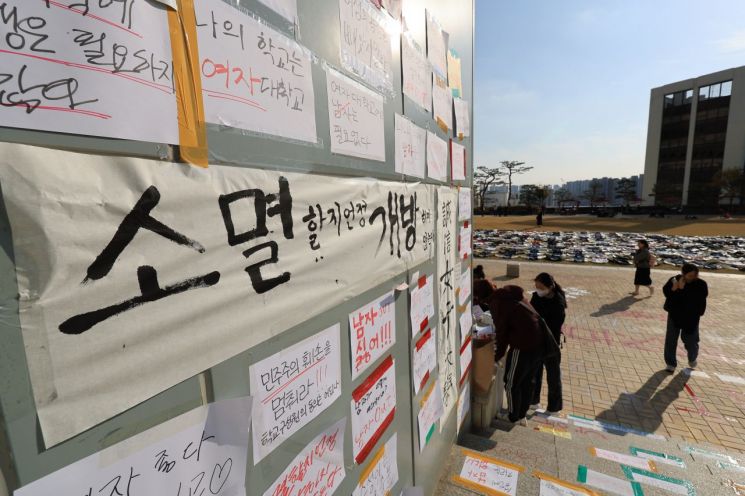 On the afternoon of the 13th, a sign opposing the recruitment of foreign male students for the International Studies Department was posted at Donam Sujeong Campus of Sungshin Women's University in Seongbuk-gu, Seoul. Photo by Yonhap News
He continued, "I was shocked by the wide area covered in graffiti, and even more surprised to find it inside the building as well," noting, "The locations of the graffiti varied, and there were multiple types of lacquer with different chemical compositions." The photos Mr. A attached showed various phrases such as "The owners of the school are the students" and "The owners of the women's university are women" written in multiple colors of lacquer on the exterior of the building as well as on the interior marble floors and walls. The university he visited is known to be Sungshin Women's University.
Mr. A explained, "Removing lacquer from indoor marble surfaces is a complicated process that requires polishing and color matching after removal," adding, "Lacquer removal is a difficult task due to the complex procedures involved, and because it requires repeated work, it takes a lot of time and increases costs." He also shared a detailed review after testing the removal of some lacquer graffiti as a sample.
When Mr. A applied chemicals to some black lacquer graffiti on a stone wall, although a faint dark mark remained, most of the lacquer was removed. He explained, "With high-pressure washing followed by repeated treatments, it can be completely removed." However, the red lacquer painted on stone stairs was not easily removed by chemicals alone. Regarding this, Mr. A said, "There is no reaction to the chemicals. Even though it is the same type of stone, it behaves differently," adding, "The only option is to remove it through repeated treatments."
He particularly noted a heavily damaged part of the stairs, saying, "The step below was not just ground down; when touched, it was deeply gouged, and there are remnants as if someone started carving and then stopped," adding, "When materials are damaged like this, restoration becomes worse than not doing it at all." Some graffiti on the walls appeared to be made with acrylic paint rather than lacquer. Mr. A said, "The color has penetrated, so chemicals alone cannot fix it; marble polishing work must be done as well," adding, "Even this part alone costs a significant amount."
Removal Feasibility Varies Greatly Depending on Lacquer Color and Type
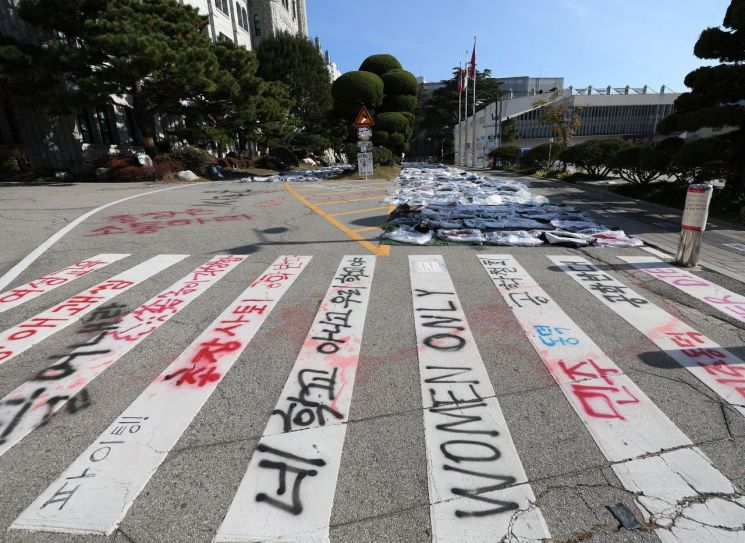 On the 25th, there was graffiti opposing the transition to coeducation on the campus of Dongduk Women's University in Seongbuk-gu, Seoul. Photo by Yonhap News
The ability to remove lacquer varied depending on its color and type. White and blue lacquer were relatively cleanly removed, but red lacquer left stains even after removal. Mr. A said, "If the lacquer residue is left as is after removal, it seeps further inside, and removing that requires two to three times more time," adding, "Although it may seem simple, the process involves many complex steps and is far from easy."
Previously, in December last year, the restoration of the Gyeongbokgung Palace wall damaged by lacquer graffiti cost tens of millions of won just for materials. Excluding the period when work was halted due to severe cold, the graffiti removal took eight days in total. The total manpower calculated by the number of workers and days was 234 person-days, averaging 29.3 workers per day. Renting specialized equipment such as steam cleaners and laser cleaners cost 9.46 million won, and supplies like protective suits, gloves, and work shoes cost 12.07 million won. The cost of materials used solely for removing graffiti traces was 21.53 million won. Among these, Dongduk Women's University, where students have recently staged lacquer spray protests, estimates that damage restoration, including lacquer removal and campus cleaning costs, could reach up to 5.4 billion won.
© The Asia Business Daily(www.asiae.co.kr). All rights reserved.
![Clutching a Stolen Dior Bag, Saying "I Hate Being Poor but Real"... The Grotesque Con of a "Human Knockoff" [Slate]](https://cwcontent.asiae.co.kr/asiaresize/183/2026021902243444107_1771435474.jpg)
















