The National Assembly's Science, Technology, Information and Broadcasting Communications Committee (STIBC) has passed the AI Basic Act, the bill to abolish the Act on the Distribution Structure of Mobile Communication Terminals (DanTong Act), and the Digital Inclusion Act through bipartisan agreement.
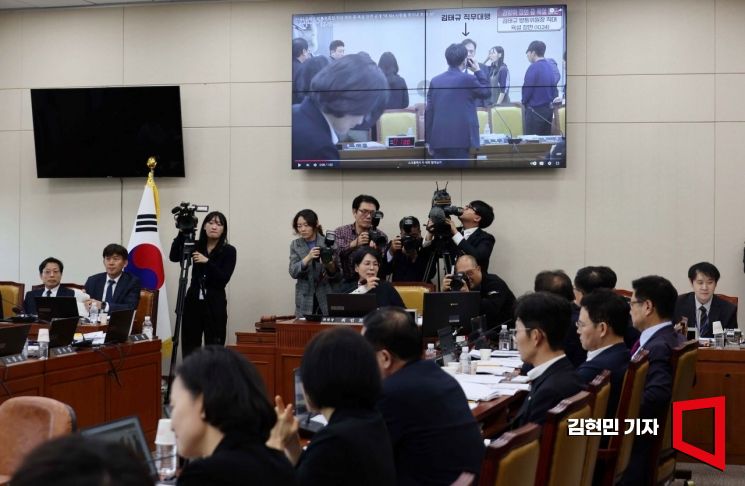 Chairperson Choi Min-hee of the National Assembly Science, Technology, Information and Broadcasting and Communications Committee is watching the footage from the time before filing a complaint against Acting Chairman Kim Tae-gyu of the Korea Communications Commission for contempt of the National Assembly, after a MBC employee collapsed during the comprehensive audit of the Broadcasting and Communications Commission and related agencies held at the National Assembly on the 24th, alleging he cursed, "XX, killing everyone." Photo by Kim Hyun-min
On the 26th, the STIBC held a plenary session in Yeouido, Seoul, and approved the AI Basic Act and the bill to abolish the DanTong Act through bipartisan agreement. The bills are expected to be submitted to and passed by the plenary session as early as the 28th.
The AI Basic Act stipulates the basis and standards for supporting the AI industry. The Ministry of Science and ICT must establish a "Basic AI Plan" every three years through the resolution of the president-led "National AI Committee." The basic plan includes AI policy directions and plans for fostering experts. Additionally, the AI Basic Act defines AI systems that significantly affect or pose risks to human life, physical safety, or fundamental rights as "high-impact AI." Businesses providing services using high-impact AI or generative AI must disclose the use of AI through watermarks or other means.
The bill to abolish the DanTong Act focuses on eliminating the public subsidy system for mobile communication terminals and the cap on additional subsidies. The selective contract discount system will be maintained under the Telecommunications Business Act. However, discrimination in subsidy payments based on users' residential area, age, or physical conditions is prohibited.
The Digital Inclusion Act aims to establish a legal and institutional framework to ensure that all citizens can enjoy the benefits of information technology without discrimination or exclusion. Furthermore, the government must establish a basic plan related to digital inclusion every three years. The Digital Inclusion Act was created to narrow the growing information gap amid the advent of the Fourth Industrial Revolution.
© The Asia Business Daily(www.asiae.co.kr). All rights reserved.

















