Negotiation Committee of the Plastic International Agreement on the 25th
Direct Regulation of Plastic Production Substances as a Key Issue
Oil-Producing Countries Strongly Resist Production Regulations
Kim Wan-seop, Minister of Environment, stated that it is practically difficult to present specific production reduction targets in the international agreement related to plastics. Although the adoption of the discussion agenda was narrowly successful, opposition remains strong, especially from oil-producing countries.
On the 25th, Minister Kim told reporters at the 5th Intergovernmental Negotiating Committee (INC-5) for the Development of an International Legally Binding Instrument on Plastic Pollution, held at BEXCO in Suyeong-gu, Busan, “Even if the agreement is finalized, the likelihood of numerical targets being included is low.”
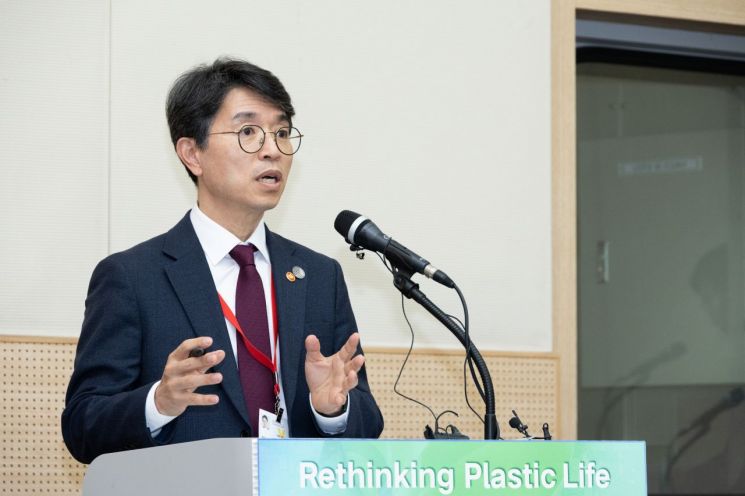 Kim Wan-seop, Minister of Environment, is holding a press conference at the 5th Intergovernmental Negotiating Committee (INC-5) for the establishment of an international agreement to end plastic pollution, currently underway at BEXCO in Suyeong-gu, Busan on the 25th. Photo by Ministry of Environment
INC-5 is a forum for discussing an international agreement related to plastic pollution. There have been four meetings so far, and the meeting held in Busan until the 1st of next month is the last one. The European Union (EU) supports a strong agreement that directly regulates plastic polymers, the production substances, but oil-producing countries oppose this, advocating instead for increasing recycling rates. This has raised concerns about whether a meaningful agreement can be reached around INC-5.
Minister Kim explained, “If there are countries insisting on negotiating with reduction numbers, realistically it will be difficult to reach an agreement,” adding, “It’s not about right or wrong, but because the positions are firmly opposed, it is not easy to proceed that way.” He further stated, “Since the probability of numerical targets coming out is low, we will manage the entire lifecycle of plastics as much as we can.”
While reducing plastic production is the path to take, considering the negotiation atmosphere, it is expected to be difficult.
By around 5 p.m. that day, INC-5 member countries had not yet agreed on which documents to discuss. INC had produced a 77-page report through the previous four meetings, but there are about 3,000 points of disagreement. Chair Luis Bayas Balvidieso created a final proposal, but it faced many objections. The proposal included discussions on production reduction, which caused strong backlash from oil-producing countries.
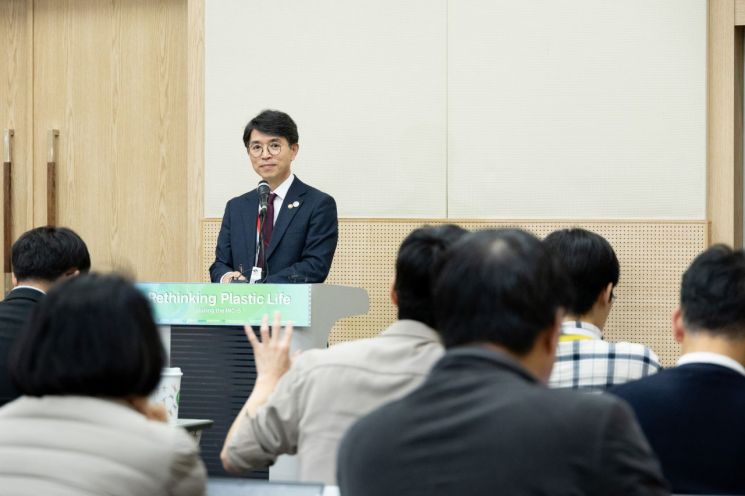 Kim Wan-seop, Minister of Environment, is holding a press conference at the 5th Intergovernmental Negotiating Committee (INC-5) for the establishment of an international agreement to end plastic pollution, currently underway at BEXCO in Suyeong-gu, Busan on the 25th. Photo by Ministry of Environment
Minister Kim said, “After the opening ceremony at 10 a.m., during the meeting until 1 p.m., there was no consensus even on discussing the chair’s proposal,” adding, “Some countries want to discuss both the 77-page report and the chair’s proposal. The current situation is a tense standoff.”
Currently, the chair’s proposed non-paper (informal document) has been adopted as an agenda item, and negotiations have begun.
Although negotiations have started, if opposition to reduction targets intensifies, the Korean government’s position is that it will be difficult to propose specific numbers. Since it is practically difficult to immediately agree on how much to reduce by when, Minister Kim’s view is to move toward indirect regulation methods such as increasing the population ratio using recycled raw materials or reducing the content or thickness of PET bottles. Regarding production and consumption, he said, “We plan to reduce them through support measures encouraging more refills and greater use of reusable containers.”
Along with this, to prepare an effective agreement, the Korean government is proposing various mediation measures. This includes a so-called phased approach that starts by reducing harmful or unnecessary plastics. To this end, the Ministry of Environment proposed an “annex” listing unnecessary plastics to the United Nations Environment Programme (UNEP). This document would first define unnecessary plastics and later regulate or eliminate those products and substances as an alternative.
Meanwhile, separate from the agreement, the Ministry of Environment announced it will continue its own efforts to reduce plastics. Minister Kim introduced, “We submitted an international plastics project to the National Assembly and agreed with the Ministry of Economy and Finance and the National Assembly to increase the budget,” adding, “We will secure 5 billion KRW annually to spread Korea’s advanced waste tracking and management system to other countries.” He also said, “We are considering policies that can support developing countries in parallel with private funds and enable business cooperation.”
© The Asia Business Daily(www.asiae.co.kr). All rights reserved.
![Clutching a Stolen Dior Bag, Saying "I Hate Being Poor but Real"... The Grotesque Con of a "Human Knockoff" [Slate]](https://cwcontent.asiae.co.kr/asiaresize/183/2026021902243444107_1771435474.jpg)
















