Lee Jae-myung, leader of the Democratic Party of Korea, who was indicted without detention on charges of suborning perjury, was acquitted in the first trial.
On the 15th, Lee, who was in crisis after being sentenced to lose his parliamentary seat in the first trial for violating the Public Official Election Act, was able to breathe a sigh of relief. With the acquittal announced that day, voices from the Democratic Party and Lee's supporters blaming the judicial risk surrounding Lee on the prosecution's targeted investigation are expected to grow louder.
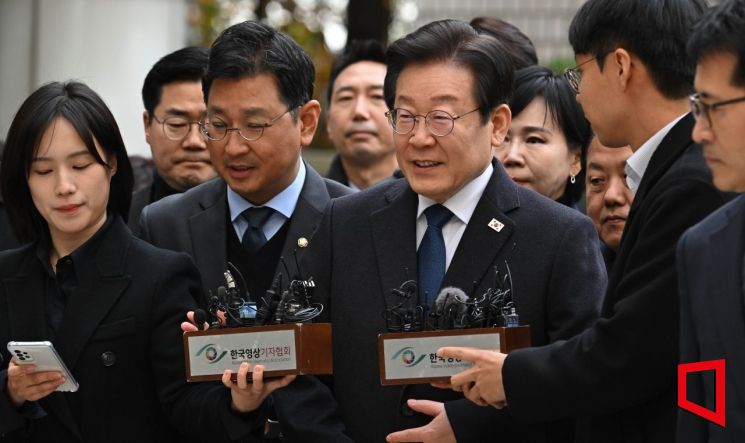 Lee Jae-myung, leader of the Democratic Party of Korea, is attending the first trial sentencing hearing on perjury instruction charges held at the Seoul Central District Court in Seocho-gu, Seoul on the 25th. Photo by Joint Press Corps
On the 25th, at the first trial sentencing hearing of Lee Jae-myung, leader of the Democratic Party of Korea, held at the Seoul Central District Court Criminal Division 33 (Presiding Judge Kim Dong-hyun), the court judged all charges against Lee to be not guilty and acquitted him. The court recognized the guilt of Kim Jin-sung, a former secretary to the late Kim Byung-ryang, former mayor of Seongnam, who was jointly indicted on charges of perjury for testifying as a witness in Lee's trial, and sentenced him to a fine of 5 million won.
The court stated, "It is difficult to consider the phone calls on December 22 and December 24, 2018, and the delivery of the brief of argument as suborning perjury, and it cannot be seen that the defendant Lee Jae-myung had the intent to suborn."
Furthermore, the court judged, "Even if defendant Kim Jin-sung wrote a statement and had phone calls and meetings with lawyer Shin before testifying in this case, these circumstances alone cannot be seen as defendant Lee Jae-myung having suborned Kim Jin-sung to commit perjury related to this testimony."
Finally, the court concluded, "Even when considering Kim Jin-sung's first to sixth testimonies individually, it cannot be concluded that defendant Lee Jae-myung suborned perjury."
The court explained, "Regarding the phone call on December 22, 2018, considering the overall content of the conversation, the flow of context, and the general circumstances, the manner of requesting testimony during the call is not significantly different from the usual way of requesting testimony, which involves mentioning what testimony the requester needs and confirming what the witness remembers or knows. Therefore, mentioning the testimony needed does not equate to demanding perjury."
On the other hand, the court found that among the six counts of perjury charges against defendant Kim Jin-sung, the parts related to testimony about the atmosphere within Kim Byung-ryang's election camp and the testimony related to the withdrawal of Choi Cheol-ho's accusation lacked proof of crime, but the remaining testimonies were proven to be criminal, thus ruling four out of six charges as guilty.
Lee was indicted in October last year on charges of suborning perjury, accused of calling Kim Jin-sung during his trial for violating the Public Official Election Act (false statement) in December 2018 and asking him to testify falsely in his favor as a witness.
At that time, Lee was on trial for allegedly making false statements during a TV debate as a candidate for governor of Gyeonggi Province in May 2018, claiming that he was "falsely accused" in the 'prosecutor impersonation case.'
The prosecutor impersonation case involved Lee, who was a lawyer in 2002, allegedly conspiring with PD Choi Cheol-ho of KBS's 'Chujeok 60 Minutes' to impersonate a prosecutor during a phone call to then-mayor Kim Byung-ryang at Lee's office in Seongnam, providing the name of the prosecutor to impersonate and questions to ask. Lee was prosecuted for this.
Lee was convicted of impersonating a public official in this case and was fined 1.5 million won by the Supreme Court in 2004.
However, on May 29, 2018, during the '2018 Local Election Gyeonggi Governor Candidate KBS Invitational Debate,' Lee responded to questions from competing candidates about the prosecutor impersonation by saying, "I did not do it; the PD impersonated, and I was just being interviewed nearby, so I was falsely accused of helping," and "I never impersonated a prosecutor. I was falsely accused of helping because I was being interviewed next to the PD who did it."
The prosecution judged that Lee's statement claiming he was falsely accused in a case where guilt was already confirmed by the Supreme Court was a false statement that could influence the election, and on December 11, 2018, indicted Lee without detention on charges of false statement under the Public Official Election Act. The prosecution's view was that Lee conspired to impersonate a prosecutor by providing the name and questions to impersonate to Mr. Choi, was criminally punished for it, yet falsely claimed he was not involved in the prosecutor impersonation case.
The prosecution judged that Kim Jin-sung, who was a secretary to former Mayor Kim, along with Kim In-seop, former CEO of Korea Housing Technology, received money in exchange for facilitating permits related to the Baekhyeon-dong development project and, while assisting CEO Jung Ba-ul with the Baekhyeon-dong project, was repeatedly asked by Lee around December 2018 via phone calls to testify that there was an agreement or atmosphere to withdraw the accusation against Mr. Choi to frame Lee as the main culprit between Kim Byung-ryang and KBS during the prosecutor impersonation case. Kim In-seop, known as a close aide to Lee, acted as a lobbyist for Baekhyeon-dong.
Kim Jin-sung, who received such a request from Lee, testified as a witness on February 14, 2019, at the Suwon District Court Seongnam Branch during Lee's trial for violating the Public Official Election Act, took the witness oath, and despite not knowing or remembering whether such an agreement or atmosphere existed, testified to the effect that there was an agreement or atmosphere to withdraw the accusation against Mr. Choi to frame Lee as the main culprit between Kim Byung-ryang and KBS during the prosecutor impersonation case. This is the criminal fact stated in the prosecution's indictment against Kim. Lee was acquitted in that trial where Kim testified, maintaining his position as governor of Gyeonggi Province and enabling him to run for president.
The prosecution indicted Kim on perjury charges and Lee on suborning perjury charges in October last year.
Kim admitted both to the prosecution and in court that he committed perjury at Lee's request. Also, a voice recording of the phone call between Kim and Lee at the time was submitted as evidence.
Among the recorded calls, Lee is heard telling Kim, "Please tell it as it is," and "I'm not asking you to reconstruct the case." Lee has argued that this shows he did not ask Kim to give false testimony. However, legal experts have analyzed that Lee, as a legal professional, may have consciously made these statements considering the possibility of the call being recorded.
In the call, Lee's request for Kim to make statements with a specific intent when Kim said he did not remember well can be clearly seen as suborning perjury. Moreover, evidence that Lee sent Kim a brief of argument before the testimony to practice desired answers to expected questions has emerged, making it difficult for Lee to escape the charges.
Last September, Judge Yoo Chang-hoon, who dismissed the arrest warrant for Lee, stated that the perjury suborning charges appeared to be substantiated. Also, even before the sentencing for the Public Official Election Act violation, Lee repeatedly posted on his Facebook claiming innocence and calling the case a "failed suborning," which can be seen as Lee himself considering the possibility of guilt in this case to be high.
Unlike the Public Official Election Act violation charges, even if Lee is found guilty of suborning perjury and fined, he can retain his parliamentary seat. However, if Lee is sentenced to imprisonment for suborning perjury (which does not have a prison sentence with labor), he will lose his parliamentary seat and be disqualified from running for office until the sentence is extinguished. According to the Act on the Execution and Exemption of Sentences, imprisonment exceeding three years is extinguished 10 years after completion or exemption of the sentence, and imprisonment of three years or less is extinguished after five years.
At around 1:48 p.m. on the day, Lee arrived at the Seoul Central District Court in Seocho-dong, Seoul, greeted Democratic Party lawmakers waiting, but did not answer any questions from reporters such as "How do you expect the verdict?" or "What is your position on the intent to commit perjury?" and entered the courthouse.
After being acquitted and leaving the courthouse, Lee said, "I thank the court for restoring truth and justice," adding, "The process was truly difficult and long, but like a grain of sand in the vast ocean, the difficulties I face are insignificant compared to the hardships and pain our people endure."
He continued, "I will continue to do my best for the better lives of our people, and I hope politics will no longer be about killing and trampling each other but about coexistence and moving forward together. I want to tell the government and ruling party, 'Let's do politics that saves people rather than politics that kills.'"
© The Asia Business Daily(www.asiae.co.kr). All rights reserved.
![Clutching a Stolen Dior Bag, Saying "I Hate Being Poor but Real"... The Grotesque Con of a "Human Knockoff" [Slate]](https://cwcontent.asiae.co.kr/asiaresize/183/2026021902243444107_1771435474.jpg)















