Additional Transplantation After Initial 50,000 Plants Last Year
Expecting Colony Size Equivalent to 15 Soccer Fields by 2026
LG Chem announced on the 25th that it has transplanted 20,000 Zalpi seaweed plants, one of the three major blue carbons, into the sea in front of Daegyeongdo, Yeosu, Jeollanam-do. Following last year's first phase transplantation of 50,000 plants, the company plans to continue habitat restoration and biodiversity research projects, aiming to create sustainable growth for future generations.
With this additional transplantation carried out in collaboration with climate tech startup ThanksCarbon, the Zalpi colony area is expected to expand to the size of 15 soccer fields (10.0ha) by 2026 through natural growth. Previously, the Zalpi colony transplanted at Daegyeongdo last year expanded from 42.7ha to 45.5ha as of June this year. This increase in area is equivalent to the size of 4 soccer fields.
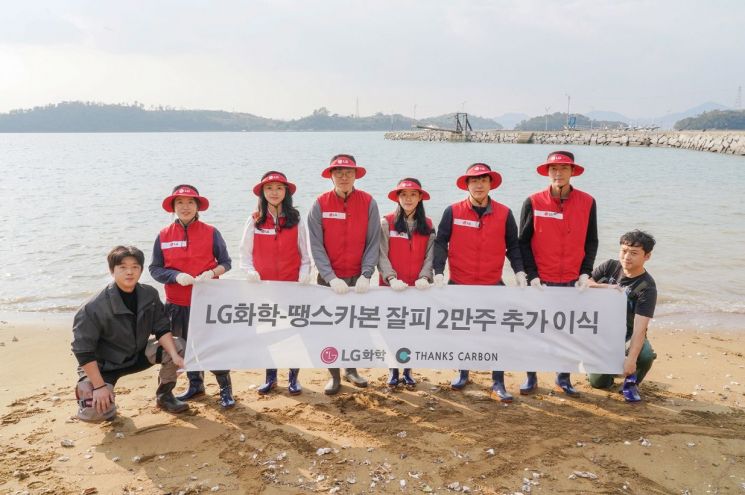 LG Chem employees and Korea Fisheries Resources Agency staff are taking a commemorative photo after planting an additional 20,000 Zostera marina shoots in the sea off Daegyeongdo, Yeosu. (Photo by LG Chem)
Zalpi is one of the three major blue carbons officially recognized by the United Nations Intergovernmental Panel on Climate Change (IPCC), along with mangrove forests and salt marshes. It is a type of seaweed that blooms underwater, serving as a habitat for marine life and an underwater carbon sink. It is known to absorb carbon 50 times faster and store carbon more than 5 times better than terrestrial carbon sinks, known as green carbon.
In this regard, LG Chem and ThanksCarbon have launched "BLUE FOREST," a space on the metaverse platform Zepeto where anyone can easily create their own sea forest. Since its opening in June last year, BLUE FOREST has attracted over 4 million visitors worldwide, raising awareness about the importance of Zalpi and marine ecosystem conservation.
© The Asia Business Daily(www.asiae.co.kr). All rights reserved.
![Clutching a Stolen Dior Bag, Saying "I Hate Being Poor but Real"... The Grotesque Con of a "Human Knockoff" [Slate]](https://cwcontent.asiae.co.kr/asiaresize/183/2026021902243444107_1771435474.jpg)















