On the 21st, the Science and ICT Committee's Bill Subcommittee Added Investigation Authority Clause
Sanctions on 'Prohibited AI' Omitted... "Questioning Whether It Was Sufficiently Discussed"
The National Assembly's Science, Technology, Information and Broadcasting and Communications Committee (STIBC) has been criticized for 'hasty processing' as it passes laws without thorough discussion on contentious issues such as the Basic Artificial Intelligence Act (AI Basic Act). However, some lawmakers' offices have expressed complaints that due to the continuous hearings and plenary sessions, they are overloaded and unable to carefully review policies.
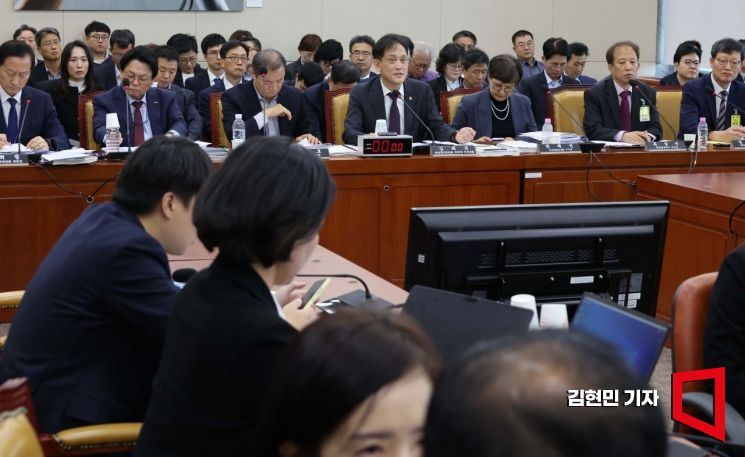 Kim Tae-gyu, Acting Chairman of the Korea Communications Commission, is responding to questions from lawmakers during the National Assembly's audit of the Korea Communications Commission held by the Science, Technology, Information and Broadcasting and Communications Committee on the 24th. Photo by Kim Hyun-min
According to a comprehensive report by Asia Economy on the 25th, at the STIBC's Bill Subcommittee meeting held on the 21st, the Ministry of Science and ICT (MSIT) added Article 40, which grants the MSIT Minister the authority to conduct fact-finding investigations on AI operators. According to this article, MSIT officials can enter AI offices and investigate ledgers and documents. The MSIT explained to lawmakers that this was for investigations in case of issues such as deepfake crimes. Although this legal provision was added on the day of the meeting, it is reported that lawmakers passed it without much discussion. The STIBC meeting started at 10 a.m. and adjourned after five hours. The bills approved by the STIBC Bill Subcommittee after discussion included the highly contentious AI Basic Act, the Act on the Improvement of Distribution Structure of Mobile Communication Devices (Mobile Device Distribution Act), and the Digital Inclusion Act.
Regarding this, there have been multiple criticisms that the AI Basic Act was hastily processed by the STIBC Bill Subcommittee. It is known that before processing the AI Basic Act, ruling and opposition lawmakers held only one related discussion on September 3. The reason why there are remarks within the STIBC such as "We did not expect it to be processed immediately" is due to the sudden approval of the AI Basic Act by the Bill Subcommittee. Concerns about the provision granting the government fact-finding authority also arise in the same context. A staff member of a lawmaker from the STIBC, who requested anonymity, said, "The state has gained the authority to arbitrarily investigate companies whenever it wants," adding, "This is a very strong regulation that contradicts the purpose of the AI Basic Act, which is to promote the AI-related industry, but there was no discussion."
On the other hand, civic groups criticize the National Assembly for failing to establish safeguards against the harms AI could bring to society. They argue that the omission of sanctions against 'prohibited AI'?AI technologies and products that harm human dignity, peace, and safety?in the AI Basic Act is an abdication of the National Assembly's responsibility. On the 22nd, the People's Solidarity for Participatory Democracy (PSPD) stated in a press release, "It is questionable whether sufficient discussion was possible with only one or two non-transparent reviews while drafting the legislation," adding, "During the 21st National Assembly's discussions, the only actions were the chairman's declaration to table the agenda and a few rounds of Q&A."
The AI Basic Act was proposed due to the growing necessity alongside the advancement of AI technology. Since AI is a technology applicable across various fields and its development direction is unpredictable, regulatory management is necessary. However, compared to other countries that have enacted AI-related laws, the deliberation process has been short. The European Union (EU) finalized the AI Act in May and has been enforcing it since this month. The law underwent a lengthy deliberation process. After the European Commission first proposed the AI Act in April 2021, the European Parliament amended the law whenever related issues such as ChatGPT arose. The European Commission, the Council of the EU, and the European Parliament held six months of consultations and reached a political agreement in December last year.
There are also criticisms that the STIBC is overloaded and struggling to conduct proper legislative discussions. Before the STIBC Bill Subcommittee meeting, from the 18th to the 20th, the STIBC held a confirmation hearing for Park Jang-beom, the KBS president nominee. It is known that some lawmakers' offices prepared for the Bill Subcommittee meeting overnight only after completing the hearing for the nominee. A staff member who requested anonymity, referred to as B, said, "Since the STIBC deals with issues such as the fairness of broadcasting through the Korea Communications Commission and the Korea Communications Standards Commission, political conflicts easily arise," adding, "The policy agenda is sidelined in such an environment."
© The Asia Business Daily(www.asiae.co.kr). All rights reserved.
![Clutching a Stolen Dior Bag, Saying "I Hate Being Poor but Real"... The Grotesque Con of a "Human Knockoff" [Slate]](https://cwcontent.asiae.co.kr/asiaresize/183/2026021902243444107_1771435474.jpg)















