Jincheon Megapolis Industrial Complex Secures Over 440,000 Pyeong... Expecting Large-Scale Investment Attraction
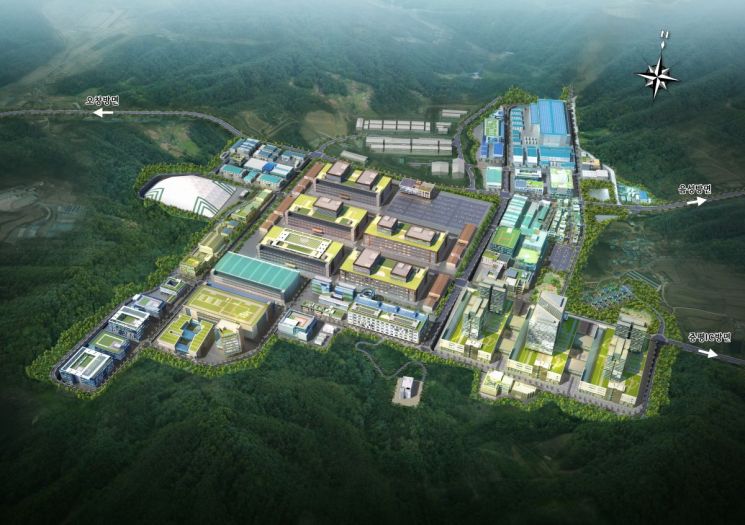 [Wide aerial view of Jincheon Megapolis Industrial Complex / Provided by Jincheon Megapolis Development Co., Ltd.]
Until now, South Korea has designated and operated economic free zones, enterprise cities, and industries to revitalize regional economies, and has provided local tax reductions to promote the relocation of companies to provincial areas. Nevertheless, as the concentration of population and economy in the Seoul metropolitan area intensified, the gap has widened further, leading to the current brink of regional extinction. In response, our government enacted the Special Act on Local Autonomy and Regional Balanced Development in 2023 and introduced Opportunity Development Zones.
Opportunity Development Zones are policies introduced to provide various benefits such as tax incentives, deregulation, and improvement of settlement conditions to companies relocating to or starting businesses in provincial areas, based on the judgment that it is difficult to overcome structural crises such as low birth rates, aging population, and regional extinction in the current Seoul metropolitan area, where about 12% of the land houses half of the population.
The core of the policy is for local governments to leverage their comparative advantages to promote development strategies, with strong support from the central government. It is also characterized by enabling rapid administrative processing by local governments to maximize corporate attraction, investment, and operational efficiency by strengthening local government autonomy.
As seen in the U.S. Opportunity Zones tax incentives and Japan’s National Strategic Special Zones tax incentives, regional balanced development is a common challenge for countries living in the modern industrial era.
The corporate inheritance deduction target for companies relocating to Opportunity Development Zones has been expanded from annual sales under 500 billion KRW to under 1 trillion KRW. The deduction limit has also increased from a maximum of 60 billion KRW to 100 billion KRW.
Businesses newly established or started within Opportunity Development Zones are exempt from corporate tax for five years, and thereafter receive a 50% reduction for two years. Property tax on business-use real estate for these startups or new businesses is also fully exempted for five years and then reduced by 50% for an additional five years.
The Ministry of Trade, Industry and Energy announced on the 6th that it has designated and publicly notified Opportunity Development Zones in six provinces: Ulsan, Sejong, Gwangju, Chungnam, Chungbuk, and Gangwon. Following the first designation in June for eight provinces?Daegu, Busan, Jeonnam, Gyeongbuk, Jeonbuk, Gyeongnam, Daejeon, and Jeju?the second designation has increased the total number of non-metropolitan provinces designated as Opportunity Development Zones to 14.
In Chungcheongbuk-do, a total of 1,096,000 pyeong (approximately 3.62 million square meters) in the Jecheon, Boeun, Eumseong, and Jincheon areas were selected, attracting companies related to advanced industries such as semiconductors and secondary battery materials, as well as food and automobile parts. This designation is expected to promote mutual development and the formation of industrial clusters among the four regions and neighboring cities and counties, thereby generating ripple effects such as population inflow.
The Jincheon district’s Jincheon Megapolis Industrial Complex, which is drawing attention, is planned to be developed on about 400,000 pyeong (approximately 1.32 million square meters) to connect with the secondary battery materials, parts, and equipment and national advanced strategic industry specialized complex located in Ochang, Cheongju. With this Opportunity Development Zone designation, Jincheon Megapolis is expected to grow into a new mecca in the semiconductor and secondary battery fields, attracting attention not only in South Korea but worldwide.
Meanwhile, the Ministry of Trade, Industry and Energy reported that about 150 companies in the newly designated six provinces’ Opportunity Development Zones plan approximately 16.4 trillion KRW in new investments. The path to survival lies not in regional extinction due to concentration in the metropolitan area but in balanced national development and coexistence. This is also a promising aspect of the future of Opportunity Development Zones.
Detailed information about the Jincheon Megapolis Industrial Complex can be found on the official website.
© The Asia Business Daily(www.asiae.co.kr). All rights reserved.

















