Uijeongbu City, Gyeonggi Province (Mayor Kim Dong-geun) announced on the 25th that it submitted the next year's budget proposal to the city council on the 21st, totaling 1.4833 trillion won, an increase of 7.7% (106.4 billion won) compared to this year.
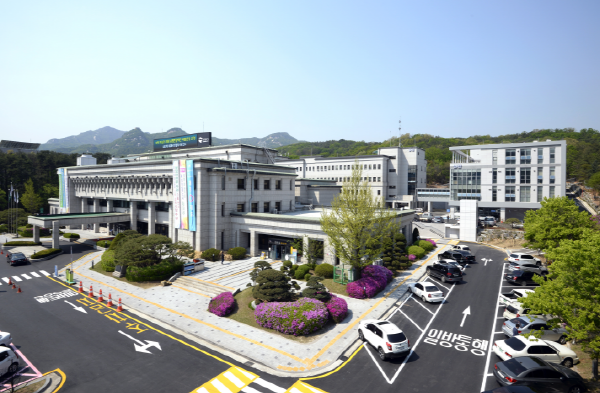
The size of next year's budget proposal increased by 106.4 billion won compared to this year, with the general account increasing by 64.3 billion won (5.3%) to 1.2896 trillion won, and the special account increasing by 42.1 billion won (27.7%) to 151.6 billion won.
Despite the continued difficult financial conditions due to consecutive adverse factors such as the government's sound fiscal policy, sluggish national tax revenue, and a downturn in real estate transactions caused by the economic downturn, the city formulated the budget focusing on "welfare for the vulnerable" and "livelihood vitality."
In particular, resources for welfare for the vulnerable and livelihood vitality were secured through the freezing of office operating expenses such as business promotion expenses and administrative operating costs, and the drastic reduction of habitual and inefficient projects, thereby improving the efficiency of current and consumptive expenditures.
Even under tight fiscal conditions, special attention was paid to stabilizing residents' lives by allocating 787 billion won, accounting for 61% of the total budget, to the social welfare sector based on the general account to ensure uninterrupted and comprehensive welfare. To effectively respond to the era of low birthrate and aging population, the budget includes ▲120 million won for childbirth incentives and ▲20.8 billion won for expanding senior citizen jobs.
Additionally, to support "livelihood vitality," the city aimed to normalize universal welfare projects that were temporarily suspended due to the fiscal crisis triggered by last year's national tax deficit, allocating ▲5.7 billion won for youth basic income, ▲1.6 billion won for universal support of menstrual products for female adolescents, ▲2 billion won for opportunity income for farmers and fishermen, and ▲2.3 billion won for incentives related to local currency issuance to stabilize grocery prices.
Furthermore, to improve urban infrastructure and ensure the smooth operation of convenient public transportation, the budget includes ▲3.9 billion won for road management and facility maintenance, ▲13 billion won for operating the public bus management system, ▲990 million won for operating school buses for Uijeongbu students, and ▲22.8 billion won for operating the Uijeongbu Light Rail Transit, dedicating efforts to maintaining essential urban functions and stabilizing residents' lives.
Mayor Kim Dong-geun emphasized, "Despite the worsening domestic and international economic conditions and no significant improvement in revenue conditions, the city's financial burden increased due to the rise in national and provincial subsidies, requiring more careful consideration than ever in preparing next year's budget proposal. We prioritized establishing a dense welfare network without blind spots and normalizing universal welfare to stabilize people's livelihoods, ensuring no negligence in budget allocation."
Meanwhile, the 2025 city budget proposal will be finalized after deliberation at the 2nd regular session of the 333rd Uijeongbu City Council, which opens on December 2.
© The Asia Business Daily(www.asiae.co.kr). All rights reserved.
![Clutching a Stolen Dior Bag, Saying "I Hate Being Poor but Real"... The Grotesque Con of a "Human Knockoff" [Slate]](https://cwcontent.asiae.co.kr/asiaresize/183/2026021902243444107_1771435474.jpg)















