'Hanok Village, Building the Next 100 Years' Symposium
Architects and Urban Scholars Foresee the Future of Hanok
Directions for a 'Hanok Everyone Wants to Live In'
A platform is being prepared to make Hanok, the traditional residential style, a representative residential culture content of Seoul. Following Mayor Oh Se-hoon's creation of the Eunpyeong Hanok Village within Eunpyeong New Town through the 'Seoul Hanok Declaration' in 2008, this is an opportunity to review the 'Seoul Hanok 4.0 Re-creation Plan' announced last year, which focuses on creating Hanok villages by region. The Seoul Metropolitan Government is currently promoting the establishment of new Hanok villages for a 'new Hanok' that considers future lifestyles and an 'everyday Hanok' where anyone would want to live.
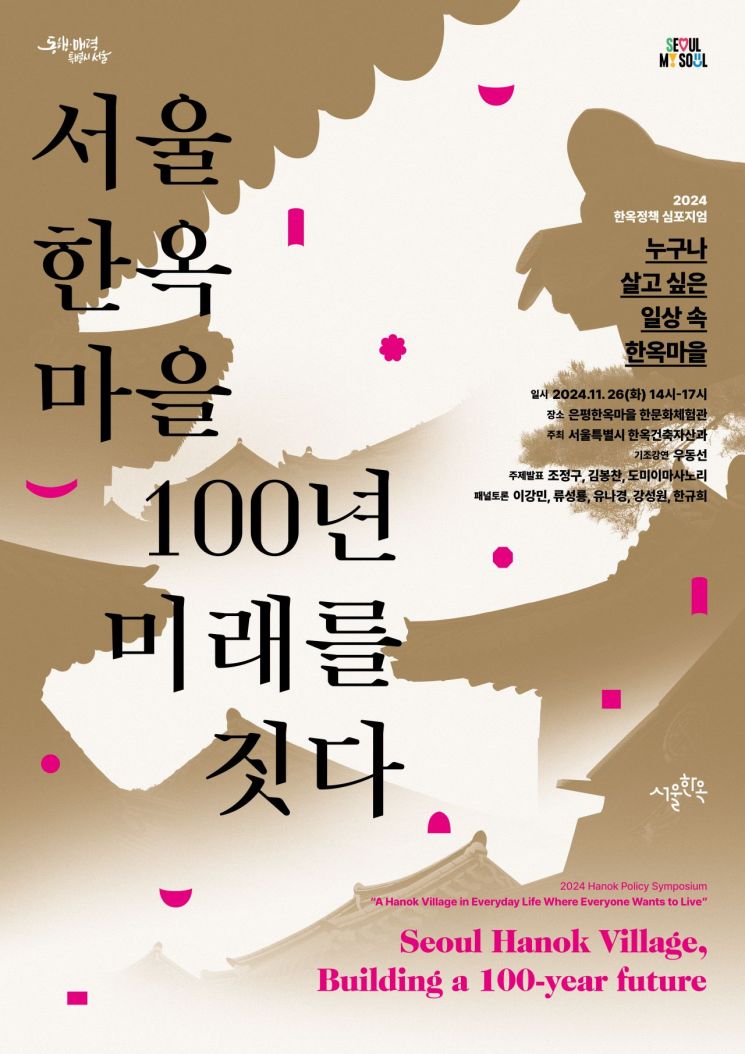
The symposium titled 'Seoul Hanok Village, Building a 100-Year Future,' held on the 26th at the Han Culture Experience Center in Eunpyeong-gu, Seoul, was planned with the intention of elevating Hanok as a representative architectural form of Seoul, creating an attractive Seoul landscape, and presenting it to the global market. Following the ▲2022 K-House Hanok Value and Future of Housing Symposium ▲2023 East Asia (Korea-China-Japan) Traditional Architecture Symposium ▲2024 'New Hanok, Another Experiment and Challenge' seminar, this is a forum for discussing Seoul's Hanok policies, where the tasks and principles for creating more than 10 Hanok villages over the next decade will be discussed together.
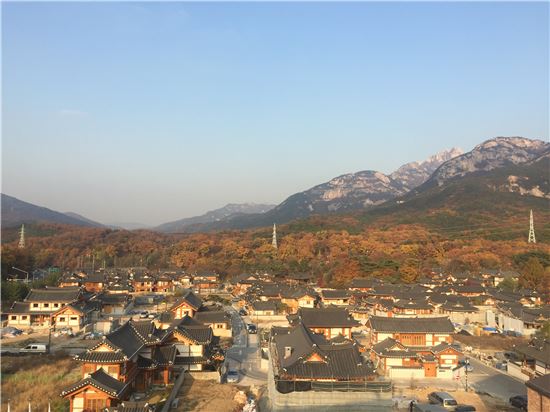 Eunpyeong Hanok Village
Korean and Japanese Architects and Landscape Architects Participate to Present the 'Future of Hanok'... What about Seoul's New Hanok Villages?
Earlier, Seoul selected new Hanok village sites last year. This reflects Mayor Oh's policy direction to select more than 10 Hanok village sites over the next 10 years to expand Hanok residential culture and related industries. The 'Hanok Village Site Selection Committee' identified ▲Amsa-dong 252-8 area in Gangdong-gu (70,244㎡) ▲Banghak-dong 543-2 area in Dobong-gu (21,146㎡) ▲San 96-4 area in Dobong-dong, Dobong-gu (35,859㎡) ▲San 123-13 area in Suyu-dong, Gangbuk-gu (19,840㎡) ▲Jegi-dong 1082 area in Dongdaemun-gu (141,695㎡) ▲Bulkwang-dong 35 area in Eunpyeong-gu (22,623㎡), among others.
Seoul judged that these sites have been severely neglected and damaged as weekend farms and cultivation areas, with poor infrastructure and parking difficulties, requiring environmental improvement. Accordingly, for the six sites located in development-restricted zones, basic plans and urban management plans will be established, followed by basic and detailed design, and related administrative procedures such as committee reviews. Subsequently, related projects such as urban development projects and district unit plan establishment will be promoted. Seoul has promised continuous investment starting with 500 million KRW in the second half of last year for the establishment of basic and management plans necessary for the Hanok village site projects.
This symposium is also organized as a place where Hanok architects, landscape architects, urban scholars, and experts gather to discuss and share concerns and tasks for creating Hanok villages. The program proceeds in the order of keynote speech, thematic presentations, and panel discussion. It begins with a keynote speech by Professor Woo Dong-seon, president of the Korean Architectural History Society and professor at Korea National University of Arts, followed by thematic presentations by three experts and a panel discussion with experts in urban planning, architecture, and landscaping.
In the thematic presentations, architects and landscape architects from Korea and Japan will present concepts and tasks for creating Seoul-style Hanok villages, the beauty of Korean gardens, and visions for the future of wooden architecture. Architect Jo Jung-gu of Guga Urban Architecture Office, who designed the Han Culture Experience Center, will present key principles and tasks for new Hanok village sites, and Kim Bong-chan, CEO of The Garden, who designed the 'Amore Seongsu' garden that planted the vitality of a deep forest in the heart of Seoul, will present how architecture and landscaping can relate to each other and embrace nature and people to have the value and function of ecological yards in future Hanok villages. Following this, Professor Masanori Tomii, a master of wooden architecture who was a professor at Kanagawa University and Hanyang University, will introduce directions for modern Hanok architecture, the possibilities and potential of wooden architecture, and related cases.
In the discussion, Professor Lee Kang-min of Korea National University of Arts will serve as the chair and conduct a 60-minute discussion under the theme 'Seoul Hanok Village, Building a 100-Year Future.' Panelists include Professor Ryu Seong-ryong of Korea University, CEO Yoo Na-kyung of PMA Urban Environment Research Institute, CEO Kang Seong-won of Kang Hee-jae Architecture Office, and CEO Han Kyu-hee of Urbanix.
Seoul Expands the Concept of 'Hanok'... Easing Regulations, Expanding Support, and Globalization
Seoul is also undertaking various attempts to expand the concept of Hanok. The core idea is to strengthen urban competitiveness by providing various incentives for modern buildings that reinterpret Hanok.
The detailed implementation plan is fully reflected in the long-term comprehensive Hanok policy plan, 'Seoul Hanok 4.0 Re-creation.' Accordingly, Seoul plans to relax architectural and review standards to allow freer construction of Hanok. Of the 73 Hanok construction review criteria, 44 will be eased or abolished. Specifically, 33 review criteria such as structure, windows, roof tiles, eaves length, yard upper structures, and yard height differences will be relaxed, and 11 items such as furniture arrangement, window frames, and gates will be abolished. For small-scale Hanok under 33㎡, review criteria such as facade proportion, roof height, and eaves length will be eased.
This reflects Mayor Oh's intention to give opportunities to citizens waiting to build Hanok. Since the standards set by past Hanok experts were high, construction costs increased, causing practical problems that this plan aims to solve. Accordingly, commercial Hanok such as Hanok cafes in Ikseon-dong, which were difficult to receive construction or repair support until now, can receive support under the 'Hanok construction style' category if they meet minimum standards. As of the end of 2022, 120 million KRW was supported for new Hanok construction and 90 million KRW for full repairs within Hanok preservation zones. Across the entire Seoul area outside Hanok preservation zones, 80 million KRW was supported for new construction and 60 million KRW for full repairs. Even for Hanok design only, support up to 50% of the existing subsidy is planned. The project budget for supporting Hanok construction and repair costs is about 8 billion KRW.
Measures to spread the appeal of Hanok residential culture and globalize it are also under discussion. The 'Public Hanok Global Lounge' established in Bukchon and Seochon Hanok villages has operated as a platform for foreign visitors to experience Hanok and residential culture. In addition, participation in 'Hanok' themed exhibitions and fairs, development of souvenirs, hosting contests, and active support for the development and industrialization of Hanok-related products through collaboration with domestic and international companies and local artisans are planned. Han Byung-yong, Director of the Housing Office of Seoul City, said, "Hanok should no longer remain only in tradition but present solutions to urban issues and become newly beautiful through new attempts. We will continue to think and strive to create future-oriented Hanok villages that coexist with the natural environment throughout Seoul."
© The Asia Business Daily(www.asiae.co.kr). All rights reserved.
![Clutching a Stolen Dior Bag, Saying "I Hate Being Poor but Real"... The Grotesque Con of a "Human Knockoff" [Slate]](https://cwcontent.asiae.co.kr/asiaresize/183/2026021902243444107_1771435474.jpg)















