Memorial Service Held at Aikawa Center in Japan on the 24th
Japan Did Not Honor the Agreement Made by the South Korean and Japanese Governments
Regarding the Japanese government's omission of any mention of 'coercion' at the memorial ceremony held at the Sado Mine in Niigata Prefecture, Japan, where Koreans were forced into labor during the Japanese colonial period, Professor Seokyungdeok of Sungshin Women's University stated that he would report this to UNESCO. On the 25th, Professor Seo announced through his social networking service (SNS) that "he will report Japan's behavior of not properly conveying the entire history of the Sado Mine by compiling research materials to UNESCO."
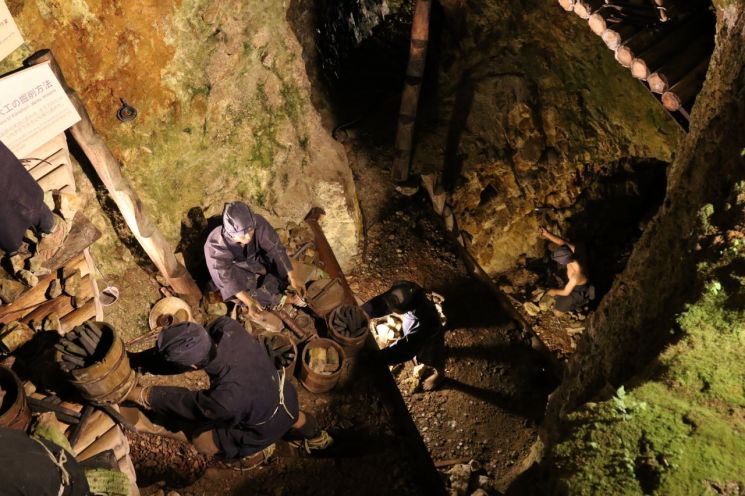 On the afternoon of the 24th, a 'Sado Mine Memorial Ceremony' was held at the Sado Mine in Niigata Prefecture, Japan, a site of forced labor of Koreans during the Japanese colonial period. Originally, the ceremony was scheduled to be attended by Korean bereaved families and officials from both the Korean and Japanese governments, but the Korean Ministry of Foreign Affairs abruptly announced its withdrawal a day before the event due to issues related to the Japanese representative's history of visiting Yasukuni Shrine, turning the ceremony into a 'half-hearted event.' Yonhap News
Professor Seo, who recently visited the Sado Mine, pointed out, "Although the harsh labor of Koreans is described at the nearby Aikawa Local Museum, there is no mention of 'coercion' at all," and added, "In particular, the exhibits contained content that belittled Koreans, such as 'Peninsular people (Koreans) are originally slow and have extremely low functional talent,' and 'The uniquely filthy bad customs of Peninsular people have not changed.'" He further criticized, "When Hashima Island was registered, Japan promised to install an information center to honor the victims," but "installing the center not at the site but 1,000 km away in Tokyo and displaying materials denying coercion is yet another betrayal."
Earlier, on the 24th, the memorial ceremony for the Sado Mine was held at the Aikawa Development Comprehensive Center near the Sado Mine. This ceremony was one of the measures agreed upon by the Korean and Japanese governments when inscribing the Sado Mine as a UNESCO World Heritage site. It was a response to the demands of South Korea and UNESCO that the history of forced labor at the Sado Mine and reflection on it be included. However, the Japanese government invited a representative who bowed to the Pacific War war criminals responsible for the forced labor of Koreans, sparking controversy.
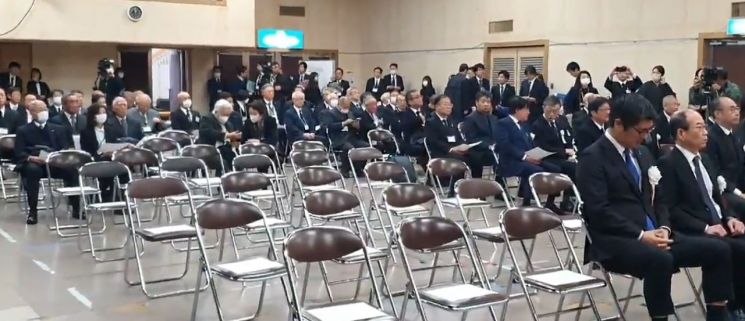 On the 24th, a de facto "half-hearted" memorial ceremony was held at the Sado Mine in Niigata Prefecture, Japan, where Koreans were forced into labor during the Japanese colonial period, amid discord between Korea and Japan. The ceremony, hosted by local governments and civic groups, was expected to have about 100 attendees, but approximately 30 seats remained empty due to the Korean side's absence, clearly showing it was a "half event." Yonhap News
In response, the South Korean government and bereaved families had planned to participate in the memorial ceremony, but withdrew after controversy continued, including the revelation that Deputy Director Ikuiina Akiko, who was to deliver the memorial address, had previously visited the Yasukuni Shrine. In her memorial speech, Deputy Director Ikuiina said, "Workers from the Korean Peninsula in the 1940s engaged in difficult labor under harsh conditions," but did not use expressions related to coercion such as forced mobilization.
© The Asia Business Daily(www.asiae.co.kr). All rights reserved.
![Clutching a Stolen Dior Bag, Saying "I Hate Being Poor but Real"... The Grotesque Con of a "Human Knockoff" [Slate]](https://cwcontent.asiae.co.kr/asiaresize/183/2026021902243444107_1771435474.jpg)
















