Global patents related to artificial intelligence security technology have grown approximately 40 times over the past decade. This is interpreted as a result of AI technology deeply embedding itself not only in industrial sectors but also in everyday life, drawing attention to security technology as well.
The size of the AI security market is estimated to grow from $24.3 billion (34 trillion KRW, estimated) this year to $53.1 billion (74 trillion KRW) by 2027. As the market size expands, patent competition to dominate the AI security market is also intensifying. South Korea has maintained the third position globally in the share of related patents over the past 10 years.
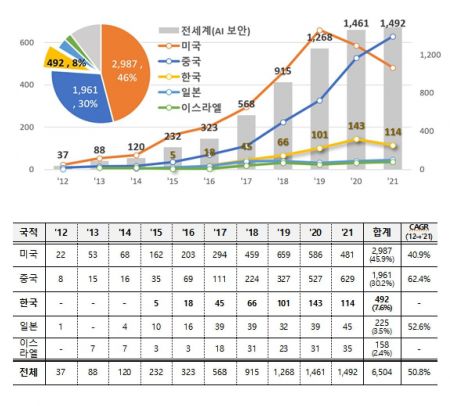 Data on Patent Application Trends by Nationality Related to Artificial Intelligence Security Technology. Provided by the Korean Intellectual Property Office
According to the Korean Intellectual Property Office (KIPO) on the 24th, patents related to AI security technology filed at major patent offices including Korea, the United States, China, Japan, and Europe (collectively IP5) grew at an average annual rate of 51% from 2012 to 2021. The number of patents, which was only 37 in 2012, increased to 1,492 in 2021. This means AI security technology patents increased 40-fold during this period.
By nationality of applicants, the United States accounted for the highest share at 45.9% (2,987 patents). China followed with 30.2% (1,961 patents), and South Korea secured third place with 7.6% (492 patents). Since surpassing Japan in AI security technology patents in 2017, South Korea has been widening the gap annually. In 2021, Japan's share of related patent applications was 3.5% (225 patents).
AI security technology can be broadly categorized into ‘AI-based hacking detection and prevention technology’ that uses AI to detect and prevent hacking, and ‘security technology for AI systems’ that blocks attacks on AI systems.
Among these, AI-based hacking detection and prevention technology is considered the main technology, accounting for 85% of all AI security technologies. However, its growth rate has slowed since 2019 (average annual growth of 1.7% from 2019 to 2021), indicating it has now entered a maturity phase.
In contrast, security technology for AI systems recorded an average annual growth rate of 68.1% from 2017 to 2021, gaining increasing attention in the market.
Among the top 10 companies with the most AI security technology patent applications, nine are U.S. companies including IBM and StrongForce. Samsung Electronics (6th place) is the only non-U.S. company in the top 10. Samsung Electronics and LG Electronics ranked 1st and 6th respectively in the user authentication field for patent applications.
Globally, patent applications for AI security technology are clearly led by companies, accounting for 78.5%. When divided by technology field, companies accounted for 80% of applications in AI-based hacking detection and prevention technology, and 68% in security technology for AI systems, with the former having a relatively higher corporate application share.
However, universities accounted for 29% of applications in security technology for AI systems, indicating active research and development in this field.
Jeon Beom-jae, Director of the AI Big Data Examination Division at KIPO, said, “As the use of AI and digital transformation become commonplace, AI security technology is gaining attention as an essential technology to protect national security and citizens’ daily lives. The Patent Office will provide timely patent analysis data needed by the industry to help domestic companies secure core patents in the AI security technology field and enhance their competitiveness.”
© The Asia Business Daily(www.asiae.co.kr). All rights reserved.
![Clutching a Stolen Dior Bag, Saying "I Hate Being Poor but Real"... The Grotesque Con of a "Human Knockoff" [Slate]](https://cwcontent.asiae.co.kr/asiaresize/183/2026021902243444107_1771435474.jpg)











