Owner Opposes Brazilian Government's Seizure Request
Originally Illegally Exported from Brazil... Appeal Decision Awaits
The world's largest emerald rough, weighing 836 pounds (approximately 380 kg) and nicknamed the "Cursed Emerald," is set to return to its homeland, Brazil, 23 years after its extraction.
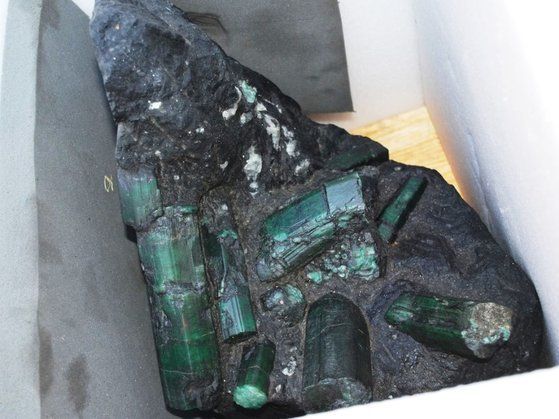 The "Baia Emerald," nicknamed the "Cursed Emerald" due to 23 years of continuous legal disputes and incidents over ownership since its excavation. Los Angeles County Sheriff's Department, USA
On the 22nd (local time), the Washington Post (WP) reported that Judge Reggie Walton of the U.S. District Court for the District of Columbia accepted the U.S. Department of Justice's seizure request for the "Bahia Emerald" the previous day. Although the current holder of the emerald requested more time to negotiate with the Brazilian government, Judge Walton dismissed the request, stating that "the claims are insufficient to prevent the return of the emerald" and that "the court must enforce the seizure ruling of the Brazilian court."
The Bahia Emerald, extracted in Brazil in 2001, is a rough stone composed of nine individual large emeralds. Immediately after extraction, it was smuggled to the United States, and ownership disputes, accidents, and legal battles have been continuous. Because of this, it earned the nickname "Cursed Emerald."
Earlier, in a 2015 lawsuit in the U.S., ownership was recognized for a consortium led by Kit Morrison, a businessman from Idaho who actually paid $1.3 million (approximately 1.827 billion KRW). However, as soon as the lawsuit concluded in California, the Brazilian government claimed that "the Bahia Emerald is a national treasure and should be placed in a museum," continuing the dispute. Subsequently, the Brazilian court decided on seizure, and the Brazilian government requested the U.S. to enforce the seizure through judicial cooperation.
The U.S. government agreed and proceeded with enforcement, but Morrison's side opposed it, reigniting the legal battle. The key issue in this lawsuit was whether the Brazilian government's claim that the Bahia Emerald was illegally exported from Brazil was valid. The court is presumed to have accepted the Brazilian government's claim based on the fact that the miners who initially exported the emerald were convicted of customs document forgery and other charges.
Morrison stated, "As an investor, I must do my best to protect my investments and opportunities, but uncontrollable matters are unavoidable," but did not clearly state whether he would appeal. If an appeal is filed, the "cursed journey" of the Bahia Emerald is expected to be prolonged. Meanwhile, foreign media estimated the value of this emerald at $1 billion (approximately 1.4 trillion KRW).
© The Asia Business Daily(www.asiae.co.kr). All rights reserved.
![Clutching a Stolen Dior Bag, Saying "I Hate Being Poor but Real"... The Grotesque Con of a "Human Knockoff" [Slate]](https://cwcontent.asiae.co.kr/asiaresize/183/2026021902243444107_1771435474.jpg)















