Real Estate R114, Weekly Apartment Market in the Seoul Metropolitan Area
Seoul Metropolitan Apartment Sales Up 0.02% · Jeonse Prices Up 0.01%
Positive Signals for Major Development Projects in Seoul
Limited Reflection on Housing Prices Due to Weakened Buying Demand
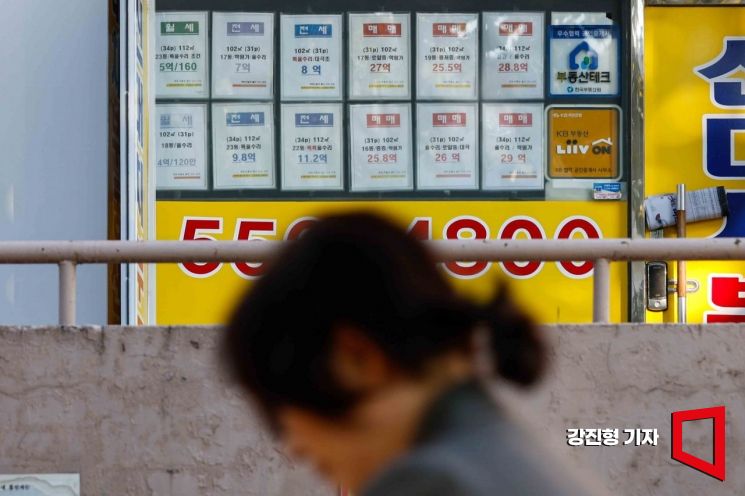 Due to the impact of loan regulations and other factors, apartment transactions have slowed down, causing listings to continue accumulating. On the 24th, sales and jeonse (long-term lease) listing flyers were posted at a real estate agency in Gangnam, Seoul. Photo by Kang Jin-hyung
The apartment sales market in the Seoul metropolitan area is showing a strong tendency for buyers to hold back as interest rates and loan thresholds rise. However, the value of redevelopment projects in prime areas of Seoul continues to climb daily.
According to the 'Weekly Apartment Market Report for the Third Week of November in the Seoul Metropolitan Area' released by Real Estate R114 on the 23rd, expectations for project acceleration have increased thanks to the government's and local governments' regulatory easing policies. Wealthy buyers with low loan dependency are actively showing purchase intentions for redevelopment projects that possess future value and scarcity. This week as well, areas such as Eunma in Daechi-dong, Gangnam-gu, Woosung and Hanyang in Gangdong-gu, and Banpo Mido 1st Complex in Banpo-dong, Seocho-gu led the market and drove price increases.
Apartment sale prices in Seoul rose slightly by 0.02% compared to the previous week. Redevelopment projects increased by 0.07%, and general apartments rose by 0.01%. New towns and Gyeonggi/Incheon recorded no significant price changes, maintaining a flat trend (0.00%) for two consecutive weeks. Among individual districts in Seoul, Gangnam (0.11%) showed the largest weekly increase, exceeding 0.10%.
Following Gangnam, the price increases were in Gangdong (0.04%), Seocho (0.02%), Mapo (0.02%), and Yeongdeungpo (0.01%). In contrast to last week, when there were no declining areas, Dongjak (-0.01%), Seodaemun (-0.01%), and Jungnang (-0.01%) saw downward adjustments centered on small complexes with fewer than 300 households.
In new towns, Dongtan rose by 0.01%, mainly in relatively new apartments completed within 10 years, while other areas remained flat (0.00%). In Gyeonggi and Incheon, Hwaseong (0.03%) and Suwon (0.01%) increased, whereas Gimpo declined by 0.01% as Castle & Famille City Phase 2 in Gochon-eup dropped by about 1 million KRW.
The jeonse (long-term lease) market also saw subdued demand similar to the sales market. Seoul rose by 0.01% for the second consecutive week, while new towns and Gyeonggi/Incheon remained flat (0.00%).
Within Seoul, areas such as Gangnam (0.08%), Seongdong (0.03%), Dongjak (0.03%), Mapo (0.01%), Dongdaemun (0.01%), and Nowon (0.01%) saw increases, whereas Dobong (-0.04%), Songpa (-0.01%), and Jungnang (-0.01%) experienced declines. In new towns, Dongtan rose by 0.03%, while Paju Unjeong fell by 0.01%, mainly due to declines in larger-sized units.
In Gyeonggi and Incheon, Suwon's Gwonseon-dong Suwon Gwonseon Xi e-Pyeonhansesang and Jowon-dong Jugong New Town Phase 2 increased by 5 to 7.5 million KRW, resulting in a 0.03% rise. In Goyang, Ilsan Edufore Prugio in Tanhyeon-dong rose by about 10 million KRW, leading to a 0.01% upward adjustment.
A Real Estate R114 official explained, "In Seoul, major development projects have begun in earnest, including the conditional approval of the Yongsan International Business District by the Metropolitan Wide-area Transportation Committee, the start of construction this month for the ‘Seoul Station North Station Area Complex Development,’ and the imminent launch of the ‘Kwangwoon University Station Area Development Project.’ Although inquiries about investments around these project sites are increasing, the housing price trends have not yet reflected these developments dynamically."
He added, "Of course, development projects require significant resources and time, demanding a long-term perspective. Currently, it appears that the slowed buying momentum caused by sluggish domestic economic conditions and stringent loan regulations is more sensitively affecting the market than localized positive issues limited to certain areas and groups."
Furthermore, he analyzed, "While the visibility of development projects could sufficiently increase upward pressure on surrounding housing prices, in the current trading environment where the price gap between sellers and buyers persists in parallel, the impact on the market remains limited."
© The Asia Business Daily(www.asiae.co.kr). All rights reserved.
![Clutching a Stolen Dior Bag, Saying "I Hate Being Poor but Real"... The Grotesque Con of a "Human Knockoff" [Slate]](https://cwcontent.asiae.co.kr/asiaresize/183/2026021902243444107_1771435474.jpg)
















