Meeting Between Ministry of Industry and Trump Administration Response
CEOs from Hyundai Steel, POSCO, and Others Attend
Minister Andukgeun: "Industry and Government United as One Team to Prepare"
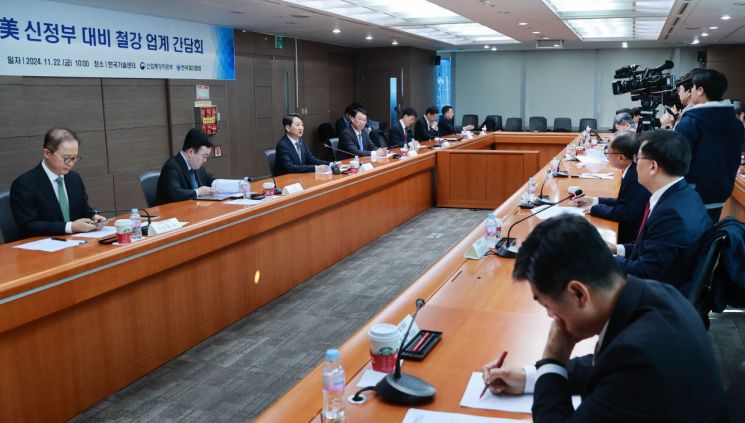
The steel industry, facing a complex crisis due to the flood of Chinese steel products and the launch of the second term of the Donald Trump administration, has requested the government to maintain the U.S. export quota (export allocation to the U.S.).
On the 22nd, Seo Kang-hyun, CEO of Hyundai Steel, told reporters at a meeting held at the Korea Technology Center in Gangnam-gu, Seoul, to review the impact of the new U.S. administration on the steel industry, organized by the Ministry of Trade, Industry and Energy and the steel industry, "There may be attempts to reduce the quota locally in the U.S., but we requested the government to maintain the quota well." He added, "Since Hyundai Motor is building a new plant in the U.S. and steel demand is increasing, we intend to appeal for local investment in terms of trade." CEOs including Lee Si-woo of POSCO, Seo Kang-hyun of Hyundai Steel, Park Sang-hoon of Dongkuk CM, and Yang Young-joo of SeAH Holdings attended the meeting.
In his opening remarks, Ahn Deok-geun, Minister of Trade, Industry and Energy, said, "The steel industry experienced a major change with the introduction of the quota system in 2018, so the industry's concerns about policy changes under the new U.S. administration are significant," adding, "If the industry and government become a 'one team' and prepare thoroughly, it could rather become an opportunity."
The steel industry, struggling against low-priced Chinese products, is concerned about the possibility of the U.S. strengthening import restrictions on Korean steel products. The U.S. introduced a quota system as part of protectionism during the first Trump administration in 2018. The quota allocated to Korea was 2.63 million tons, significantly reduced compared to the annual average of 3.83 million tons from 2015 to 2017. The industry believes that after Trump's re-election, there is a possibility of reducing import quotas for countries subject to quotas through the reassessment of Section 232 of the Trade Expansion Act. Although the Korea-U.S. Free Trade Agreement (FTA) exists, there are concerns that the U.S. might consider applying general tariffs to Korea by circumventing the FTA.
Regarding the sluggish steel market, CEO Seo said, "Internally, what we can do is improve production efficiency," adding, "We are trying hard to build competitiveness that can endure difficulties by improving efficiency. If we secure competitiveness to invest when the market recovers, I believe we can endure well."
Recently, the steel industry has been experiencing a recession, with factories shutting down one after another. POSCO, the number one steel company in Korea, decided to close its Pohang Steelworks' first long product plant for the first time in 45 years. This plant produced nails, screws, tire cords, etc., with a cumulative production volume of 28 million tons. POSCO decided on the second shutdown in about four months following the closure of Pohang's first steel mill in July. POSCO is also undergoing structural reorganization. It is considering selling the Jiangsu Zhangjiagang Pohang Bul Steelworks in China, classified as a low-profit business. Hyundai Steel also decided to close its second plant in Pohang, Gyeongbuk.
The steel market is not favorable enough for the top two domestic steel companies to have to close factories. POSCO reported sales of 9.479 trillion won and operating profit of 438 billion won in the third quarter, down 2.0% and 39.8%, respectively, compared to the same period last year. Hyundai Steel's operating profit for the third quarter this year was 51.5 billion won, a 77.4% decrease.
© The Asia Business Daily(www.asiae.co.kr). All rights reserved.
![Clutching a Stolen Dior Bag, Saying "I Hate Being Poor but Real"... The Grotesque Con of a "Human Knockoff" [Slate]](https://cwcontent.asiae.co.kr/asiaresize/183/2026021902243444107_1771435474.jpg)















