CarbonCo, a subsidiary of DL E&C specializing in carbon dioxide capture, utilization, and storage (CCUS) technology, announced on the 22nd that it will participate in a national project consortium to convert decommissioned mine tunnels into carbon dioxide storage facilities. This is the first time a domestic company has entered the onshore carbon storage development business.
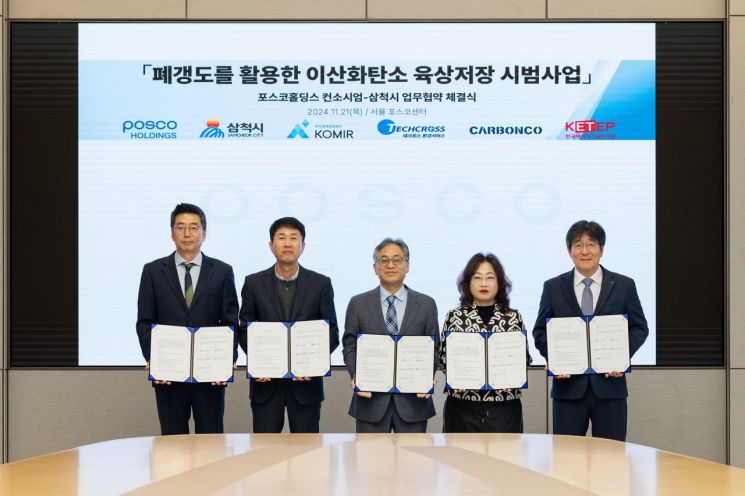 Ko Hyun-shin, Chief Technology Officer (CTO) of Carbonco (from left), Jo In-sung, Director of the Samcheok City Economic Promotion Bureau, Han Geon-woo, Head of the Low Carbon CCUS Research Center at POSCO Holdings, Lee Jin-soo, Director of the Korea Mine Reclamation Corporation Research Institute, and Kim Sang-min, Head of New Business Division at Techross Environmental Services, are posing for a commemorative photo after signing an MOU on the 21st for the "Pilot Project for Onshore Carbon Dioxide Storage Using Abandoned Mine Tunnels." / Photo by DL E&C
The consortium, consisting of CarbonCo, POSCO Holdings, water treatment specialist Techros Environmental Services, and the Korea Mine Reclamation Corporation, signed a memorandum of understanding (MOU) with Samcheok City on the 21st for a "Pilot Project for Onshore Carbon Dioxide Storage Using Decommissioned Mine Tunnels." This project, with a total national budget of 6.76 billion KRW, will run from this year until 2027. The consortium was selected as the pilot project institution in July and will develop and demonstrate technology to utilize decommissioned mine tunnels as storage sites for carbon dioxide.
First, gaseous carbon dioxide is converted into a solid form. Carbon dioxide is captured from exhaust gases emitted by steel mill chimneys and mixed with slag, a byproduct obtained during the steelmaking process. When carbon dioxide meets calcium and magnesium, the main components of slag, it transforms into hard solids such as calcium carbonate and magnesium carbonate. This process is called mineral carbonation.
The solidified mass produced in this way is buried (stored) in the decommissioned mine tunnels. The target area is a decommissioned mine tunnel located in Samcheok City, Gangwon Province. The consortium plans to collect 3 tons of carbon dioxide per day and produce 300 tons of mine tunnel filling material by 2027. The consortium and Samcheok City will establish specific institutional support measures, including permits and approvals, for the storage and utilization of carbon dioxide.
CarbonCo is responsible for verifying onshore carbon dioxide storage technology and reviewing business models for commercialization in this project. Previously, it participated in a project to capture and store up to 80,000 tons of carbon dioxide annually from the Boryeong Thermal Power Plant, and in Indonesia, it developed a business model to capture carbon dioxide and store it in offshore gas fields in collaboration with the state-owned power company.
Lee Sang-min, CEO of CarbonCo, said, "In the domestic environment where carbon dioxide storage sites are scarce, this pilot project utilizing decommissioned mine tunnels and mineral carbonation technology will be an important alternative. As a CCUS technology specialist company, we will successfully complete the pilot project and lay the foundation for revitalizing the domestic CCUS market."
© The Asia Business Daily(www.asiae.co.kr). All rights reserved.
![Clutching a Stolen Dior Bag, Saying "I Hate Being Poor but Real"... The Grotesque Con of a "Human Knockoff" [Slate]](https://cwcontent.asiae.co.kr/asiaresize/183/2026021902243444107_1771435474.jpg)















