World Economy Institute-KB Financial Group International Conference
Press Conference with Yukiko Fukagawa, Professor at Waseda University
A suggestion has been made that the Korean economy should focus on sustainability rather than pursuing excessive high growth. Additionally, it was argued that in order to respond to policies under the second Trump administration next year, Korea must stop polarization and division and build strong political foundations to enhance its negotiating power.
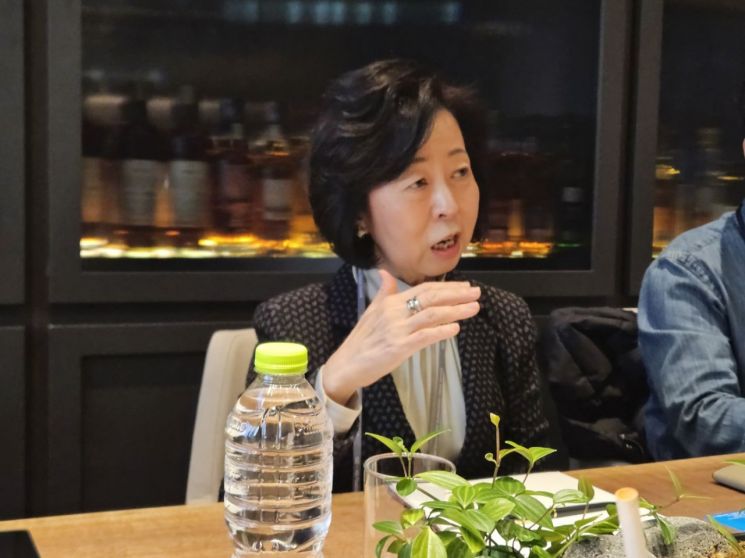 Professor Yukiko Fukagawa of Waseda University is speaking at a press conference following the International Finance Conference jointly hosted by the World Economy Research Institute and KB Financial Group at the Conrad Hotel in Yeouido, Seoul on the 21st. (Photo by Jaehyun Park)
Yukiko Fukagawa, a professor at Waseda University, pointed out at a press conference held on the 21st at the Conrad Hotel in Yeouido, Seoul, jointly hosted by the World Economy Research Institute and KB Financial Group during the International Finance Conference, "Korea is a manufacturing powerhouse, but it is necessary to break away from the fixed notion that countries good at manufacturing do not collapse."
She emphasized that Korea's economic growth rate should consider sustainability. Professor Fukagawa said, "Rather than thinking about next year's economic growth rate immediately, we should think about the sustainability of the economy," adding, "It is better to aim for steady growth with sustainability rather than pushing for excessive high growth."
When asked about the meaning of steady growth, she explained, "There is no bottom line regarding how much social welfare funding should be allocated," and "As the elderly population increases, proportionally more social welfare funding is needed."
She predicted that the effects of policies under the second Trump administration would begin in earnest about three months after inauguration. Professor Fukagawa said, "I expect tariffs on Asian products, including those from China, to be raised to excessively high levels around early next year, about three months after the inauguration," warning, "Trump's characteristic is that he wants to make deals with people who have a political base, but if Korea remains as polarized and divided as it is now, it will not be able to conduct truly effective negotiations."
She also emphasized the need to strengthen domestic demand. Professor Fukagawa said, "Since wages in Korea are rising, the country has no choice but to focus on industries with a high concentration of research and development (R&D), which are high value-added industries," adding, "These industries are vulnerable to geopolitical crises and other risks." She continued, "The priority for the Korean economy now is to maintain the competitiveness of manufacturing while establishing a structure where domestic demand, such as service industries, can be sustained to some extent."
She added, "Domestic demand is overwhelmingly lacking in momentum, similar to Japan, so it is rather important to establish good labor conditions," and "Rather than expecting domestic demand to improve next year or the year after, caution should be exercised regarding real estate issues."
Professor Fukagawa stated that immigration policy alone should not be insisted upon as a solution to sluggish domestic demand caused by population decline. She said, "Korea's biggest problem is the short-term thinking that tries to achieve everything overnight," and "Advanced economies cannot change overnight, so immigration cannot be taken lightly, and the political costs paid by many countries due to immigration must be considered."
She warned that real estate issues should be handled carefully in the Korean economy. Professor Fukagawa expressed concern, saying, "Most of Korea's household debt is related to real estate investment," and "Since self-employed businesses are also closely connected to real estate, if the real estate market collapses overnight, the shock will be greater than during the foreign exchange crisis."
Regarding future exchange rate trends, she evaluated, "Exchange rates are determined by interest rate differentials, so if a certain level of interest rate differential is maintained, the conclusion will inevitably be a weaker yen and won," adding, "The yen will weaken more than the won."
© The Asia Business Daily(www.asiae.co.kr). All rights reserved.
![Clutching a Stolen Dior Bag, Saying "I Hate Being Poor but Real"... The Grotesque Con of a "Human Knockoff" [Slate]](https://cwcontent.asiae.co.kr/asiaresize/183/2026021902243444107_1771435474.jpg)















