Mayor Lee Jangwoo and Governor Kim Taeheum Make Joint Declaration at Former Chungnam Provincial Office... "Will Overcome Capital Region Monopoly"
Formation of Public-Private Council, Collecting Citizen Opinions to Promote Unified Legislation
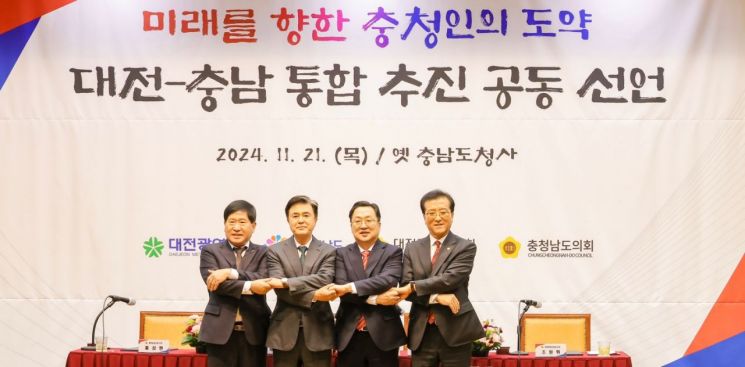 Chungnam Provincial Council Chairman Hong Seonghyun, Chungnam Governor Kim Taehum, Daejeon Mayor Lee Jangwoo, and Daejeon City Council Chairman Jo Wonhui join hands after a joint declaration. / Daejeon City
Daejeon Metropolitan City and Chungcheongnam-do, which have been separated for 35 years since Daejeon was promoted to a metropolitan city in 1989, are pushing for administrative district integration.
On the afternoon of the 21st, Daejeon Mayor Lee Jangwoo, Chungcheongnam-do Governor Kim Taeheum, Daejeon City Council Chairman Cho Wonhui, and Chungcheongnam-do Council Chairman Hong Seonghyeon declared the launch of an integrated local government at the former Chungcheongnam-do Provincial Government building.
In their joint declaration, they emphasized, "To overcome the dominance of the Seoul metropolitan area and prevent the decline of local regions, it is necessary to promote the integration of administrative districts of both regions, which share a common history and community spirit, in order to establish a globally competitive metropolitan economic zone and improve the welfare of residents."
They added, "We will push for the enactment of a special law to establish an integrated local government, and strive to secure substantial authority and functions equivalent to those of a state in a federal system through the transfer of national administrative and financial powers."
To this end, Daejeon and Chungcheongnam-do will form a "tentatively named Administrative District Integration Public-Private Council" with equal representation from both regions, prepare an integration bill within the council, and propose it to both regions. After collecting opinions from the Daejeon City Council, Chungcheongnam-do Council, and local residents, they plan to finalize the integration plan and proceed with the integration as soon as possible.
Daejeon and Chungcheongnam-do have developed separately for 35 years since Daejeon's promotion to a metropolitan city in 1989, but this has led to problems such as excessive competition to attract national projects and overlapping investments in industrial ecosystems, difficulties in handling increasing metropolitan administrative tasks such as transportation, culture, and medical facilities, as well as overinvestment, and weakening financial capacity and administrative inefficiency in small cities due to population decline.
If the administrative integration of Daejeon and Chungcheongnam-do is achieved, it is expected that they will be able to respond more closely to metropolitan administrative demands such as transportation networks and public facility construction that cross local government boundaries, resolve inconveniences caused by mismatches between living areas and administrative districts, and improve administrative efficiency.
The integrated city will have a population of about 3.6 million, an area of 8,787 km², administrative districts consisting of 5 autonomous districts, 8 cities, and 7 counties, 18 members of the National Assembly, a budget of 30.9 trillion won, and a gross regional product of 178.1 trillion won.
The two regions expect that, upon integration, Daejeon's excellent research and development capabilities and human capital, combined with Chungcheongnam-do's strong manufacturing base, will create synergy and form a metropolitan economic zone comparable to the Seoul metropolitan area.
Daejeon Mayor Lee Jangwoo stated, "Daejeon and Chungcheongnam-do, which started from the same root, must integrate and achieve world-class competitiveness so that Korea can overcome the dominance of the Seoul metropolitan area and move towards the future," adding, "We will make efforts to sincerely listen to the opinions of residents and build consensus during the integration process."
Chungcheongnam-do Governor Kim Taeheum emphasized, "In order to overcome the inefficiency of the current system and allow local regions to take the lead in resolving national issues such as local extinction and concentration in the Seoul metropolitan area, a reorganization of the administrative system at a metropolitan level, equivalent to national reform, is necessary," adding, "If the two regions with the same roots integrate, they will become a new axis of future growth for Korea."
© The Asia Business Daily(www.asiae.co.kr). All rights reserved.
![Clutching a Stolen Dior Bag, Saying "I Hate Being Poor but Real"... The Grotesque Con of a "Human Knockoff" [Slate]](https://cwcontent.asiae.co.kr/asiaresize/183/2026021902243444107_1771435474.jpg)















