Samsung Electronics' 'Poor Earnings' Impact Leads to Cancellation of Two Major Gas Company Deals
Popularity of Gas Companies Favored for Infrastructure Investment Fades
Remaining 'Big Deal' SK Specialty Less Dependent on Samsung Electronics... Still Sailing Smoothly
The sale of Hyosung Chemical's specialty gases division has fallen through, continuing the ripple effects of Samsung Electronics' poor performance in the mergers and acquisitions (M&A) market. Following Air Products Korea, another 'big deal' involving a gas company with Samsung Electronics as a major client has also collapsed. This has led to remarks that the M&A market is taking a direct hit due to Samsung Electronics' downturn.
According to the financial investment industry on the 22nd, among the three gas companies put up for sale in this year's M&A market?Hyosung Chemical's specialty gases division, Air Products Korea, and SK Specialty?sales of the first two, excluding SK Specialty, have failed. Air Products Korea, once touted as this year's 'biggest catch' with a valuation of up to 5 trillion won, suddenly canceled its sale, and Hyosung Chemical withdrew its selection of a preferred negotiation partner with the Stick Investment and IMM Private Equity (PE) consortium on the 20th. Thus, 'big deals' worth over 1 trillion won have consecutively fallen through.
Previously, sales went through as soon as they appeared... but Samsung Electronics' poor performance has 'reversed the mood'
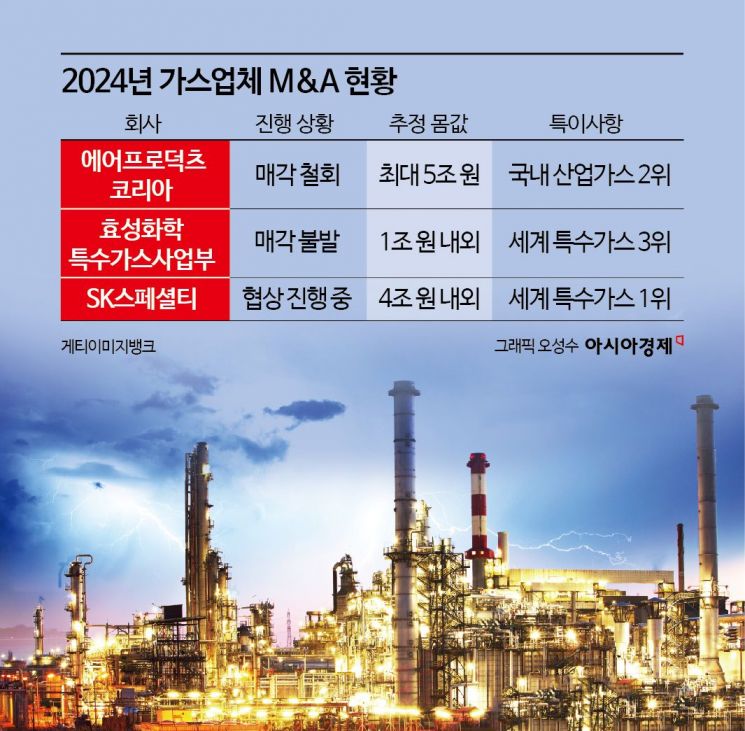
Hyosung Chemical's specialty gases division ranks third globally in specialty gases, and Air Products Korea is the second-largest industrial gas company domestically. Although their fields differ slightly, both share Samsung Electronics as their main client. In particular, over 70% of Hyosung Chemical's specialty gases division's sales come from Samsung Electronics. With such a reliable guarantee, the atmosphere was positive when the sale process began in the first half of the year. Private equity funds (PEFs) and sovereign wealth funds entered the bidding, with as many as nine bidders making the shortlist.
However, the mood changed in the second half of the year. The acquisition price, once rumored to be up to 1.3 trillion won, was reportedly adjusted below 1 trillion won, and 'discord' began to leak out. Samsung Electronics' poor performance, coupled with market expectations of reduced capital expenditures next year, were flooding out at that time. Ultimately, Hyosung Chemical announced that the deal had fallen through. Facing 11 consecutive quarters of losses, Hyosung Chemical is now under urgent pressure to restructure its financials. Earlier, Air Products Korea's sudden withdrawal from the sale was attributed to the complete halt of Samsung Electronics' Pyeongtaek Campus 5th Plant (P5) construction, which caused its expected valuation to drop sharply from 5 trillion won to the 3 trillion won range. P5 was the plant to which Air Products Korea was to supply gas.
Gas companies have traditionally been popular in the M&A market. Thanks to long-term contracts with large clients, their profit structures are stable, making them a kind of 'infrastructure investment.' Transactions were active. In 2019, IMM PE acquired Linde Korea (now Air First), in 2020 Macquarie Asset Management acquired Daesung Industrial Gases (now DIG Airgas), and last year SG PE purchased Korea Specialty Gases. However, the market mood appears to be shifting due to the 'Samsung Electronics crisis theory.' Jung Kyung-soo, head of the M&A Center at Samil PwC, said, "Gas companies that can generate stable cash flow are so popular that their enterprise value relative to EBITDA is higher than in other sectors," adding, "As the client's poor performance reduces growth expectations, differing 'price expectations' between buyers and sellers seem to have led to negotiation breakdowns."
Sale of SK Specialty, with high SK dependence, remains 'clear'
Market attention is now turning to SK Specialty, the last major gas company deal of the year. SK Specialty, a 100% subsidiary of SK Holdings, is the world's number one specialty gases company. It was put up for sale during SK Group's governance restructuring (rebalancing) process, and currently, private equity firm Hahn & Company has been selected as the preferred negotiation partner, with detailed terms such as price under negotiation. The goal is to sign a stock purchase agreement (SPA) in December, with a valuation rumored to be in the 4 trillion won range.
Unlike Air Products Korea and Hyosung Chemical's specialty gases division, which are highly dependent on Samsung Electronics, SK Specialty's negotiations have proceeded without significant issues, presenting a contrast. SK Specialty has a high transaction proportion with SK Group affiliates, including SK Hynix, and relatively minimal dependence on Samsung Electronics. An investment banking (IB) industry insider said, "While the consecutive failures of gas company deals cannot be said to have no impact on this transaction, I understand that negotiations are progressing smoothly."
© The Asia Business Daily(www.asiae.co.kr). All rights reserved.
![Clutching a Stolen Dior Bag, Saying "I Hate Being Poor but Real"... The Grotesque Con of a "Human Knockoff" [Slate]](https://cwcontent.asiae.co.kr/asiaresize/183/2026021902243444107_1771435474.jpg)















