2024 Youth Health Behavior Survey Results Announcement
Stress and Depression Reach Highest Levels in Jeonbuk
Smoking and Drinking Rates Decrease for Both Genders
The number of adolescents experiencing depression and severe stress has increased. In particular, half of the female respondents reported feeling stressed.
According to the results of the Youth Health Behavior Survey announced on the 22nd by the Ministry of Education and the Korea Disease Control and Prevention Agency, the rate of adolescents experiencing depression this year was 23.1% for male students and 32.5% for female students, increasing by 1.7 percentage points and 1.6 percentage points respectively compared to last year. The stress recognition rate also rose by 4.4 percentage points for male students to 35.2%, and by 5.7 percentage points for female students to 49.9%.
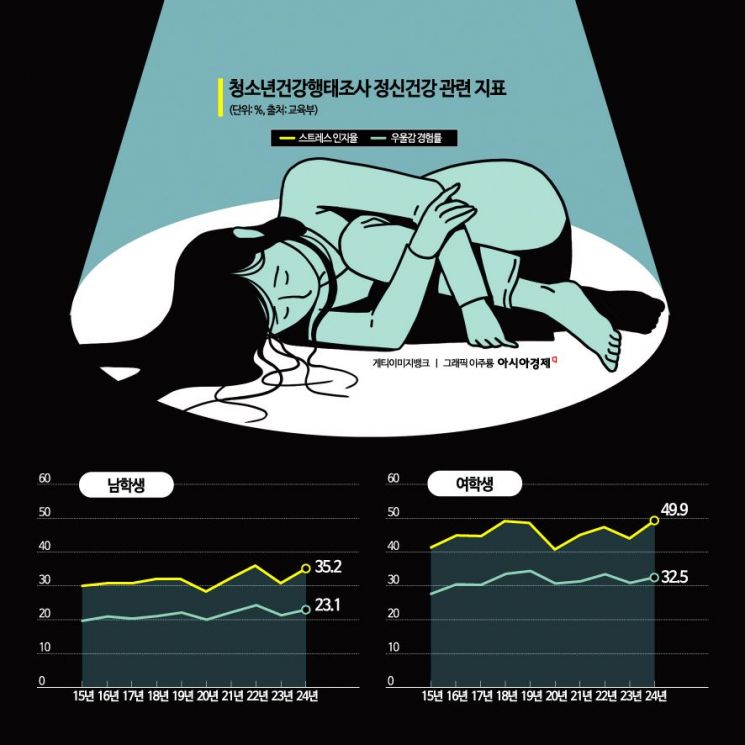
The mental health indicators for adolescents showed an upward trend immediately after the COVID-19 pandemic in 2019-2020, then declined last year, and rose again to the 2022 level. In particular, the stress recognition rate among female students exceeded the 2022 level (47.0%).
The depression experience rate refers to the proportion of individuals who felt so sad or hopeless that they stopped their daily activities for two consecutive weeks during the past 12 months. The stress recognition rate refers to the proportion of individuals who usually feel (very) stressed. This survey was conducted from June 10 to July 12, targeting approximately 60,000 students enrolled in 800 middle and high schools nationwide.
By region, Jeonbuk had the highest stress recognition rate at 46.1%, followed by Seoul (45.3%) and Jeju (45.0%). The depression experience rate was also highest in Jeonbuk (30.4%), followed by Daejeon (29.8%) and Sejong (29.7%).
The average weekday sleep duration this year was 6.5 hours for male students and 5.9 hours for female students, similar to last year, but the subjective sleep satisfaction rate decreased by 3.5 percentage points for male students to 27.1%, and by 4.7 percentage points for female students to 16.5% compared to the previous year.
The smoking rate among adolescents improved this year compared to last year. It was 4.8% for male students and 2.4% for female students, decreasing by 0.8 percentage points and 0.3 percentage points respectively. The use rate of electronic cigarettes, both liquid type and heated tobacco type, remained similar to last year. The drinking rate was 11.8% for male students and 7.5% for female students, decreasing by 1.2 percentage points and 1.5 percentage points respectively compared to last year. The rate of risky drinking, defined as an average drinking amount per session at moderate levels or higher (5 shots of soju for males, 3 shots for females), also decreased for both male and female students.
The rate of skipping breakfast (5 or more days per week) increased by 2.1 percentage points for female students and by 0.5 percentage points for male students this year. The rate of fast food consumption 3 or more times per week also increased by 2.0 percentage points for male students and 2.1 percentage points for female students.
An official from the Ministry of Education explained, "Since this is a status survey, the specific causes have not yet been identified. The survey period was changed from August-October during the COVID-19 pandemic back to June-July, so it is possible that academic schedules such as final exams had an influence."
Lee Ju-ho, Deputy Prime Minister and Minister of Education, stated, "Going forward, when promoting related policies such as the ‘Basic Plan for Student Health Promotion’ and the ‘Integrated Support Plan for Customized Student Mental Health,’ we will strengthen detailed measures to supplement health indicators that need improvement."
© The Asia Business Daily(www.asiae.co.kr). All rights reserved.
![Clutching a Stolen Dior Bag, Saying "I Hate Being Poor but Real"... The Grotesque Con of a "Human Knockoff" [Slate]](https://cwcontent.asiae.co.kr/asiaresize/183/2026021902243444107_1771435474.jpg)















