Shin Sung-hwan, a Monetary Policy Board member of the Bank of Korea, stated on the 21st that productivity improvement should be the highest priority policy. He emphasized that deregulation must be actively promoted to enhance South Korea's productivity.
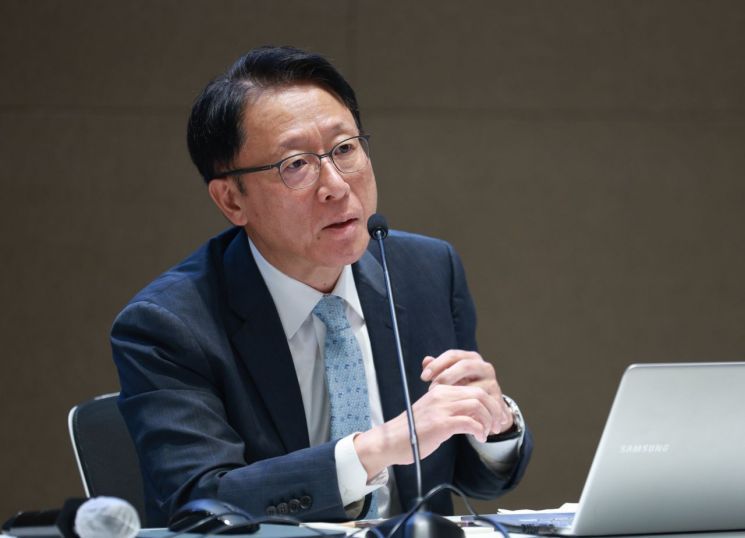
On the same day, Shin attended as the chair of Session 1 at the international finance conference titled "Beyond the Global Great Transformation and Policy Pivot: Sustainable Growth and the Future of Finance," co-hosted by the World Economy Research Institute and KB Financial Group at the Conrad Hotel in Yeouido, Seoul, where he made these remarks.
He pointed out, "According to economic theory, capital moves from low-growth countries to high-growth countries, and if productivity is low, capital moves from Korea to the U.S., causing the dollar to strengthen and the won to weaken. As a result, our exports increase and domestic productivity improves, but in reality, this mechanism does not function."
He continued, "I strongly agree that productivity improvement should be the most important economic growth policy. It should be the highest priority policy for the current government, the next government, and the government after that, but it is not an easy situation." He stressed the importance of deregulation for productivity improvement and asked the panelists how Korea’s deregulation could be accelerated.
Choi Byung-il, Honorary Professor at Ewha Womans University Graduate School of International Studies and a discussant in Session 1, said, "We faced similar questions 10 years ago, but the problem has not changed. It seems each government has forgotten that without a resilient economy, there is no future. The election of Trump will be a new opportunity, so political will is most necessary," he emphasized.
Cho Dong-chul, President of KDI (Korea Development Institute), said, "In all reforms or deregulation processes, political economy is where the interests of the general public are pursued but may conflict with the interests of specific interest groups. In such political economy, we must carefully listen to the voices concerning the interests of the general public." He cited healthcare reform as a representative example.
There was also a question regarding China’s non-performing asset problem. Shin asked, "Many investors doubt whether China can clear non-performing assets in a short period." In response, Nicholas Lardy, Senior Fellow at the Peterson Institute for International Economics (PIIE), said, "It is difficult to know how many non-performing assets exist within the system, so visibility is low. Currently, there seems to be an accountability issue between China’s central and local governments, where neither takes responsibility."
Meanwhile, before the start of Session 1, Shin mentioned that difficulties could be imposed on the Korean economy due to a strong dollar following the U.S. presidential election. He said, "We are at a very important point in the global economy. The U.S. presidential election has taken place, and China, the U.S.’s primary competitor, continues to face difficulties, so there will be many changes worldwide." He added, "Decoupling between the U.S. and China, the possible repeal of subsidies under the Inflation Reduction Act (IRA), and the imposition of tariffs will bring significant challenges to our companies. The strong dollar and the resilient U.S. economy may impose difficulties on the Korean economy."
© The Asia Business Daily(www.asiae.co.kr). All rights reserved.
![Clutching a Stolen Dior Bag, Saying "I Hate Being Poor but Real"... The Grotesque Con of a "Human Knockoff" [Slate]](https://cwcontent.asiae.co.kr/asiaresize/183/2026021902243444107_1771435474.jpg)















