A smuggling and distribution ring attempting to evade customs inspections by disguising the product name was uncovered.
On the 21st, the Incheon Regional Customs Office of the Korea Customs Service announced that it had apprehended 13 members of the smuggling organization, including ringleader Mr. A and domestic distributor Mr. B, on charges of violating the Customs Act, and referred them to the prosecution.
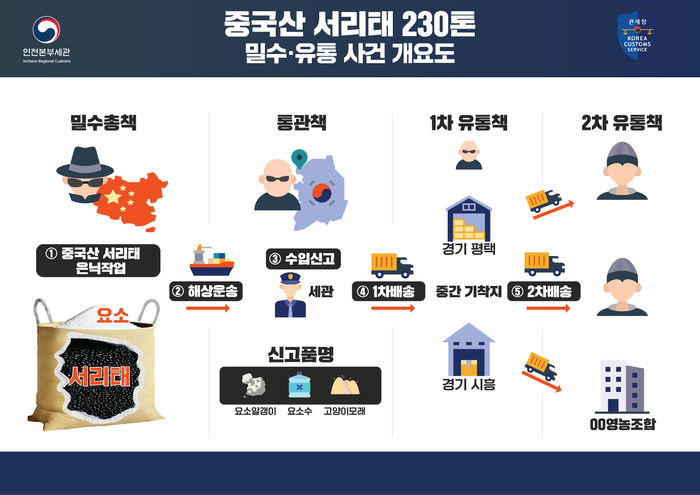
Mr. A and others are suspected of secretly importing 230 tons of Chinese-origin Seoritae soybeans worth approximately 1.3 billion KRW into the country over 19 occasions from November last year to March this year.
They took advantage of the fact that Seoritae is recognized domestically as a “superfood” effective for cancer prevention, anti-aging, and hair loss prevention, and that it is subject to a high tariff rate of 487%, to illicitly profit from smuggling Seoritae.
According to Incheon Customs, Mr. A and his associates committed the crime after learning from media reports that a shortage of urea solution supply would occur in 2023 as it did in 2021, and judged that they could avoid customs inspections when importing urea solution or urea.
In particular, they showed meticulousness by using a method called “shimji bakgi,” where Seoritae was loaded at the bottom of pallets with urea solution stacked on top, or Seoritae was placed at the bottom of ton bags with urea granules poured on top, in preparation for being designated as a customs inspection target.
However, Incheon Customs identified the final destination and buyers of the smuggled goods through CCTV analysis and interviews with cargo transport drivers, and arrested the Chinese suppliers, customs clearance agents, and domestic distributors.
During the investigation, Incheon Customs also confirmed that Mr. B and his spouse, operators of an agricultural cooperative corporation handling domestic agricultural products, purchased 56 tons of Chinese-origin Seoritae (worth approximately 300 million KRW) from the smugglers and distributed it in the market disguised as domestic produce.
An official from Incheon Customs stated, “Certain agricultural products such as Seoritae are subject to high tariffs to protect domestic farmers,” and added, “We will strengthen intelligence gathering and customs inspections to respond to sophisticated smuggling that abuses government customs support policies, like the case of Mr. A and his group.”
They also added, “Agricultural products distributed domestically without formal customs clearance procedures can threaten consumers’ health,” and urged the public to actively report such illegal activities to the ‘Korea Customs Service Smuggling Report Center.’
© The Asia Business Daily(www.asiae.co.kr). All rights reserved.
![Clutching a Stolen Dior Bag, Saying "I Hate Being Poor but Real"... The Grotesque Con of a "Human Knockoff" [Slate]](https://cwcontent.asiae.co.kr/asiaresize/183/2026021902243444107_1771435474.jpg)
















