Blackwell Overheating Concerns Dismissed... "Supplied More Than Expected"
Nvidia Stock Down 2.5% After Hours Amid Growth Slowdown Worries
"Situation Improving" Despite China Export Concerns
Despite Nvidia posting earnings that exceeded expectations, its stock price fell, prompting Jensen Huang, Nvidia's CEO, to once again emphasize the strong demand for the next-generation chip 'Blackwell' and the plan for mass production within the year in an effort to soothe the market.
On the 20th (local time), Nvidia announced that its revenue for the third quarter reached $35.08 billion, with earnings per share (EPS) of $0.81.
This performance surpassed market expectations. According to market research firm LSEG, Nvidia was forecasted to record revenue of $33.16 billion and an EPS of $0.75.
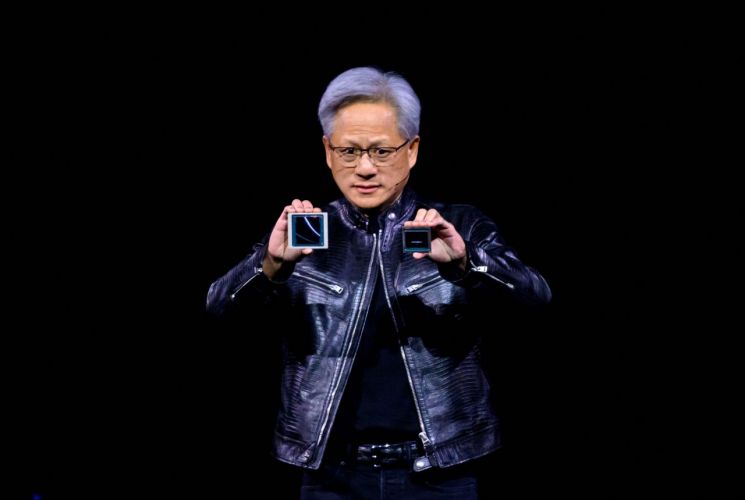
During the conference call that day, numerous questions were raised about the upcoming release of the next-generation graphics processing unit (GPU), Blackwell, which is considered key to future earnings. Nvidia's management emphasized that Blackwell would be officially launched in the fourth quarter, dismissing concerns about overheating issues. CEO Huang stated, "Blackwell production has ramped up," adding, "We will supply more Blackwell units this quarter than previously anticipated." He also said, "The demand for Blackwell is astonishing."
CFO Colette Kress said, "Blackwell shipments are scheduled to begin in the fourth quarter and will increase further next year," noting that demand for Blackwell will significantly outpace supply. She projected that fourth-quarter Blackwell revenue would exceed the initially expected $5 to $6 billion.
Originally, Nvidia planned to launch Blackwell in the second quarter, but the release was delayed due to a design flaw. Nvidia had announced during its second-quarter earnings report that mass production of Blackwell would begin in the fourth quarter. However, recently, IT media outlet The Information reported that Blackwell has issues causing servers to overheat, sparking speculation that the launch might be further delayed.
Nonetheless, CFO Kress forecasted that due to initial costs associated with Blackwell's launch, the gross margin would be in the low 70% range. She stated, "We expect to reach a mid-70% gross margin by the second half of next year." She also mentioned that demand for Hopper, Nvidia's current flagship AI chip, would remain steady despite Blackwell's launch. When asked when Blackwell demand would surpass Hopper's, CEO Huang and others did not provide an answer.
Nvidia's management reiterated the Blackwell launch to address concerns about slowing revenue growth. They forecasted fourth-quarter revenue of $37.5 billion, surpassing the market consensus of $37.1 billion, but Nvidia's recent revenue growth has been slowing. Compared to a year ago, first-quarter revenue grew 262%, second quarter 122%, and third quarter 94%, falling below 100%. If the fourth quarter meets expectations, growth will be in the 70% range year-over-year. Despite this forecast, Nvidia's stock price fell 2.5% in after-hours trading around 8 p.m. that day.
The Wall Street Journal (WSJ) noted, "As Nvidia has grown over the past two years, maintaining dramatic revenue growth rates has become increasingly difficult," adding, "It faces challenges from competitors like AMD and AI chip startups. Some major customers such as Amazon and Google are developing their own AI chips to reduce dependence on Nvidia."
CEO Huang emphasized the strong demand outlook, stating that global trends are driving adoption of Nvidia chips. Computing is shifting from CPU-supported coding to GPU-supported machine learning, and a completely new industry is emerging in the AI field. He said, "Thousands of AI-based startups are emerging that will impact every aspect of the computing experience," and "AI will bring entirely new opportunities."
Exports to China remain a concern. Nvidia released chips with reduced performance for China to comply with U.S. government export restrictions, but competition with Chinese companies is intensifying. Moreover, if former U.S. President Donald Trump returns to the White House next year and implements strong tariffs on China, there is concern about retaliatory trade measures. According to Bloomberg, before advanced technology sanctions were fully enforced in 2021, China accounted for 25% of Nvidia's revenue, but recently that share has dropped to 12%.
CFO Kress commented on the current situation in the Chinese market, saying, "We are shipping Hopper chips that comply with export regulations, so the situation is improving, but revenue will remain lower than if there were no such regulations," while also stating, "We will continue to maintain competitiveness in the Chinese market."
CEO Huang said, "Whatever the new government decides, we will, of course, support the government," adding, "We will comply with all regulations while doing our best to support our customers."
Meanwhile, CEO Huang mentioned memory suppliers such as SK Hynix and Micron when discussing the supply chain. Bloomberg explained, "The important point is that Samsung Electronics, the largest supplier, was not mentioned," suggesting, "This could be another hint that Samsung is currently facing difficulties with memory technology and its ability to supply Nvidia."
© The Asia Business Daily(www.asiae.co.kr). All rights reserved.
![Clutching a Stolen Dior Bag, Saying "I Hate Being Poor but Real"... The Grotesque Con of a "Human Knockoff" [Slate]](https://cwcontent.asiae.co.kr/asiaresize/183/2026021902243444107_1771435474.jpg)
















