The Advantage of Teaching Profession is 'Stability'... 20 Years Ago it was 'Expertise'
Teachers identified student violations and complaints or disturbances from parents as the top sources of stress. The most frequently cited advantage of the teaching profession was "stability." This contrasts with the response from 20 years ago, when "professionalism" was the most mentioned benefit.
The Korea Federation of Teachers' Associations (KFTA) affiliated research institute, the Korea Educational Policy Institute, announced on the 20th the results of a survey on perceptions of teaching culture conducted from June 18 to 30 among 6,050 elementary, middle, and high school teachers. The institute had conducted the same study 20 years ago in 2004.
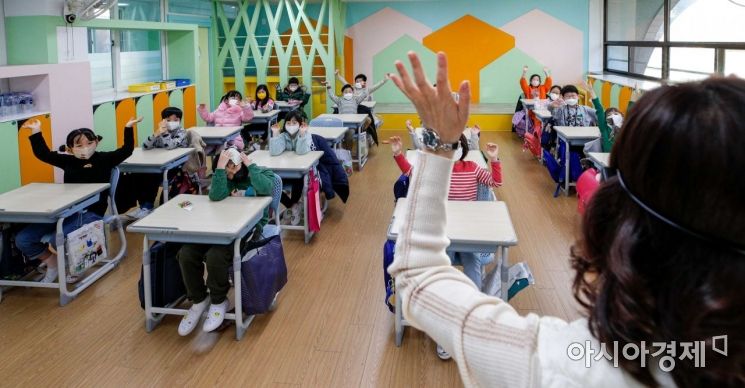 An elementary school classroom during a lesson. Not directly related to the content of the above article.
Comparing the results revealed significant changes in teachers' perceptions of teaching culture over the past 20 years. First, regarding the causes of teacher stress, this year’s top cause was "student violations and complaints/disturbances from parents" (39.8%), which is three times higher than the lowest ranking in 2004 (11.6%). In 2004, the top cause was "work overload" (29.7%).
Regarding obstacles to performing teaching activities, in 2004, "excessive administrative tasks and infringement on autonomy" was the most cited at 57.0%, while "uncooperative attitudes of students and parents" accounted for only 10.3%. In contrast, this year, "uncooperative attitudes of students and parents" rose to 50.1%, while "excessive administrative tasks and infringement on autonomy" dropped to 2.6%, reversing the rankings.
As for the advantages of the teaching profession, this year’s survey showed "job stability" (42.2%) and "time flexibility including vacations" (21.3%) as the first and second most cited. Twenty years ago, "professionalism of the job" (41.4%) and "social recognition and respect" (22.3%) were the main advantages noted. At that time, job stability (9.3%) and time flexibility including vacations (9.8%) were below 10%.
Regarding moments when teachers feel powerless, 64.0% of respondents this year chose "uncooperative attitudes and distrust from students and parents." The response rate for "when education becomes a target of criticism or the value of the teaching profession is diminished," which was the highest in the 2004 survey (52.1%), dropped to 10.1% this year.
Since the enactment of the Student Human Rights Ordinance in 2011, 78.6% responded that "student human rights and rights have become important throughout educational activities." However, 91.3% also said that "teacher authority has declined and difficulties in student discipline have intensified." This figure is higher than the 84.1% who responded in a survey conducted by KFTA last July among over 30,000 teachers nationwide that the Student Human Rights Ordinance affected the decline in teacher authority.
Additionally, 79.7% responded that "a confrontational structure has formed between students and teachers rather than mutual respect." The response rate for "educational activities focusing on academic achievement have become difficult due to guarantees of student rest rights" was 79.0%.
Regarding changes and impacts on the teaching community following the death of a teacher at Seoul Seoi Elementary School, negative responses outweighed positive ones. For the statements "a culture of respect for schools and teachers among students and parents has spread" and "laws and systems protecting educational activities have been supplemented," positive responses were 28.9% and 36.4%, respectively, while negative responses were much higher at 71.1% and 63.6%, respectively.
© The Asia Business Daily(www.asiae.co.kr). All rights reserved.
![Clutching a Stolen Dior Bag, Saying "I Hate Being Poor but Real"... The Grotesque Con of a "Human Knockoff" [Slate]](https://cwcontent.asiae.co.kr/asiaresize/183/2026021902243444107_1771435474.jpg)















