Limited Prosecution Authority of the Corruption Investigation Office Raises Issues
Similar Cases May Occur Again
The High-ranking Officials' Crime Investigation Agency (Gong-su-cheo) and the prosecution engaged in a 'ping-pong controversy' over the bribery case involving an executive of the Board of Audit and Inspection, each shifting responsibility to the other. Although the prosecution agreed to conduct supplementary investigations, bringing the issue to a temporary close, concerns remain that conflicts may recur without institutional improvements. This is because a significant portion of Gong-su-cheo's investigative authority in cases without prosecution rights remains in a legislative vacuum. Legal circles also agree that urgent institutional reforms are needed regarding the detention warrant period for suspects.
Gong-su-cheo’s ‘Fear of Becoming a Police Force’ Behind the ‘Ping-Pong’ Dispute
According to legal sources on the 19th, the Seoul Central District Prosecutors' Office assigned the bribery case involving a Grade 3 executive of the Board of Audit and Inspection to the Anti-Corruption Investigation Division 1 (led by Chief Prosecutor Lee Jun-dong) and plans to conduct supplementary investigations directly.
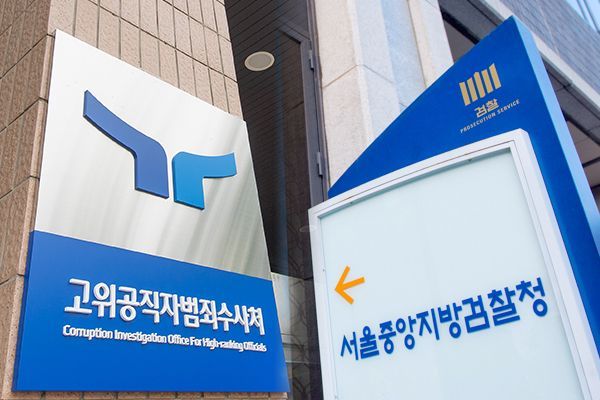
The case involves allegations that Kim, an executive at the Board of Audit and Inspection, received bribes worth approximately 1.5 billion KRW from companies while conducting audits in the SOC sector in 2020. After receiving a request for investigation from the Board of Audit and Inspection, Gong-su-cheo forwarded Kim to the prosecution last November with a prosecution recommendation. The prosecution, in January this year, requested supplementary investigations and re-transferred the case to Gong-su-cheo, but Gong-su-cheo refused to accept the case, citing lack of legal grounds.
It is analyzed that Gong-su-cheo’s refusal to accept the prosecution’s request for supplementary investigations was influenced by concerns about 'being reduced to a judicial police force.' Accepting the prosecution’s supplementary investigations in cases without prosecution rights could give the impression that Gong-su-cheo is acting under the prosecution’s investigative command, akin to judicial police.
Within the prosecution, there is considerable dissatisfaction with Gong-su-cheo’s stance. A senior prosecutor said, “If Gong-su-cheo forwards cases with only basic investigations done and a prosecution recommendation, can the prosecution simply proceed with prosecution as is?”
Institutional Gap Could Lead to ‘Maximum 40 Days Detention’
The conflict between the two agencies is widely seen as stemming from Gong-su-cheo’s dual status. It is a structural problem that Gong-su-cheo’s investigative and prosecutorial powers differ. Gong-su-cheo can directly prosecute only Supreme Court justices, the Prosecutor General, judges and prosecutors, and police officers of rank Superintendent or higher. For other high-ranking officials’ cases, it has investigative authority but no prosecution rights.
When the establishment of Gong-su-cheo was discussed in the National Assembly in 2019, the ruling party, the Democratic Party of Korea, advocated granting both investigative and prosecutorial powers to Gong-su-cheo. However, during the bipartisan agreement process excluding the Liberty Korea Party at the time, prosecution rights were limited, leaving procedural and authority scopes unclear and resulting in an institutional gap.
In particular, the process for handling detention warrants has been criticized for serious institutional gaps. Article 8, Paragraph 4 of the current Gong-su-cheo Act broadly stipulates that Gong-su-cheo prosecutors may apply the duties of prosecutors under the Prosecutors' Office Act. Accordingly, even in cases without prosecution rights, Gong-su-cheo prosecutors can obtain detention warrants for suspects and extend detention for up to 20 days. After the case is transferred to the prosecution, the prosecution can also extend detention separately for up to 20 days, potentially resulting in suspects being detained for a maximum of 40 days.
An anonymous law professor specializing in criminal law at a law school said, “Whether fortunately or unfortunately, all detention warrants requested by Gong-su-cheo have been dismissed so far, so such cases have not yet occurred,” but expressed concern, saying, “Detention periods are limited to protect suspects, but the current legal framework poses a significant risk of infringing on suspects’ human rights.”
Legal experts agree that the only solution is legislation clearly defining case handling procedures and authority scopes. Due to Gong-su-cheo’s independent nature, coordination between agencies through the executive branch is difficult. A law professor from a Seoul-area law school said, “From the perspective of responsible investigation, the agency that starts the investigation should also handle supplementary investigations,” but added, “Since Gong-su-cheo’s independence is also an important issue, the only way is to resolve this through legislation.”
Reporter Im Hyun-kyung, Legal Times
※This article is based on content supplied by Law Times.
© The Asia Business Daily(www.asiae.co.kr). All rights reserved.
![Clutching a Stolen Dior Bag, Saying "I Hate Being Poor but Real"... The Grotesque Con of a "Human Knockoff" [Slate]](https://cwcontent.asiae.co.kr/asiaresize/183/2026021902243444107_1771435474.jpg)















