Russia Changes Doctrine on Nuclear Use
US Approves Long-Range Weapons for Ukraine in Response
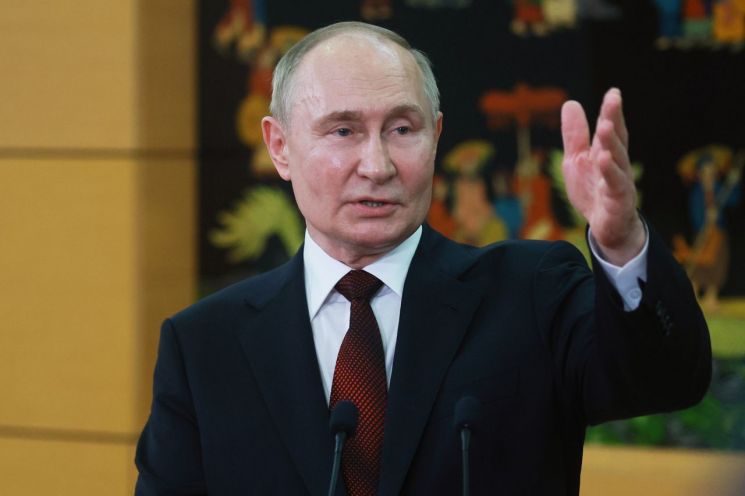
Russia has changed its nuclear doctrine to allow the use of nuclear weapons against non-nuclear-weapon states supported by nuclear-weapon states.
This appears to be aimed at Ukraine, which is supported by Western nuclear-weapon states (the United States, the United Kingdom, and France).
According to TASS news agency on the 19th (local time), Russian President Vladimir Putin signed a presidential decree (Basic Principles of the Russian Federation's Nuclear Deterrence Policy) approving the revised national policy foundation in the field of nuclear deterrence (nuclear doctrine) on that day.
The revised nuclear doctrine takes effect from that day.
According to the nuclear doctrine document, Russia considers any attack by a non-nuclear-weapon state supported by a nuclear-weapon state as a joint attack.
It also explicitly states in the doctrine the right to consider nuclear retaliation if there is a conventional weapon attack threatening sovereignty, a massive launch of enemy aircraft or missiles against Russian territory, or an attack on its ally Belarus.
This is seen as a response to the recent allowance by the United States for Ukraine to use long-range missiles to strike the Russian mainland.
Dmitry Peskov, Kremlin spokesperson, warned at a briefing that day, "If Ukraine uses Western non-nuclear missiles, nuclear retaliation may follow."
As the United States approved the use of long-range weapons at Ukraine's request, Russia responded by revising its nuclear doctrine to expand the scope and targets of nuclear weapon use.
In an interview with TASS on the same day, spokesperson Peskov said, "(The nuclear doctrine revision) has not yet been formalized but has already been practically formalized," and predicted, "It will be formalized as needed."
© The Asia Business Daily(www.asiae.co.kr). All rights reserved.
![Clutching a Stolen Dior Bag, Saying "I Hate Being Poor but Real"... The Grotesque Con of a "Human Knockoff" [Slate]](https://cwcontent.asiae.co.kr/asiaresize/183/2026021902243444107_1771435474.jpg)















