Yoon Administration Unveils Second Half Initiatives in Science and Technology Sector
Park Sang-wook, Chief Secretary for Science and Technology at the Presidential Office, stated, "Although our scientific innovation ecosystem is evaluated as one of the top in the world, there are some longstanding weaknesses," and emphasized, "These must be overcome in the second half of the Yoon Suk-yeol administration through five key initiatives."
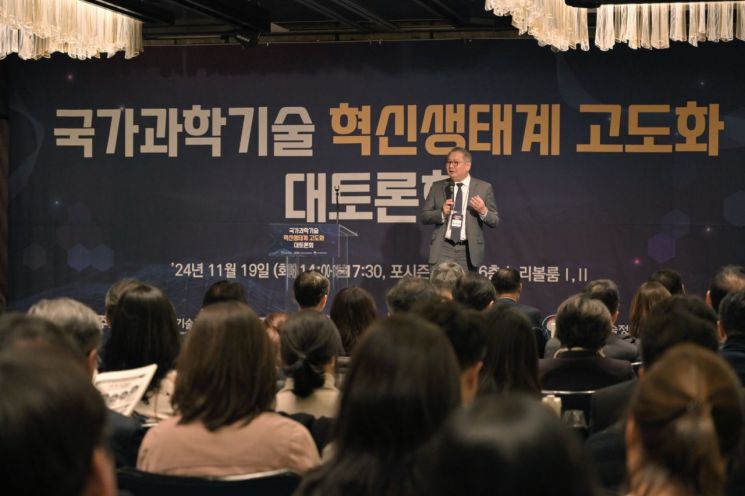 Sangwook Park, Senior Secretary for Science and Technology at the Presidential Office, is speaking at the National Science and Technology Innovation Ecosystem Advancement Forum held on the 19th. Photo by Ministry of Science and ICT
On the 19th, at the 'National Science and Technology Innovation Ecosystem Advancement Forum' held at the Four Seasons Hotel in Jongno-gu, Seoul, Chief Secretary Park introduced the policy achievements of the Science and Technology Secretariat, presenting the proposal for a leading national science and technology innovation system, the establishment of a presidential initiative for three major game-changing technologies, the establishment of governance and abolition of preliminary feasibility studies for research and development (R&D), and research living allowances for graduate students in science and engineering as achievements, followed by five major focus tasks to overcome persistent weaknesses.
The tasks proposed by Chief Secretary Park are ▲ upgrading the public research sector of universities and government-funded research institutes ▲ qualitative transition to leading basic research ▲ global science and technology cooperation ▲ fostering the technology commercialization market ▲ and advancing R&D management.
Chief Secretary Park stated, "We used to view government-funded research institutes as targets for reform, but now we no longer see them that way. Even advanced countries overseas envy our research institutes," and added, "Except for the two transferred to the Space Agency, the fact that 23 research institutes each have their own campuses needs improvement."
Park's remarks are interpreted as pointing out that despite the policy to break down barriers between research institutes mentioned in the improvement plan announced earlier this year, barriers still exist. He said that a status check will be conducted to review the implementation of breaking down these barriers. He continued, "Researchers are producing world-class results in basic research, but a support system commensurate with that level is necessary," and added, "The research ecosystem is too confined within national borders and lacks openness, so to overcome economies of scale, it must be opened to a global innovation ecosystem."
Chief Secretary Park also emphasized the need to actively promote the commercialization of technologies developed by research institutes. He said, "Technology commercialization started 30 to 40 years later than major advanced countries but has grown well; however, since it has been government-led, it has been pushed in a top-down manner," and suggested, "Research administration should move away from the perception of mere receipt processing and be advanced so that it can become a partner to researchers, allowing them to focus more on their research."
Regarding the directions presented that day, Chief Secretary Park said, "This is the first time we are unveiling the work that has been quietly carried out with experts over the past nine months since the launch of the Science and Technology Secretariat," and emphasized, "These five tasks are the directions to push forward the reform of the science and technology innovation ecosystem in the second half of the Yoon Suk-yeol administration."
At the event, researchers also presented on each of the initiatives.
Jang Jun-yeon, Deputy Director of the Korea Institute of Science and Technology (KIST), proposed a 'wall-breaking' strategy between universities and research institutes in his capacity as a member of the Science and Technology Advisory Committee. Lee Joo-won, a professor at Sungkyunkwan University, suggested transitioning to a tailored support system for the 'research growth stage' to shift to basic research.
Son Seok-ho, Head of the Korea Institute of Science and Technology Evaluation and Planning (KISTEP), emphasized the need for institutional improvements to enable overseas researchers to be utilized as our researchers, leveraging the expansion of global R&D investment. Son Su-jeong, Senior Research Fellow at the Science and Technology Policy Institute (STEPI), pointed out that the low level of technology industrialization is due to government-led, push-style technology transfer and commercialization, highlighting the inadequacy of the compensation system, and proposed fostering specialized companies to promote commercialization regardless of the affiliated research institutions.
Jung Yoo-han, a professor at Dankook University, suggested improving the research system so that researchers and research administrators can work as a 'one team.'
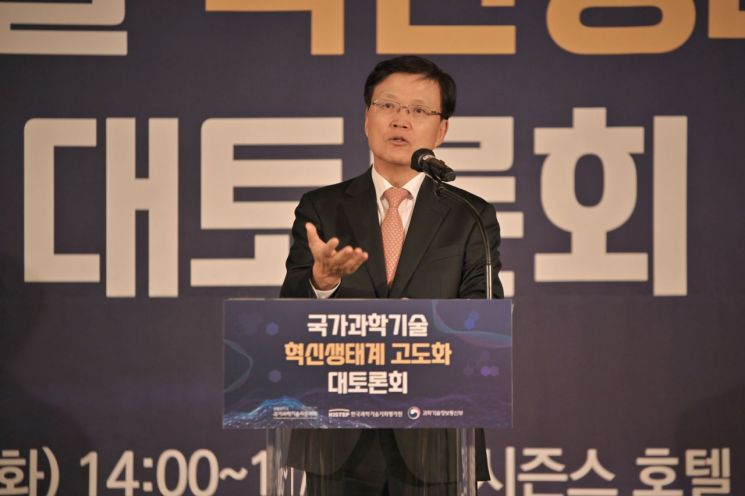 Choi Yang-hee, Vice Chair of the National Science and Technology Advisory Council, is delivering a welcome speech at the National Science and Technology Innovation Ecosystem Advancement Forum held on the 19th. Photo by Ministry of Science and ICT
Choi Yang-hee, Vice Chair of the Advisory Council, said, "We had a follower-type, developing country-style R&D system, but now it is essential to transition to a leading science and technology innovation ecosystem," and added, "We will promote various opinion-gathering activities to ensure continuous communication and cooperation with the research field."
© The Asia Business Daily(www.asiae.co.kr). All rights reserved.


















