Presentation of Tasks in Culture, Sports, and Tourism
Reviewing Key Achievements Including Cheongwadae Opening
Responding to Future Cultural Environment with AI Innovation and Overseas Market Expansion
Emphasizing Tourism Industry Innovation through Regional Tourism Ecosystem Development
The Ministry of Culture, Sports and Tourism presented policy tasks for the second half of the Yoon Suk-yeol administration’s term in the fields of culture, arts, sports, and tourism, including AI innovation, overseas market development, and the creation of regional tourism ecosystems.
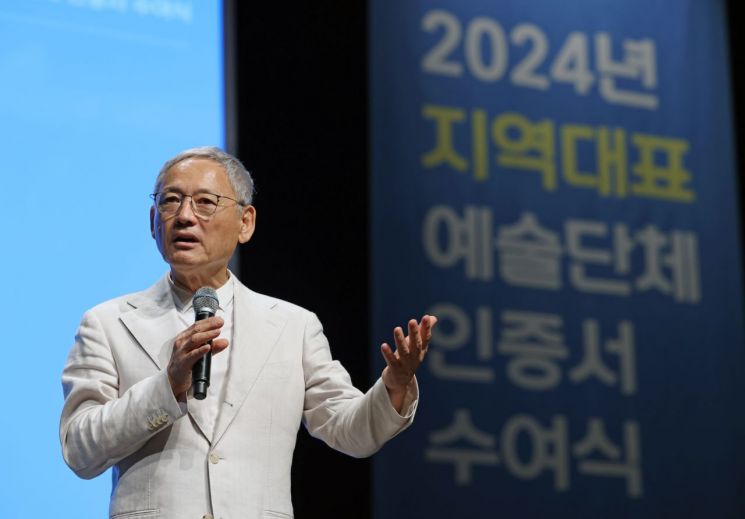 Yoon In-chon, Minister of Culture, Sports and Tourism, is speaking at the certificate awarding ceremony for the 2024 Regional Representative Art Organizations held at the Multi-space of the National Museum of Modern and Contemporary Art, Seoul, Jongno-gu, on the 23rd. Photo by Yonhap News
On the 19th, the Ministry of Culture, Sports and Tourism announced the achievements so far and future policy plans for the culture, arts, sports, and tourism sectors, marking 2 years and 6 months since the government’s launch.
Key achievements in the culture, arts, sports, and tourism sectors include △ opening the Blue House to the public △ achieving record-high sales in the content industry and spreading K-Culture △ expanding cultural welfare △ creating an environment for artists’ creative activities △ fostering a culture of sports participation among the public △ supporting domestic travel and attracting foreign tourists.
Since the Blue House was opened in May 2022, the government has restructured it into a complex cultural space based on four core contents: history, culture and arts, cultural heritage, and trees, and prepared over 100 programs such as concerts, special exhibitions, and festivals for disabled artists to enable the public to enjoy diverse cultural activities. As a result, the cumulative number of visitors has surpassed 6.58 million, establishing it as a representative attraction connecting the city and nature.
Additionally, to make the Blue House area a representative hub of Korean tourism, a 'Blue House K-Tourism Landmark Declaration Ceremony' was held in April last year, introducing ten major tourist courses linking the Blue House, Gyeongbokgung Palace, Seochon and Bukchon neighborhoods, museums and art galleries, and K-Climbing.
The content industry, including K-pop, movies, and games, achieved record sales of 151 trillion won in 2022 (128 trillion won in 2020) and exports of 13.2 billion dollars (11.9 billion dollars in 2020). In particular, to resolve funding difficulties within the content industry and produce content capable of competing in the global market, policy financing for the content industry was expanded to a record high of 1.74 trillion won (503.9 billion won in 2021).
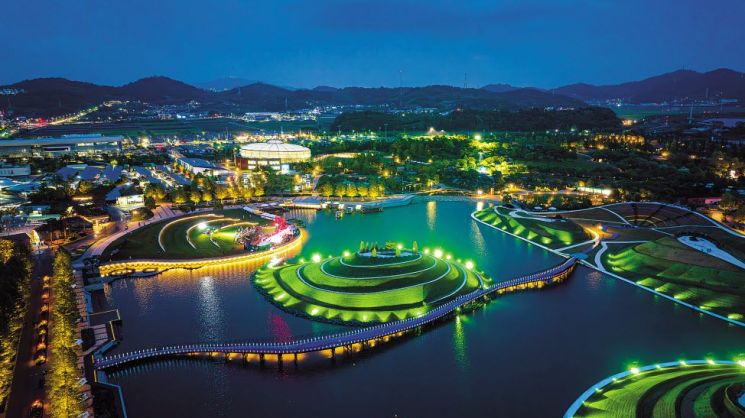 Night view of Suncheonman National Garden in Suncheon City, selected as a Cultural City of the Republic of Korea.
 Photo by Suncheon City
Future tasks prioritize 'AI innovation' and 'overseas market development.'
In the AI era, the Ministry of Culture, Sports and Tourism plans to establish future strategies for the content industry and prepare reasonable laws and systems to protect creators’ rights, such as AI copyrights, actively responding to the new future cultural environment.
The ministry also plans to create a 'Global League Fund' to attract overseas capital and support the content industry’s resurgence, aiming to build a world-class 'K-Content Complex Cultural Zone.' Other policies include supporting airfare for overseas performances and exhibitions by cultural artists, hosting large-scale Hallyu festivals for foreign tourists (in June), and reorganizing overseas cultural center touring programs to be more demand-oriented.
Furthermore, leveraging the Asia-Pacific Economic Cooperation (APEC) summit to be held next year in Gyeongju, Gyeongbuk, the government announced plans to establish a 'High-Level Meeting on Culture in the Asia-Pacific Economic Cooperation' attended by culture ministers from various countries.
The government will also actively address social issues such as regional extinction and low birth rates through culture.
From next year, 20 billion won will be invested over three years in the 'Korea Cultural Cities' policy utilizing unique regional cultural resources, and efforts will be made to reduce cultural disparities between regions by supporting customized cultural programs in culturally vulnerable areas. New cultural policies related to low birth rates will also be promoted, including creating a children’s complex cultural space and content experience center around Yongsan Children’s Garden and establishing the National Children and Youth Theater Company.
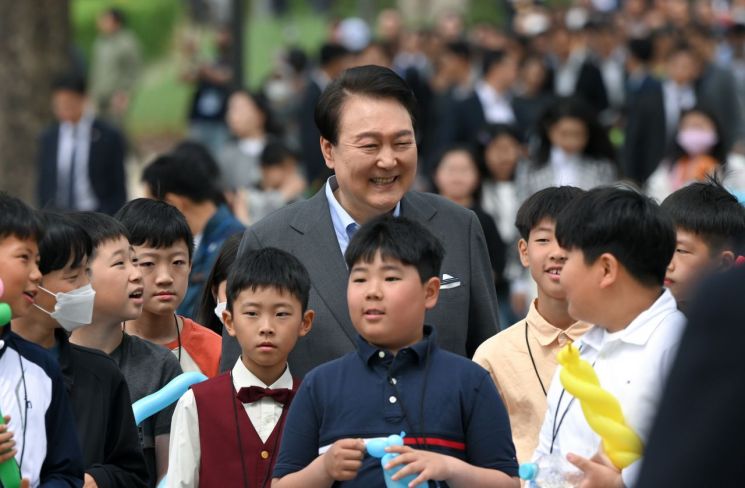 President Yoon Suk-yeol is smiling brightly with children at the opening event of the Yongsan Children's Garden, created in the front yard of the Yongsan Presidential Office in Seoul on the 4th. Photo by the Presidential Office Press Photographers Group
Moreover, cultural welfare support such as integrated cultural vouchers and sports lesson vouchers will be expanded, and efforts will be made to reduce disparities in cultural enjoyment according to social conditions, including increasing special grants for promising young athletes.
The Ministry of Culture, Sports and Tourism also announced plans to reform outdated practices in the sports sector and create a free and fair training environment. To this end, a 'Sports Innovation Support Division' will be established within the ministry to eradicate unfair practices in sports and establish a transparent sports administration system. Legal and institutional improvements will be pursued, such as delegating the review of reappointments of sports organization executives to a separate body and raising disciplinary jurisdiction over sports organization executives. Approximately 41.6 billion won of the living sports budget previously supported through the Korea Sports Council will be converted into local cooperation projects. Along with this, execution and performance management of the National Sports Promotion Fund projects will be strengthened.
The government also presented a blueprint to shift the growth axis of tourism to regions by changing the tourism policy framework. To support the local era, tourism legislation will be revised, and tourism industry innovation will be promoted to create regional tourism ecosystems. New policies such as the 'Small-scale Tourism Complex System,' which relaxes facility standards for depopulated areas, and 'K-Tourism Islands You Want to Visit' and 'K-Tourism Leisure Belts' to promote regional tourism investment will be implemented.
To increase the length of stay and expenditure of foreign tourists visiting Korea, the government will focus on expanding tourism content linked to K-Culture. For this, tourism content capturing the charm of every corner of Korea, such as nationwide bicycle tours and historical site tours, will be continuously expanded.
© The Asia Business Daily(www.asiae.co.kr). All rights reserved.
![Clutching a Stolen Dior Bag, Saying "I Hate Being Poor but Real"... The Grotesque Con of a "Human Knockoff" [Slate]](https://cwcontent.asiae.co.kr/asiaresize/183/2026021902243444107_1771435474.jpg)

















