Climate Action Network Names Korea Today's Fossil Award Winner
South Korea Ranks 2nd in Public Fossil Fuel Export Finance Over Past 3 Years
"Korea Is Blocking Fossil Fuel Finance Restrictions"
 On the 18th (local time) at the 29th United Nations Climate Change Conference of the Parties (COP29) held in Baku, Azerbaijan, South Korea was awarded first place for the "Fossil of the Day" by the international environmental organization Climate Action Network. Photo by Climate Solution
South Korea has been dishonorably ranked as the number one climate villain. It was named the recipient of the ‘Fossil of the Day’ award, given to the country that most obstructs global climate negotiations. The reasons cited for the award included South Korea’s leading role in fossil fuel export financing and its active opposition to the international community’s emission reduction efforts.
The international environmental organization Climate Action Network selected South Korea as the top Fossil of the Day on the 18th (local time) at the 29th United Nations Climate Change Conference of the Parties (COP29) held in Baku, Azerbaijan. Climate Action Network is an organization comprising over 2,000 environmental groups from 150 countries worldwide. Since 1999, it has annually awarded the country that delays climate negotiations the most. South Korea was first listed as a recipient in third place last year.
Kevin Burkland, an activist with Climate Action Network, stated, “Among the 37 countries currently negotiating under the Organisation for Economic Co-operation and Development (OECD) in Paris, 30 have already joined efforts to restrict fossil fuel financing, but today’s recipient (South Korea) is blocking this.” He added, “BTS, Samsung, and Samgyeopsal might make South Korea a trendsetter, but when it comes to fossil fuel financing, South Korea remains stuck in the past.”
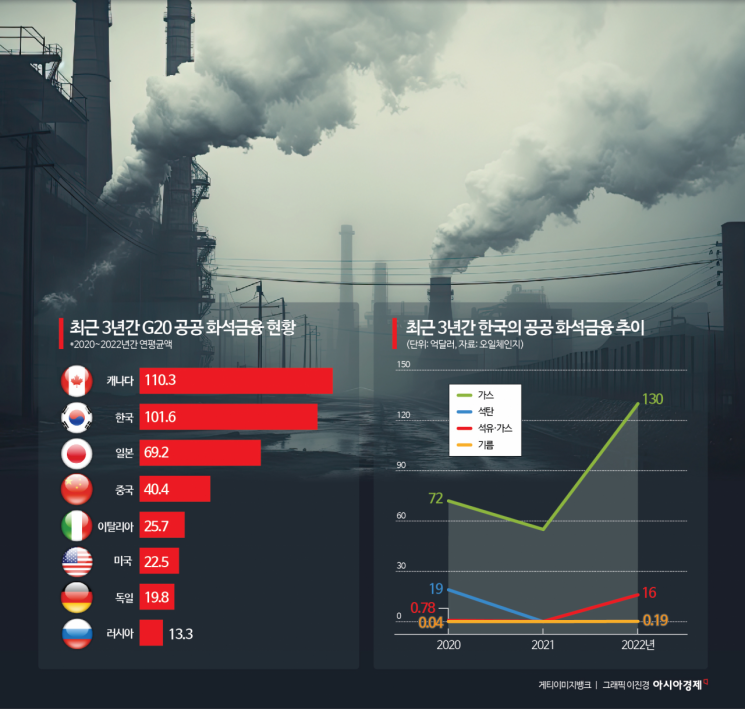
Among the Group of Twenty (G20) countries, South Korea ranks second after Canada in the amount of public finance invested in fossil fuels. According to the climate environmental group Oil Change, from 2020 to 2022, South Korea’s public finance institutions such as the Korea Development Bank, Export-Import Bank of Korea, and Korea Trade Insurance Corporation invested an average of $10.16 billion (approximately 14.22 trillion KRW) annually in fossil fuels. The difference with Canada, which ranks first, is $870 million. Compared to Japan ($6.92 billion), China ($4.04 billion), and Italy ($2.57 billion), South Korea’s amount is overwhelmingly higher.
Fossil fuel export financing is on the rise, especially in gas investments. Export financing for the gas sector, which was around $6 billion in 2017, increased significantly to $13 billion in 2022.
The international community is discussing restrictions on fossil fuel export financing, and South Korea’s opposition to these measures has also been criticized. According to major foreign media such as Bloomberg, in September, the OECD planned to expand the ‘ban on unlimited financing of coal-fired power plants.’ Although most participating countries supported the measure, the South Korean government opposed it due to concerns over energy security and fair competition, reportedly causing the negotiations to collapse.
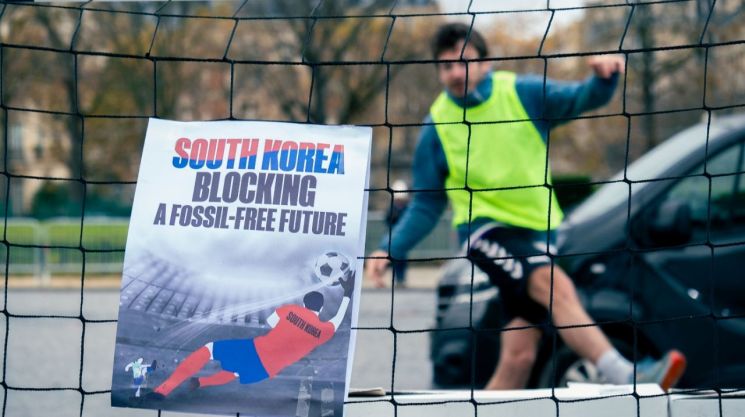 On the 18th (local time) in Paris, France, the environmental group 'Stop Total' held a performance. It symbolized that a goalkeeper named Hanguk is BLOCKING a future without fossil fuels. Photo by Climate Solution
Protests by international environmental groups also followed. Flavi Mahalin, an activist with the environmental group Stop Total, which led the condemnation protest in Paris that day, said, “I joined the criticism to express deep concern over the massive financial support promised by the Export-Import Bank of Korea for the Mozambique liquefied natural gas (LNG) project led by the French oil company TotalEnergies.” She added, “We strongly urge the South Korean government to cease providing public finance for fossil fuel projects.”
In South Korea, a condemnation press conference was also held. At a protest press conference held in front of the Export-Import Bank of Korea in Yeouido, Seoul, on the same day, Greenpeace activist Yang Yeon-ho said, “The government’s opposition to halting financial support for LNG projects in the OECD negotiations is an act that ignores international commitments and responsibilities to reduce methane emissions and declares to the international community that it has no intention of achieving carbon neutrality goals.” He continued, “We urge the government to break free from gas addiction and participate in international cooperation toward fossil fuel phase-out with a progressive attitude.”
© The Asia Business Daily(www.asiae.co.kr). All rights reserved.
![Clutching a Stolen Dior Bag, Saying "I Hate Being Poor but Real"... The Grotesque Con of a "Human Knockoff" [Slate]](https://cwcontent.asiae.co.kr/asiaresize/183/2026021902243444107_1771435474.jpg)

















