"We don't need to participate directly"
"Need to supplement to enhance Ukraine's defense capability"
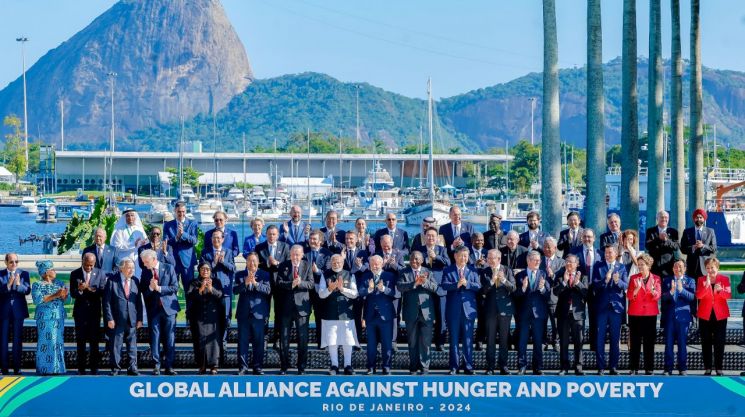 President Yoon Suk-yeol (eighth from the left in the middle row) is attending the 19th G20 Summit held at the Museum of Modern Art in Rio de Janeiro, Brazil, on the 18th (local time), and is taking a commemorative photo with G20 leaders and heads of international organizations who participated in the launch of the Global Alliance for the Eradication of Hunger and Poverty. Photo by Yonhap News
On the 18th (local time), the Presidential Office stated that the U.S. government’s decision to allow Ukraine to use the long-range missile 'ATACMS' capable of striking Russian mainland was "pre-notified to us by the U.S. side that they would extend the range of ATACMS (already provided to Ukraine) to permit strikes on Russian mainland."
A senior official from the Presidential Office, speaking to reporters at the press center in Rio de Janeiro, Brazil, where the G20 summit was being held, responded to a question about whether the U.S. had shared information on the approval of ATACMS use in advance by saying, "When the U.S. makes a decision, they inform us ahead of time." However, the official added, "It is not a matter to explain in detail enough to disclose to the media," and elaborated, "Since our country does not need to directly participate or act on this issue, we have only shared the U.S. decision to that extent."
Regarding support for Ukraine’s weapons, the official indicated that they will closely monitor the situation and respond accordingly. The senior official said, "If Russia and North Korea continue to ignore the international community’s recommendations and do not cease cooperation in the Ukraine war, it will be necessary to supplement Ukraine’s ability to defend itself," adding, "NATO, the U.S., and South Korea, as a U.S. ally, also need to pay closer attention and care about this issue going forward."
"No Decision Yet on Ukraine Weapons Support"
However, regarding specific weapons support plans, the official explained that NATO and the Biden administration are handling the situation, and South Korea will make a judgment after hearing from the Ukrainian special envoy delegation first. While weapons systems necessary between the South Korea-U.S. alliance can be exchanged, no decision has been made yet with Ukraine in mind, and no concrete discussions have started.
When asked about prospects for ending the Ukraine war with Trump’s return to power and the South Korean government’s strategy, the official said, "Even if talks begin to reach a peace agreement, the current occupied territories are important, so Russia and Ukraine are doing their best in battle before the end of the year." He added, "This is not a policy issue now," and continued, "Since it is easy to predict that the fighting will intensify over the next two months before remaining uncertainties arise, South Korea will seriously review the situation with its allies, share information, and make judgments."
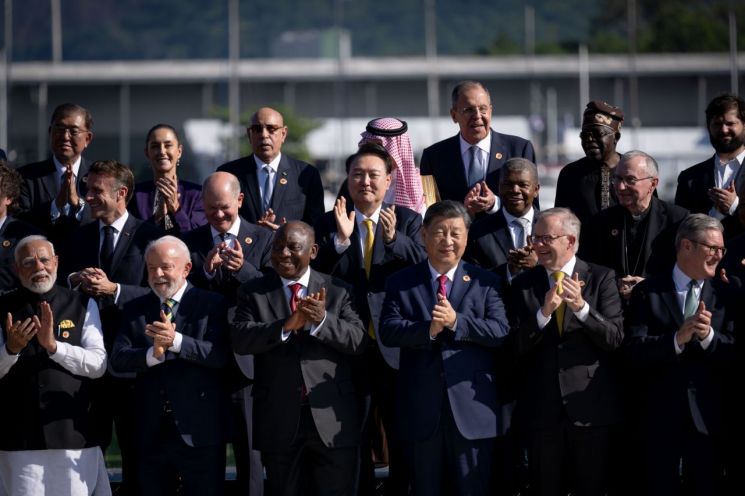 President Yoon Suk-yeol (center) is attending the 19th G20 Summit held at the Museum of Modern Art in Rio de Janeiro, Brazil, on the 18th (local time), and is taking a commemorative photo with G20 leaders and heads of international organizations who participated in the launch of the Global Alliance to End Hunger and Poverty.
Photo by hihong@yna.co.kr, Yonhap News
"No Change in South Korea-China Diplomatic Policy... Not a Shift to Pragmatic Diplomacy"
Additionally, a senior official from the Presidential Office stated that there is no change in the diplomatic policy prioritizing national interests despite recent perceived changes in South Korea-China relations following Trump’s return to power.
When asked by reporters about President Yoon Suk-yeol’s remark in an interview with Brazilian media that "The U.S. and China are not a matter of choice for South Korea," and whether it signified a change in diplomatic strategy, the official said, "Our strategy has not changed even once in the past two and a half years." Although there was analysis that the value-based diplomacy centered on the South Korea-U.S. alliance might shift to pragmatic diplomacy as South Korea and China held a summit for the first time in two years on the 15th and Chinese President Xi Jinping is likely to attend the Asia-Pacific Economic Cooperation (APEC) summit in Gyeongju next year, the official dismissed this, saying, "That is not correct."
The official who mentioned, "Our strategy has not changed even once in the past two and a half years," emphasized, "Our diplomacy prioritizes national interests, one being securing security and the other securing economic benefits. In seeking transparent, consistent, and predictable partners, it so happened that those countries shared tendencies toward freedom, values, and democracy."
Regarding future South Korea-China relations strategy, the official explained, "Our country has always paid attention to South Korea-China relations, and maintaining high-level consultations and communication is most important," adding, "China is a country with a party-centered, disciplined socialist decision-making process, so once decisions are made at the top, they are implemented swiftly." The official said, "Activating high-level government-to-government dialogue tends to lead to improved relations."
Xi Jinping’s Conciliatory Gesture Toward South Korea... Suggests Thawing Mode
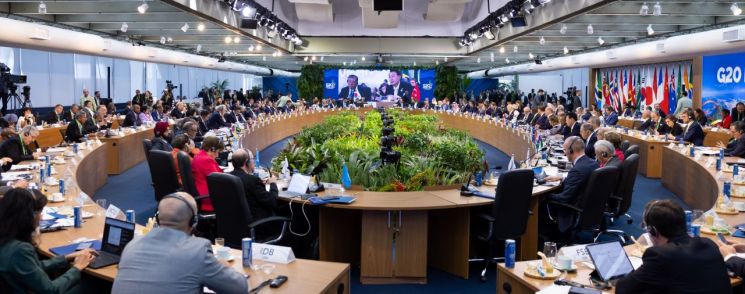 On the 18th (local time), the 1st session of the 19th G20 Summit is being held at the Museum of Modern Art in Rio de Janeiro, Brazil, with President Yoon Suk-yeol in attendance. Photo by Yonhap News.
While the Presidential Office gave a principled response that "South Korea-China diplomatic strategy remains unchanged," diplomatic experts view that given the rapidly changing global situation with the start of Trump’s second term, changes in South Korea’s China diplomacy strategy are inevitable. On the 1st, China included South Korea among countries eligible for a 'unilateral visa-free policy' allowing stays of up to 15 days for tourism and business purposes, which is analyzed as a signal for improving South Korea-China relations. China is focusing on conciliatory gestures toward South Korea by appointing the long-delayed 'Chinese Ambassador to South Korea.'
At the South Korea-China summit on the 15th, President Xi’s response regarding the Korean Peninsula issue, moving away from his previous unilateral support for North Korea by stating "We do not want tensions on the Korean Peninsula," also signals change. Especially, if President Xi’s visit to South Korea next year is realized, it would be the first in 11 years since July 2014, suggesting a thawing mode in South Korea-China relations.
A senior official from the Presidential Office added, "It is encouraging that high-level talks have accelerated, become more frequent, and deepened since May, and going forward, the two countries will work to achieve concrete results in free trade negotiations, trade cooperation, and human and cultural exchanges."
© The Asia Business Daily(www.asiae.co.kr). All rights reserved.
![Clutching a Stolen Dior Bag, Saying "I Hate Being Poor but Real"... The Grotesque Con of a "Human Knockoff" [Slate]](https://cwcontent.asiae.co.kr/asiaresize/183/2026021902243444107_1771435474.jpg)

















