High Efficiency in National Fund Matching Project Budget Investment
City Budget Input Achieves Results → Positive Participation of PhD-Level Experts
How should Busan establish an efficient research and development investment strategy?
A study revealed that the investment-to-creation effect of national matching projects is higher than that of Busan City's own projects. Additionally, the efficiency increased with the involvement of more doctoral-level senior researchers.
Busan Institute of Science and Technology Promotion (BISTEP, Director Kim Young-bu) announced on the 19th that it published the "No. 9 Industry & Innovation Brief," which empirically analyzed the investment efficiency of Busan's research and development projects on the 15th.
This report analyzed the investment efficiency of 262 Busan City R&D projects across six categories (△support type △project type △industry classification △institution type △number of doctoral-level participants △solo/joint execution). Investment efficiency was calculated as a relative figure based on budget investment against five performance areas (△published papers △intellectual property creation △commercialization sales △technology transfer fees △direct and indirect employment).
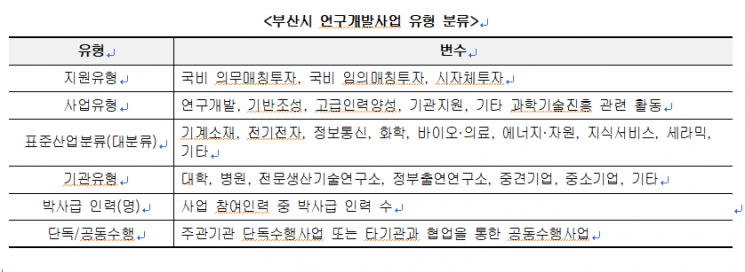
The analysis showed that the efficiency of national matching projects (both voluntary and mandatory) was higher compared to the city's own investment projects.
Since national matching projects use additional national funds beyond Busan City's budget, they demonstrated higher efficiency from the perspective of Busan City's budget input. Furthermore, projects with higher efficiency tended to have a greater number of doctoral-level personnel among participants, and as the number of such personnel increased, the efficiency index also tended to rise, confirming that the participation of doctoral-level researchers positively influences project efficiency.
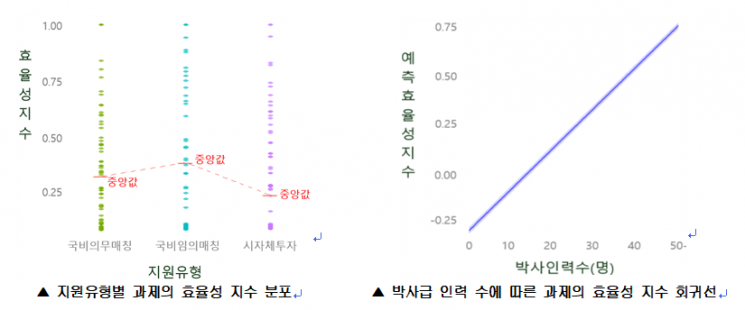 Distribution of Efficiency Index by Support Type of Projects (Left) and Regression Line of Project Efficiency Index According to Number of PhD-Level Personnel.
This suggests that continuous efforts are needed to attract national projects and cultivate high-level personnel in common areas of national science and technology policy and Busan City's science and technology policy.
The report also proposed promoting the city's own projects not merely based on individual project performance but as project-type initiatives aimed at resolving blind spots in national policy and creating synergy with national projects, thereby enhancing the overall efficiency of research and development projects. It emphasized the need for policy support that enables not only the cultivation of high-level personnel but also their settlement in the region and participation in research and development.
Researcher Lim Hyung-bin of BISTEP stated, “Since efficient allocation and investment of limited regional R&D budgets are essential, it is meaningful that we diagnosed the investment efficiency by type of Busan R&D projects and presented implications to improve efficiency. If investment strategies are effectively established and implemented based on an in-depth diagnosis of R&D investment, the contribution of R&D investment to regional innovation will increase further.”
© The Asia Business Daily(www.asiae.co.kr). All rights reserved.
![Clutching a Stolen Dior Bag, Saying "I Hate Being Poor but Real"... The Grotesque Con of a "Human Knockoff" [Slate]](https://cwcontent.asiae.co.kr/asiaresize/183/2026021902243444107_1771435474.jpg)

















