Large-scale Operation of the So-called 'KK Project'
Identity Theft, Forgery of Seals and Documents
A group that fabricated documents to deceive the embassy by making it appear as if foreign athletes were participating in a competition and then illegally employed them at fish farms across the Gyeongnam region was caught by the Coast Guard.
On the 19th, the Changwon Coast Guard in Gyeongnam announced that they had arrested and sent marathon runner A, 29, to prosecution on charges of violating the Immigration Control Act, and sent former marathon coach B, 52, and A’s common-law spouse C, 33, to prosecution without detention for aiding the crime.
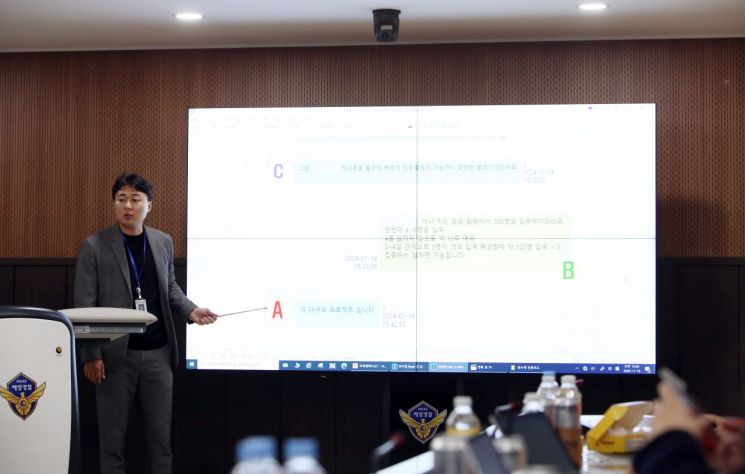 Jang Seok-gyun, head of the Information and Foreign Affairs Division at Changwon Coast Guard, is explaining the incident. Photo by Lee Se-ryeong
A and others are accused of fabricating documents to obtain visas by making it appear that Kenyan athletes wishing to work in Korea were invited as pacemakers for domestic marathon competitions, and then illegally employing them.
According to the Changwon Coast Guard, A is a current athlete affiliated with the ㄱ Sports Council in the Gyeonggi area, and B is a former coach affiliated with the ㄴ County Sports Council in the Chungnam area; the two were confirmed to have been senior and junior members of the same sports council in the past.
Since December last year, the group planned a so-called ‘KK Project (Kenya-Korea Project)’ aiming to recruit 300 Kenyan workers both domestically and in Kenya, and began full-scale implementation from January this year.
This project involved posting promotional videos on social networking services (SNS) claiming that work at Korean fish farms is easy and well-paid, recruiting foreign athletes who wanted to work in Korea, sending false invitation letters to the Korean Embassy in Kenya to induce their entry into Korea, and then illegally employing them.
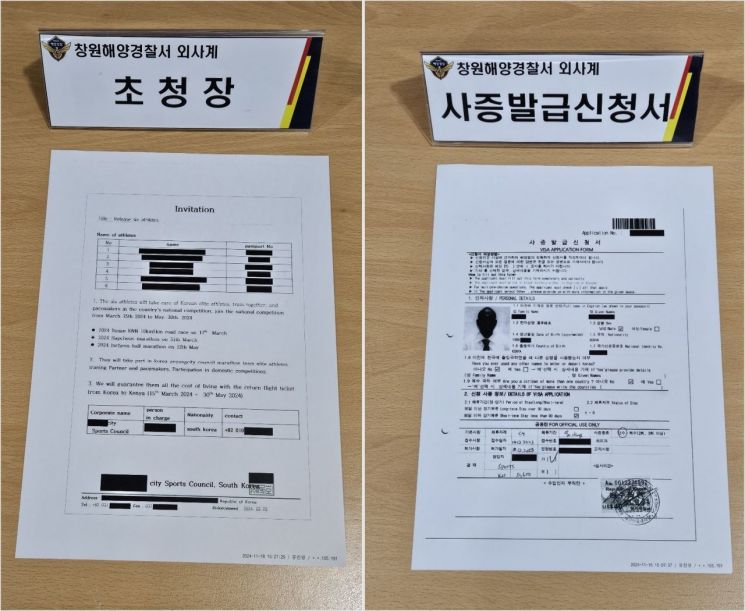 Invitation letter and visa application form for a domestic marathon event forged by the group. Photo by Se-ryeong Lee
Starting around January this year, the group posted videos to recruit athletes and forged documents to make it appear as if these athletes were participating as pacemakers helping runners in domestic marathon competitions.
In this process, they stole the name of D, a naturalized marathon runner in Kenya, and forged seals of sports councils from four local governments?Gyeongnam, Gyeonggi, Chungnam, and Gangwon?to create false invitation letters.
They sent the forged documents along with the athletes’ genuine athlete certificates to the Korean Embassy in Kenya, requested sports competition participation visas (C-4-5) for 26 athletes, and successfully brought seven visa holders into Korea.
The athletes who entered the country were illegally employed at fish farms in Tongyeong, Geoje, and Goseong areas through employment brokers such as E, and worked until July this year.
A and others featured two Kenyan athletes working at fish farms in promotional videos for the project and also collected approximately 34 million KRW in wages that the athletes should have received for working at the fish farms into their own accounts.
Before the 90-day sports participation visas expired, the athletes obtained medical certificates citing pre-existing illnesses to extend their visas and continued illegal employment.
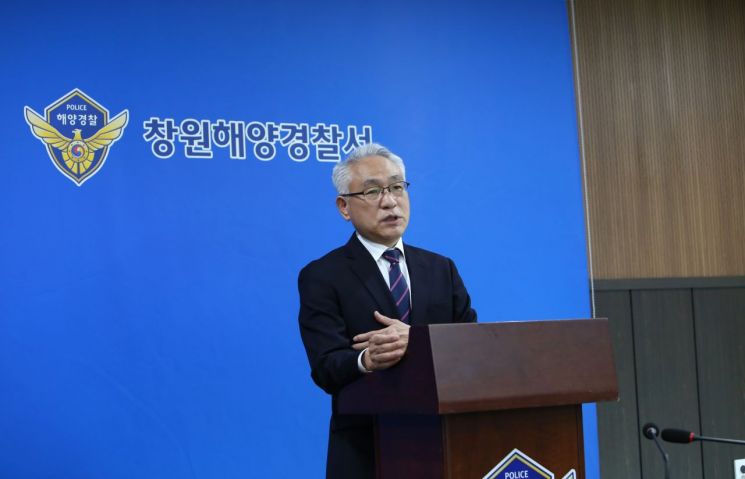 Hwang Chang-seop, Head of the Information and Foreign Affairs Division at Changwon Coast Guard, is answering questions from reporters related to the incident. Photo by Lee Se-ryeong
Hwang Chang-seop, head of the Intelligence and Foreign Affairs Division, explained, “Kenya does not have an employment permit system agreement with Korea, so Kenyan athletes cannot work in Korea unless they have a student visa. It is understood that A, who was well aware of Kenyan athletes being invited as pacemakers for domestic marathon competitions, led the crime.”
Most of the athletes who illegally entered Korea were in their mid-20s to mid-30s, including some who had won domestic competitions in 2016.
The athletes reportedly entered Korea believing only that they could earn a lot of money working in Korea, where the exchange rate with Kenya is nearly ten times higher, and were unaware that they were employed through false invitations.
The fish farms that employed the athletes also apparently did not know that the workers introduced to them were marathon runners who had entered through false invitations.
It was also confirmed that naturalized athlete D was completely unaware that A, whom he knew personally, had used his name without permission.
Of the seven athletes who illegally entered Korea, six have returned to their home country, and one has no record of departure and is currently untraceable, with the Coast Guard continuing to track him.
Earlier, in February, the Changwon Coast Guard became suspicious upon seeing African-descended black individuals working at fish farms along the southern coast, which was unusual, and confirmed evidence that an illegal employment brokerage organization was inducing foreign athletes seeking employment in Korea to enter illegally, prompting an investigation.
During this process, in July, three employment brokers including 50-year-old E were arrested and sent to prosecution without detention, and after confirming the crimes of A and others, all those who entered Korea in late August and September were apprehended.
Chief Kim Young-chul said, “Although this case was meticulously planned in advance, thanks to early detection and close cooperation with the Korean Embassy in Kenya, we were able to quickly apprehend the false invitation brokerage organization.”
He added, “This case, involving false invitations using a naturalized athlete’s name and illegal employment brokerage, highlights the need for thorough management by sports organizations regarding the invitation of foreign athletes to Korea.”
© The Asia Business Daily(www.asiae.co.kr). All rights reserved.
![Clutching a Stolen Dior Bag, Saying "I Hate Being Poor but Real"... The Grotesque Con of a "Human Knockoff" [Slate]](https://cwcontent.asiae.co.kr/asiaresize/183/2026021902243444107_1771435474.jpg)

















