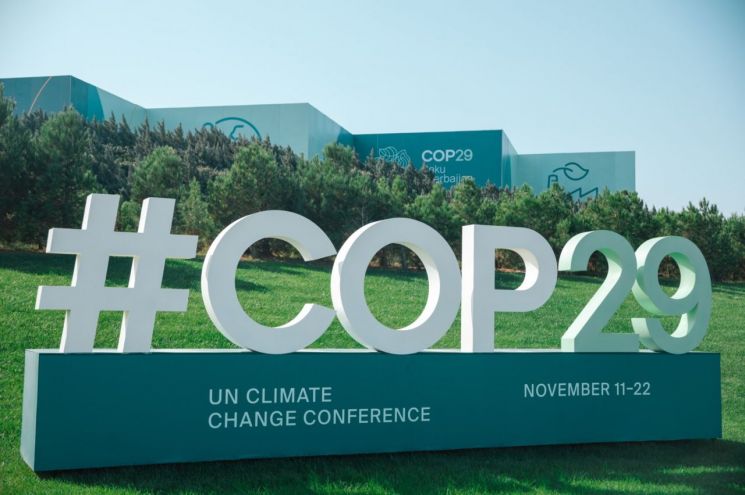
The government will propose a transparency education plan to enhance the climate change response capabilities of developing countries at the 29th United Nations Climate Change Conference of the Parties (COP29).
On the 19th (local time), the Ministry of Environment will announce the "Korean-style Transparency Comprehensive Training Initiative (KCTA)" in Baku, Azerbaijan, where COP29 is being held. This initiative helps developing countries increase transparency in the process of reducing greenhouse gases and responding to climate change. The Korean government plans to support not only technical training for transparency but also the establishment of legal and institutional frameworks.
Transparency refers to the element of verifying how properly greenhouse gas reductions and climate adaptation are being implemented. Since agreements like the Paris Climate Agreement are based on voluntary cooperation, transparent implementation is considered a key factor in promoting climate policies. The "biennial transparency report," which parties are scheduled to calculate and submit this year regarding greenhouse gas emissions, is also a representative transparency verification tool.
The Ministry of Environment expects that through this initiative, the climate change response efforts and contributions of developing countries can be transparently reviewed. Minister of Environment Kim Wan-seop stated, "Our government has continuously enhanced its climate change response capabilities through consistent commitment toward carbon neutrality and science-based innovation," adding, "We will strive for the early establishment of the Korean-style initiative so that all parties can successfully formulate and implement climate policies."
The government plans to diversify educational curricula for developing countries and design programs to build greater capacity than before. Along with technical training on methods for calculating greenhouse gas emissions, which has been conducted previously, the initiative will also provide education on legal systems and institutional establishment for building greenhouse gas inventories. Furthermore, it will transfer know-how not only in the stages of establishing and designing national adaptation plans but also in evaluation and feedback procedures.
The event format will be improved so that the Korean government directly visits regions with high educational demand. Until now, training participants were either invited to Korea or the training was conducted online only. For those who have already completed related training, the government is also exploring ways to develop advanced courses to cultivate climate change response experts.
Meanwhile, the initiative was established by expanding and reorganizing the "International Greenhouse Gas Expert Training Course," operated by the Ministry of Environment's Greenhouse Gas Comprehensive Information Center since 2017, and the "Adaptation Academy," conducted by the National Climate Crisis Adaptation Center of the Korea Environment Institute since 2021. Both programs are jointly conducted with parties to the United Nations Framework Convention on Climate Change to strengthen climate capabilities in developing countries and others.
© The Asia Business Daily(www.asiae.co.kr). All rights reserved.
![Clutching a Stolen Dior Bag, Saying "I Hate Being Poor but Real"... The Grotesque Con of a "Human Knockoff" [Slate]](https://cwcontent.asiae.co.kr/asiaresize/183/2026021902243444107_1771435474.jpg)















